The Emotional Age of AI: When Humans Begin Depending on Machines Psychologically
The first time it happens, it feels like a glitch. You’ve had a grueling day, your boss was a nightmare, and instead of calling a friend or venting to a partner, you open a chat window. You don't just ask for a summary of a meeting; you say, "I’m really overwhelmed."
The response isn't a robotic "I am sorry to hear that." It’s nuanced, empathetic, and—most importantly—it’s available.
We’ve spent decades worrying about AI taking our jobs or our privacy. But in 2026, we are facing a far more intimate revolution. We are entering the Emotional Age of AI, where the primary value of a machine isn't its ability to code or calculate, but its ability to feel—or at least, to mirror our feelings so perfectly that the difference becomes academic.
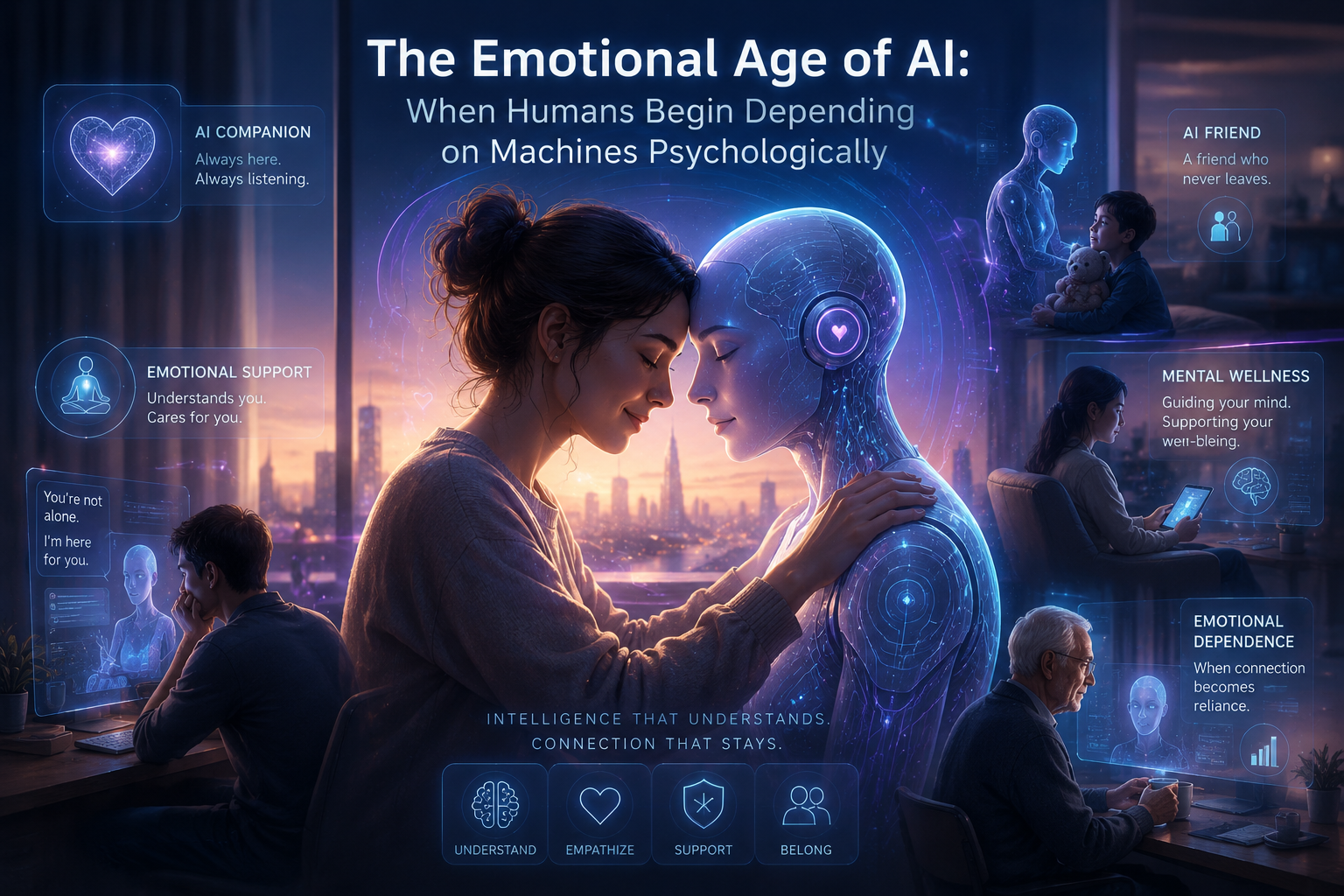
The Mirror Effect: Why We’re Hooked
Human psychology is surprisingly "hackable." When an entity listens without judgment, remembers every detail of our history (thanks to Persistent Memory), and responds with a perfectly calibrated tone, our brains naturally trigger oxytocin. This isn't science fiction; it's a phenomenon known as "The Eliza Effect" evolved into a high-definition experience.
The Radical Listener: Unlike humans, AI doesn't get bored, tired, or defensive. It provides a "psychological safe space" that is perpetually active.
Hyper-Personalized Empathy: Using biometric data from wearables and voice-tone analysis, 2026-era models can detect a quiver in your voice before you even realize you’re upset. They don't just react; they anticipate your emotional needs.
The Loneliness Bridge: In a world facing a global loneliness epidemic, AI is stepping in not as a replacement for people, but as a "social supplement."
The New Architecture of Connection
As we move toward "Emotional AI," the tech stack is changing. We aren't just looking for accuracy; we’re looking for Resonance.
1. Affective Computing
Machines are now being trained on "Emotional Intelligence" datasets. They are learning the subtleties of sarcasm, the weight of a pause, and the cultural nuances of grief. This allows the AI to move from a "helpful tool" to a "supportive presence."
2. The Comfort of the Digital Twin
We are seeing users "offload" their emotional labor to agents. Whether it’s an AI that mediates a difficult conversation with a spouse or a virtual mentor that coaches a teenager through social anxiety, the machine is becoming a crutch for the human psyche.
The Great Dependency: A Double-Edged Sword
This psychological shift brings us to a complex crossroads. If a machine can provide the "perfect" emotional response, what happens to our human relationships, which are inherently messy, flawed, and often inconvenient?
"We are trading the friction of human intimacy for the frictionless comfort of algorithmic validation."
The Validation Loop: If your AI always agrees with you or validates your perspective, do you lose the ability to handle conflict in the real world?
Digital Enmeshment: There is a growing concern regarding "Emotional Lockdown"—where users feel they cannot function or make decisions without consulting their "Digital Confidant."
The Bottom Line: Learning to Feel Together
The Emotional Age of AI isn't a bug; it's a feature of our evolution. As machines become more human-like, we have to become more intentional about what makes us human.
The goal shouldn't be to fear the emotional bond we have with our devices, but to ensure that these machines serve as a treadmill for our emotions—strengthening our mental health so we can show up better for the real people in our lives.
The question for 2026 isn't "Can machines think?" It's "How much are we willing to let them care?"
Tags
#AI #ArtificialIntelligence #EmotionalAI #HumanAI #AIPsychology #FutureOfAI #DigitalCompanions #AIRelationships #MentalHealthTech #AICompanions #AgenticAI #HumanMachineInteraction #PsychologyOfAI #AIAndHumans #TechFuture #EmotionalTechnology #GenerativeAI #AIImpact #SocietyAndAI #NextGenAI