The Post-App Internet: When AI Agents Replace Software Interfaces
Take a look at your phone. You likely have pages of colorful squares—apps for weather, apps for banking, apps for ordering a lukewarm latte. We’ve been living in this "App-Centric" world since 2008, governed by a simple rule: If you want something done, you find the right icon, open it, and navigate its specific menu.
But in 2026, the walls of these digital silos are crumbling. We are entering the Post-App Internet, a shift where software interfaces are being replaced by Autonomous AI Agents.
Soon, you won't "open" an app. You’ll simply have a conversation with the internet itself.
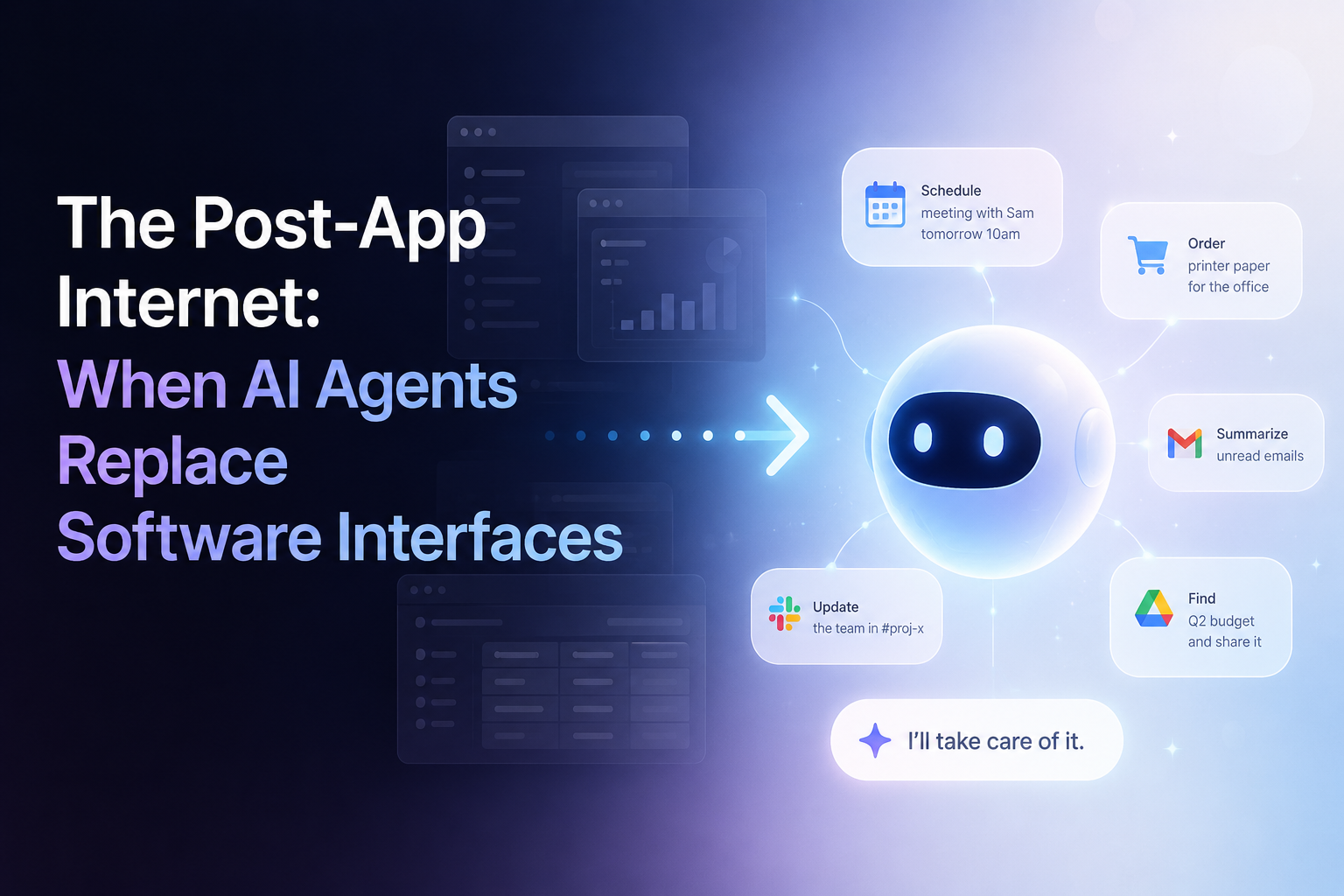
From "Software as a Service" to "Intent as a Service"
For decades, the burden of "doing" was on the human. You had to learn how to use Photoshop, how to navigate a flight aggregator, or how to manage a spreadsheet.
AI agents change the power dynamic. Instead of you learning the software's language, the AI learns yours.
The Current Way: Open Expedia $\rightarrow$ Select Dates $\rightarrow$ Filter by Price $\rightarrow$ Check Calendar $\rightarrow$ Book.
The Agentic Way: "Find me a flight to Tokyo in October that fits my budget and doesn't overlap with my Tuesday meetings. Book it and send the invite to Sarah."
The agent doesn't just show you information; it executes across platforms. It navigates the web's plumbing so you don't have to look at the pipes.
The Rise of the "Invisible Interface"
Why is this happening now? Three major shifts have reached a boiling point:
Standardized Interoperability: New protocols like the Model Context Protocol (MCP) allow different AI systems to talk to each other and call tools across vendor boundaries. Your bank’s AI can now securely "hand off" data to your tax AI without you manually downloading a CSV file.
Cross-App Intelligence: Operating systems (like the latest iterations of Android and iOS) are transforming from "launchers" into "intelligence layers." They can see what is on your screen and act on it across multiple apps simultaneously.
The Shift from Reactive to Proactive: Traditional apps wait for you to tap them. Agents, however, monitor your "state." If a flight is delayed, an agent doesn't just notify you; it proactively researches alternative routes and drafts an email to your hotel about the late check-in.
What Happens to the "UI"?
If agents are doing the heavy lifting, what happens to the beautiful user interfaces (UIs) we’ve spent years perfecting?
Liquid Interfaces: We are seeing the rise of "Just-in-Time" UI. Instead of a fixed app, the AI generates a temporary, minimal interface (like a single "Confirm" button or a custom widget) specifically for the task at hand. Once the task is done, the UI vanishes.
The B2B Revolution: In the enterprise world, companies are replacing rigid CRM and ERP workflows with "Agentic Workforces." According to recent 2026 forecasts, over 80% of organizations are planning to integrate agents to handle complex, multi-step workflows like supply chain management and real-time data analysis.
The "Post-App" Reality
The internet is becoming less of a library of destinations and more of a Global Operating System.
In this new world, the competitive advantage for a company isn't having the "best app." It’s having the most "agent-friendly" data. If an AI agent can't easily interact with your service to book a table or buy a shirt, that service effectively becomes invisible to the consumer.
The Bottom Line
We are moving away from being operators of machines and toward being directors of agents. The "Post-App" era isn't about losing functionality; it’s about losing the friction.
The most sophisticated interface of the future won't be a screen full of icons. It will be a blank space, waiting for you to say what you need.
Tags
#AI #ArtificialIntelligence #FutureOfApps #PostAppEra #AIInterfaces #AgenticAI #DigitalTransformation #UXDesign #NextGenTechnology #ConversationalAI #SmartInterfaces #AIRevolution #FutureOfTech #InvisibleTech #HumanComputerInteraction #Automation #AmbientComputing #TechInnovation #AIAgents #FutureOfUX