The Dark Matter of AI: NVIDIA Unveils the Vera Rubin Platform at CES 2026
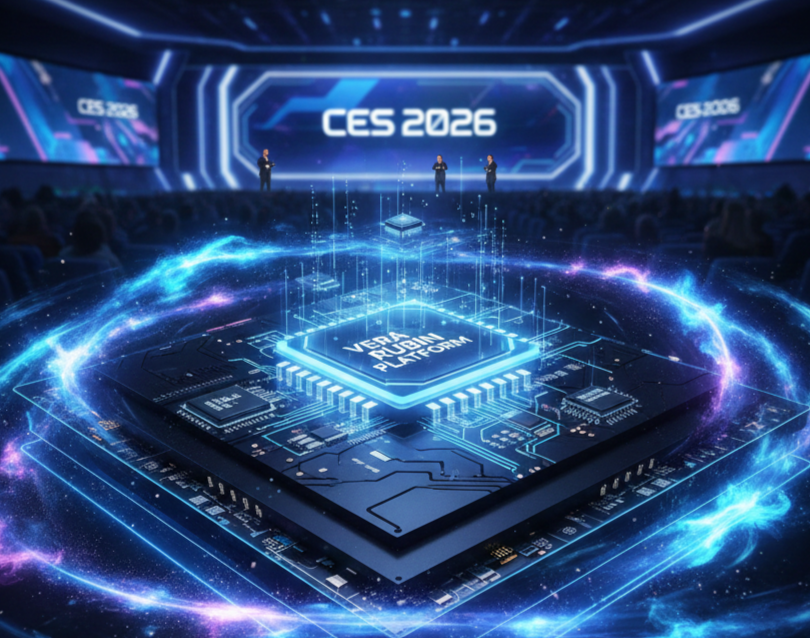
In the fast-moving world of artificial intelligence, a "generational leap" usually happens every few years. But NVIDIA is no longer following the traditional rules. At CES 2026, Jensen Huang took the stage to unveil the NVIDIA Rubin platform, a massive architectural shift that aims to make "Blackwell" feel like a distant memory.
Named after Vera Rubin, the legendary astronomer who discovered evidence of dark matter, the platform is designed to illuminate the "dark matter" of the AI world: the massive bottlenecks in data movement and reasoning that currently slow down the world's most complex models.
One Platform, Six New Chips
Rather than just releasing a faster GPU, NVIDIA has introduced what they call "extreme co-design." The Rubin platform isn't just a chip; it’s a synchronized orchestra of six brand-new silicon components designed to work as a single AI supercomputer:
Rubin GPU: The heart of the system, featuring HBM4 memory and a 3rd Gen Transformer Engine.
Vera CPU: A custom Arm-based processor with 88 "Olympus" cores, built specifically to handle AI agent orchestration.
NVLink 6 Switch: Doubling the bandwidth of its predecessor to a staggering 3.6 TB/s per GPU.
ConnectX-9 SuperNIC: Redefining how data moves across massive clusters.
BlueField-4 DPU: A data processing unit that triples memory bandwidth to secure and accelerate AI factories.
Spectrum-6 Ethernet Switch: Providing 5x better power efficiency for network-heavy workloads.
The Power Shift: Rubin vs. Blackwell
While the Blackwell architecture was the king of 2024 and 2025, Rubin is a "dimensionality-reduction strike" against it. The numbers are, quite frankly, hard to wrap your head around.
Feature Blackwell Ultra (GB300) Vera Rubin (VR NVL72)
Inference Performance 1.44 ExaFLOPS 3.6 ExaFLOPS
GPU Memory Bandwidth ~8 TB/s ~22 TB/s (HBM4)
Cost per Token 1x 10x Reduction
NVLink Bandwidth 1.8 TB/s 3.6 TB/s
CPU Cores 72 Arm Cores 88 Olympus Cores
The most significant takeaway for enterprises isn't just the raw speed—it's the 10x reduction in inference token costs. This makes running trillion-parameter models not just possible, but economically viable for mainstream adoption.
Why "Vera"? The Rise of Agentic AI
The naming of the Vera CPU is intentional. As we move into 2026, the industry is shifting from "Chatbots" to "Agentic AI"—systems that don't just talk, but actually do things. These agents require massive amounts of data movement and "context memory."
The Vera CPU features Spatial Multithreading, a new technology that physically partitions core resources to run two threads simultaneously without the lag of traditional time-slicing. This allows AI agents to reason through millions of tokens of context in real-time, effectively solving the "memory wall" that has plagued previous generations.
Security at Scale
For the first time, NVIDIA is bringing Confidential Computing to the entire rack. Previously, you could secure a GPU, but the data was vulnerable as it moved to the CPU. With the Vera Rubin NVL72, the entire system—all 72 GPUs and 36 CPUs—operates as a single Trusted Execution Environment (TEE). This is a game-changer for industries like healthcare and finance that handle sensitive proprietary data.
When Can We See It?
NVIDIA confirmed that all six chips are already back from fabrication and undergoing validation. The first Rubin systems are expected to ship in the second half of 2026, with major cloud providers like Microsoft, AWS, Google, and CoreWeave already lining up to be the first to offer them.
As Jensen Huang put it during the keynote: "Intelligence scales with compute. With Rubin, we are turning the data center into the unit of compute."