The Apple + Gemini Impact: What the Integration Means for Mobile Enterprise Security
In early 2026, the mobile landscape reached a fever pitch with the official rollout of the Apple-Google Gemini partnership. For Enterprise IT and Security teams, this isn't just another Siri update; it is a fundamental shift in how "Mobile Intelligence" interacts with corporate data.
By integrating Google’s Gemini 2.5 Pro (and reportedly the "Nano Banana" model for localized tasks) into the Apple Intelligence framework, Apple has created a hybrid security model that attempts to solve the "AI Privacy Paradox." Here is what this means for your organization’s mobile security strategy.
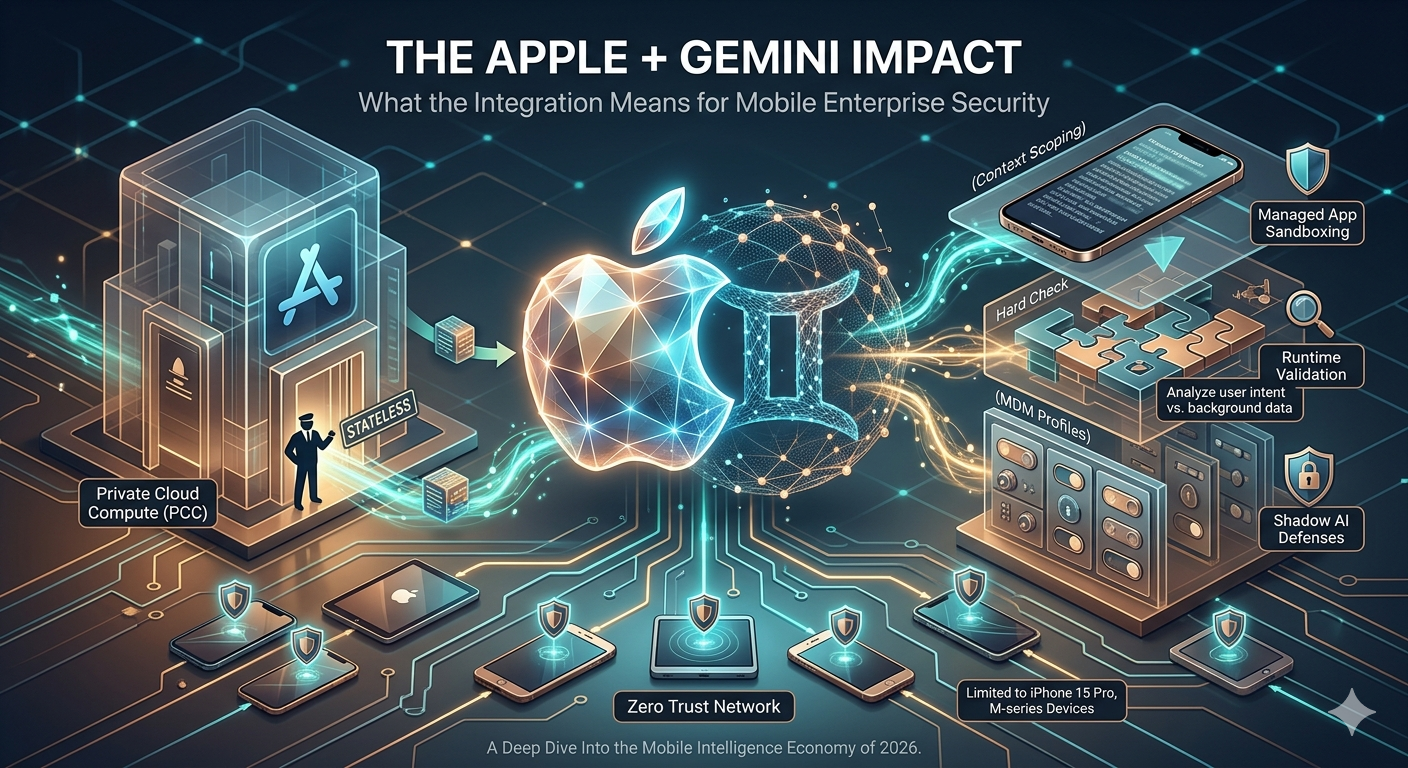
1. The "Private Cloud Compute" (PCC) Fortress
The most significant impact on enterprise security is Apple’s Private Cloud Compute (PCC) architecture. When a mobile user asks Siri a complex question—such as "Summarize the last three urgent emails from the CEO"—the request often exceeds on-device processing power.
The Security Fix: Instead of sending that sensitive data to a standard cloud server, Apple routes it to PCC nodes running on custom Apple Silicon.
Zero-Trace Execution: These nodes are stateless; once the response is delivered, the data is wiped. Not even Apple or Google staff can retrieve the logs or personal data used during the session.
Verifiable Transparency: Security researchers can now inspect the production software of these PCC nodes, providing a level of auditability previously unheard of in cloud AI.
2. Guarding the "Screen Context"
One of the most powerful (and potentially risky) features of the Gemini-powered Siri is Screen Recognition. The AI can now "see" what is on an employee’s screen to provide context-aware help.
Enterprise Concern: Could an AI inadvertently capture a sensitive internal dashboard or a legal contract?
The Mitigation: Apple has implemented Local Intelligence Layering. The initial recognition happens on-device. Only "de-identified" tokens or specific high-level reasoning requests are escalated to the cloud. For businesses, this means your most sensitive pixels never leave the physical iPhone.
3. Fighting "Agentic" Vulnerabilities
With iOS 26.5 and beyond, Siri is moving from a chatbot to an Agent capable of taking actions across apps (e.g., "Draft a response in Slack and attach the Q1 PDF").
This introduces the risk of Indirect Prompt Injection, where a malicious document could contain "hidden" instructions for the Gemini engine. To counter this, the new integration uses:
Runtime Action Validation: Before an action is taken in a third-party app, the OS requires a "Hard Check" to ensure the intent originated from the user, not a background document.
Managed App Sandboxing: AI agents operate within the same strict sandboxing rules as regular apps, preventing an AI-driven "data crawl" across unmanaged corporate partitions.
4. The End of "Shadow AI" on Mobile?
For years, SMBs and Enterprises have struggled with employees using unmanaged AI apps (Shadow AI) to get work done.
By integrating a world-class model like Gemini directly into the OS with Managed Open-In protections, Apple is providing a "Safe Haven" for AI productivity. IT Admins can now manage AI capabilities through Mobile Device Management (MDM) profiles, allowing them to enable Gemini-powered features for work apps while disabling them for personal ones.
The Bottom Line for 2026
The Apple + Gemini integration isn't just about making Siri smarter; it’s about making AI governable. By leveraging Google’s reasoning power and Apple’s hardware-level security, the partnership has set a new standard for mobile enterprise defense.
Key Takeaway: If your fleet is still on older hardware, the "Security Gap" is widening. The most advanced PCC protections and Gemini-powered Siri capabilities are limited to iPhone 15 Pro, the iPhone 16/17 series, and M-series iPads/Macs.