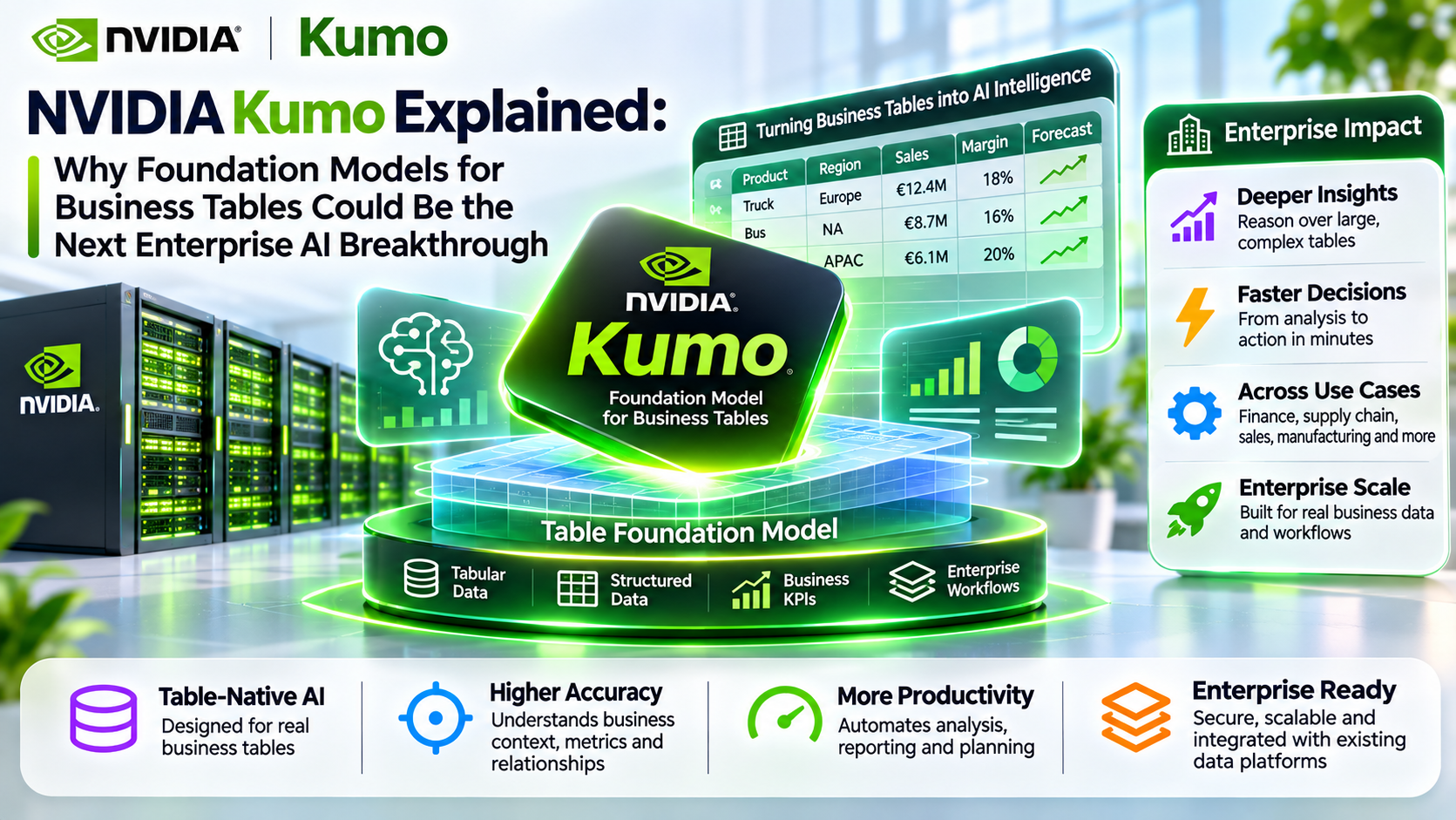
Most business decisions depend on rows, relationships and time series rather than chat transcripts. NVIDIA Kumo targets that world with models for tabular predictions, related records, forecasts and anomalies. Here is how the family fits into an enterprise data stack and how to check whether it beats the methods teams already trust.
Quick Take
- What launched: NVIDIA describes Kumo as a family of open models and libraries for structured business data.
- Four uses: Tabular prediction, predictions across related tables, forecasting and anomaly detection are distinct Kumo components.
- Claim to test: Reusing a pretrained model could reduce per-task feature engineering, but it does not make data quality or leakage irrelevant.
- Enterprise test: Compare Kumo against a strong existing baseline on time-split data, using cost and calibration as well as accuracy.
What is NVIDIA Kumo?
NVIDIA’s Kumo overview presents a family of models and tools for tabular, relational and time-series prediction. It positions Kumo within its Agent Knowledge Foundation: a way to give software agents structured predictions rather than asking a language model to guess a risk score from a prose summary.
An enterprise database may contain customers, orders, assets and payments in separate related tables. Traditional predictive projects often require task-specific feature construction, labels, training and evaluation. Kumo’s promise is to reuse learned representations for a range of tasks so a team can reach a baseline faster and adapt it when needed.
That promise is not proof of an automatic breakthrough for every database. Predicting future behavior requires a clear outcome definition, a valid time window and data that would actually have been available when the prediction was made.
What do the four model families do?
Kumo Tabular uses labeled examples from a single table for classification or regression. NVIDIA describes in-context prediction and estimates that include uncertainty. Kumo Relational incorporates connections among tables, using record relationships when a flat customer row would miss useful history. These two approaches answer different data-structure questions.
Kumo Forecast uses historical numeric signals to estimate future values such as demand. Kumo Anomaly flags unusual patterns in time series, including multivariate signals. A predicted sales total, a fraud-risk score and an anomaly alert should never be judged with the same one-size-fits-all accuracy number.
NVIDIA provides documentation and tooling for building and evaluating models. Check exact model licenses and infrastructure needs before assuming that every open artifact can be modified, redistributed or deployed under identical terms.
Why could this matter more than another chatbot?
A financial institution needs to predict events across accounts and transactions; a factory needs to find anomalous sensor patterns; a logistics operation needs demand or capacity forecasts. Much of their most valuable information is structured. The important question is whether a reusable model can deliver acceptable predictions while reducing months of specialized feature work.
A language model may explain a prediction or summarize the relevant records, but it should not be the only source of a numerical probability unless that output has been independently validated. A Kumo-style predictor can be one component in an agent workflow: fetch approved data, generate a score, explain the evidence and route consequential decisions to a qualified person.
Prediction is also distinct from action. A high-risk score does not authorize rejecting an insurance claim or freezing a bank account. A business needs documented thresholds, appeal paths and monitoring for errors across groups.
How would a team evaluate Kumo fairly?
Build a baseline with a proven method for the exact task, such as an established gradient-boosted tree, survival model or time-series approach. Hold out the most recent period; freeze the data available at prediction time. A random row split can leak information from the future into both training and test sets, especially when tables share customers or repeated events.
Measure the score appropriate to the decision: precision at review capacity for anomaly triage, calibrated probabilities for risk, forecast error across demand regimes and total cost per prediction. Inspect performance for rare outcomes and missing data. If Kumo returns uncertainty, test whether that estimate corresponds to actual error rates.
Then assess operations: integration with source systems, GPU and memory requirements, refresh cadence, access policy and rollback. An attractive benchmark does not settle the cost of maintaining a production data pipeline.
What risks arise with connected business tables?
Related records can make predictions more informative and more sensitive. A relational model might link customer, household, location and payment records in ways that expose unexpected personal attributes. Define approved joins, retention periods and who can inspect scores. Audit data lineage so analysts know which fields were used.
Bias, target leakage and changes in business behavior can shift results after deployment. Create drift checks and a review process for model updates. For alerts that affect a person, document why a case was flagged and give reviewers a way to overturn an incorrect result.
The architecture may support useful forecasts and recommendations, but the organization remains responsible for what it decides to do with them.
Which Kumo component matches the question?
The product families solve different prediction problems; select by the data and decision, not by a generic model ranking.
| Kumo component | Typical input | Example question |
|---|---|---|
| Tabular | One table with historical labeled rows. | Which service request is likely to be delayed? |
| Relational | Linked tables with entities and event histories. | Which account needs investigation given related records? |
| Forecast | Historical measurements over time. | How much capacity might a site need next week? |
| Anomaly | One or more changing signals. | Is this machine behavior unusual for its operating state? |
Four possible enterprise pilots
Prioritize follow-up for likely churn, with consented features and a strong historical baseline.
Forecast demand across changing seasons and compare with existing planning errors.
Flag unusual sensor sequences and measure useful alerts per engineer-hour.
Score a narrowly defined risk question, test calibration and retain human decision ownership.
Privacy, copyright and EU risk classification
Training or evaluating on enterprise tables requires rights to use the source data and controls for personal information. The Commission’s GDPR guidance points to purpose limitation and data minimization. Open model weights are not a license to distribute customer records or copy protected datasets.
The EU AI Act evaluates intended use and provider/deployer roles. A demand forecast and certain creditworthiness or employment assessments can have different obligations. Classify the actual application and keep human review appropriate to the stakes.
MaGeN-AI View
Put the data question ahead of the model
Kumo has a compelling premise because business AI often starts with tables and event histories. The practical win will be repeatable improvement over a well-tested baseline at an acceptable cost, with clear data provenance and accountability for downstream decisions.
Frequently Asked Questions
What is NVIDIA Kumo?
Kumo is NVIDIA’s family of models and tools for predictions from structured tabular, relational and time-series data.
Is Kumo a chatbot?
No. The Kumo family focuses on tasks such as classification, regression, forecasting and anomaly detection; its outputs can inform an agent workflow.
What is the difference between Kumo Tabular and Relational?
Tabular predicts from a single table with labeled examples; Relational uses connections among related records and tables.
Can Kumo replace every custom machine-learning model?
That has not been established. Compare it with strong task-specific baselines on the same governed dataset and production constraints.
Does an open model make business data public?
No. Model availability and rights to company or customer records are separate. Access, licensing and privacy controls remain necessary.