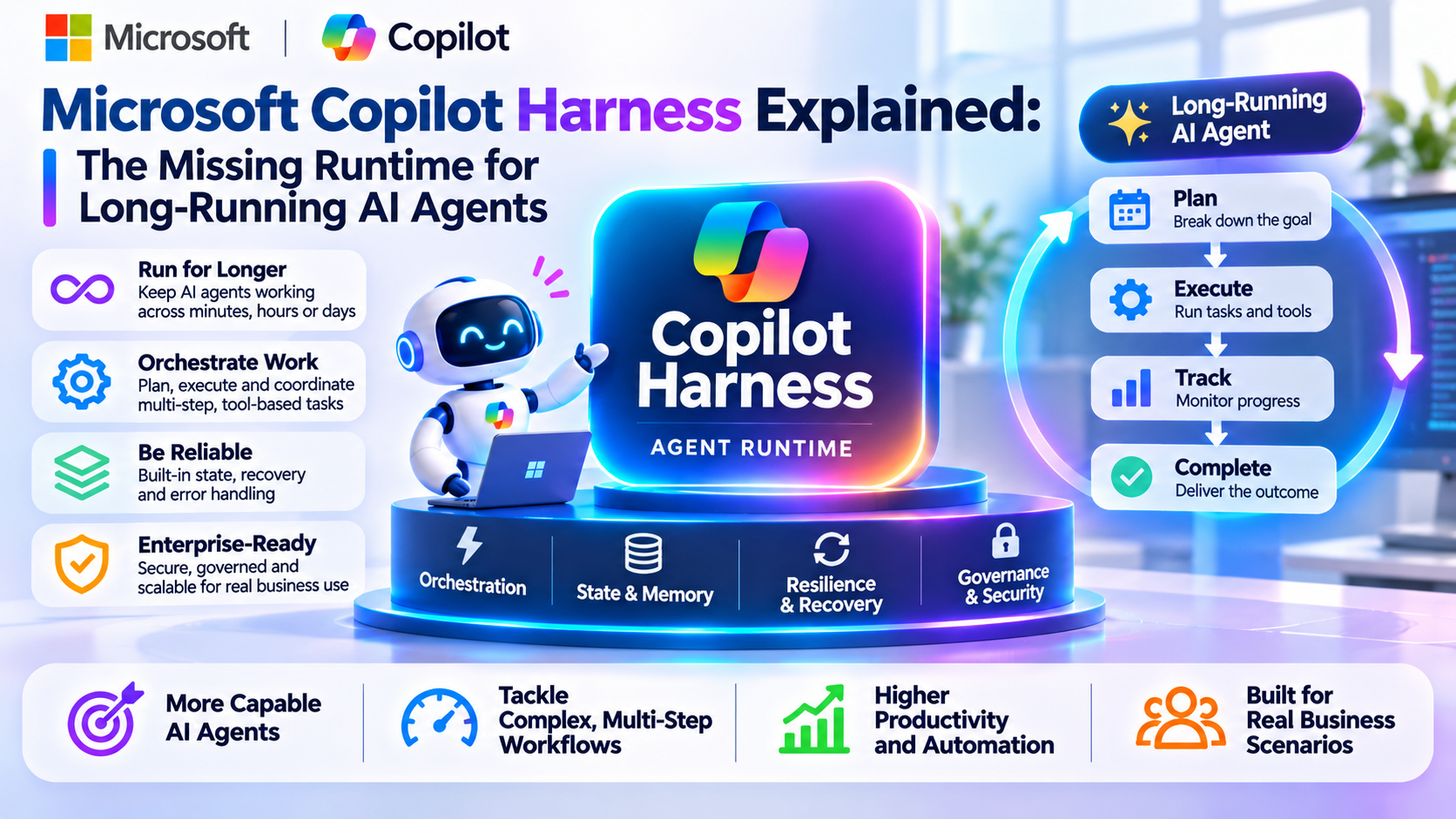
A capable model can plan work, yet a production agent also needs files, tools, resumable execution and permission boundaries. Microsoft has introduced the Copilot harness in Foundry Agent Service as a managed public preview. Here is what that layer handles, where hosted-agent resilience differs and how to evaluate the runtime for long tasks.
Quick Take
- Product status: The Copilot harness in Foundry Agent Service is a public preview, according to Microsoft.
- Managed layer: Microsoft runs the agent loop and sandbox, while developers configure skills, tools, permissions and supported models.
- Separate milestone: Microsoft also announced general availability of long-running resilience for hosted agents; that is not identical to calling the new harness generally available.
- Cost: Preview terms and model/tool charges differ; Microsoft says harness runtime billing starts on 1 December 2026.
What is the Copilot harness?
Microsoft’s Foundry announcement describes a managed agent execution system. A model proposes next steps, but the harness coordinates model calls, tools, files and working context within a configured sandbox. Developers supply their agent’s task instructions, reusable procedures and allowed connections.
Think of it as the part of an agent that answers what happens after the first model response. The system may search a permitted source, inspect a file, run code, request approval and keep working toward a deliverable. A reliable runtime should handle tool errors, intermediate artifacts and context without silently giving the model broader authority.
Microsoft says its preview includes reusable skills, MCP and other supported tools with configured authentication, bounded delegation to built-in subagents and agent definitions that can live alongside application code. These are building blocks for structured work, not evidence that every agent will finish every task correctly.
Why are long-running agents harder than chat?
A multi-step research brief can take longer than a single request. It may depend on a file arriving, a tool returning an error or a human approving an action. If the process fails at step eight, the operator needs to know what was completed, which state can be recovered and whether a repeated tool call would cause a duplicate change.
Long-running resilience for hosted agents is described separately from the new preview harness. A hosted agent may bring its own framework and execution logic while relying on the service for hosting and resilience. The new Copilot harness is a managed option for teams that want Microsoft to own more of the agent loop. The choice is an architecture decision about control and operations.
Test with a workflow that has a realistic interruption: revoke a tool permission, time out a data source, or require approval before sending a draft. Verify the resume behavior and ensure the final answer tells the user what was done and what remains open.
How do skills, tools and models interact?
A skill can package a repeatable method, supporting scripts and examples. A tool reaches an external service under a defined identity and permission. The model reasons over the task and selects allowed next steps. The harness manages the sequence and execution environment. Confusing those roles leads to an agent with impressive prompts but no dependable way to carry out work.
Microsoft says the managed harness lets developers choose a supported Foundry model without rebuilding orchestration for each one. That is a portability claim within the supported product surface, not proof that different models behave identically. Check available model and region lists in current Microsoft documentation before designing a production dependency.
For each connected tool, define read-only defaults, approval requirements and the scope of data sent. A document returned by a tool can contain instructions directed at the model; it remains untrusted content even when delivered by an authorized connector.
Which Foundry agent approach should a developer choose?
Microsoft distinguishes simpler prompt agents, prompt agents using the Copilot harness and hosted agents. A task requiring one retrieval and one answer may not need a full managed harness. A job that manipulates files and coordinates several tools might benefit from managed context and delegated tasks. A team that needs custom middleware or its own agent loop may favor a hosted agent.
During public preview, Microsoft says an existing agent is not automatically changed and switching the harness after creation is not yet supported. Create a pilot agent separately, pin its expected tools and permissions, and test its deployment path before migrating a business workflow.
Compare the actual cost of running the job as well: model inference and connected tools can be billed separately from the harness runtime. A simple question should not become an expensive multi-tool workflow because the orchestration is easy to enable.
How should an enterprise test the runtime?
Start with a bounded task such as researching a policy change and drafting an internal brief with citations. Specify allowed sources, a maximum execution time, approval points and a human reviewer. Deliberately introduce stale documents, a transient API error and a malicious-looking instruction in retrieved text.
Measure completion rate, errors caught, duplicate actions after retry, tool timeouts, time to first useful result and manual review minutes. Inspect the execution trace and ask whether a user can reconstruct every external action. Long-running success means the agent completed the right job under the right permissions, not merely that the process stayed alive.
Foundry execution options at a glance
The distinctions below follow Microsoft’s description; verify supported combinations for your region and account.
| Approach | Who owns the loop? | Best fit |
|---|---|---|
| Prompt agent | Microsoft provides agent-service facilities; developer configures instructions and supported tools. | Shorter tasks with relatively simple tool use. |
| Prompt agent with Copilot harness | Microsoft runs managed loop and sandbox; developer defines skills and authorized tools. | Complex work with files, context and bounded delegation. |
| Hosted agent | Developer controls framework, loop, middleware and dependencies within managed hosting. | Custom orchestration and runtime behavior. |
Four workflow tests to run
Require citations to approved sources and check whether stale documents are identified.
Pause before an external message or write; confirm that review displays the real action.
Interrupt an API call mid-task and verify resumption does not repeat a consequential step.
Compare runtime, inference, tool charges and human correction time per accepted brief.
Privacy, source rights and EU obligations
Connected agents may read private files, employee records and third-party content. Choose the smallest data and tool scope necessary, and verify retention and identity configurations. The GDPR principles require attention when processing personal data; access to a connector is not permission to reuse protected source documents publicly.
The EU AI Act assesses intended use and roles. A research brief and an automated employment decision should be evaluated differently. A managed runtime can make controls easier to operate, but does not establish legal compliance for the application built on top of it.
MaGeN-AI View
The runtime is where agent promises meet operations
The Copilot harness could remove repetitive plumbing for teams that need complex agents. Its value will depend on recovery, permissions, cost visibility and traceable results in real workloads. Keep the public-preview harness and generally available hosted-agent resilience distinct when evaluating Microsoft’s offering.
Frequently Asked Questions
What is the Microsoft Copilot harness?
It is a managed agent execution system in Microsoft Foundry Agent Service for coordinating model calls, tools, context, files and bounded tasks.
Is the Copilot harness generally available?
Microsoft describes the Copilot harness in Foundry Agent Service as a public preview. It separately announced general availability of long-running resilience for hosted agents.
Does the harness choose the model for developers?
Developers can choose among supported Foundry models while Microsoft handles the managed orchestration; supported choices and regions should be checked in current documentation.
Can existing agents switch to the Copilot harness?
Microsoft says switching an agent to the preview harness after it has been created is not yet supported.
When does harness runtime billing begin?
Microsoft’s October 2026 announcement says harness runtime charges start on 1 December 2026; inference, tools and other services can incur separate charges.