NVIDIA GTC Berlin 2026 Preview: Physical AI, AI Factories and Europe’s Next AI Infrastructure Wave
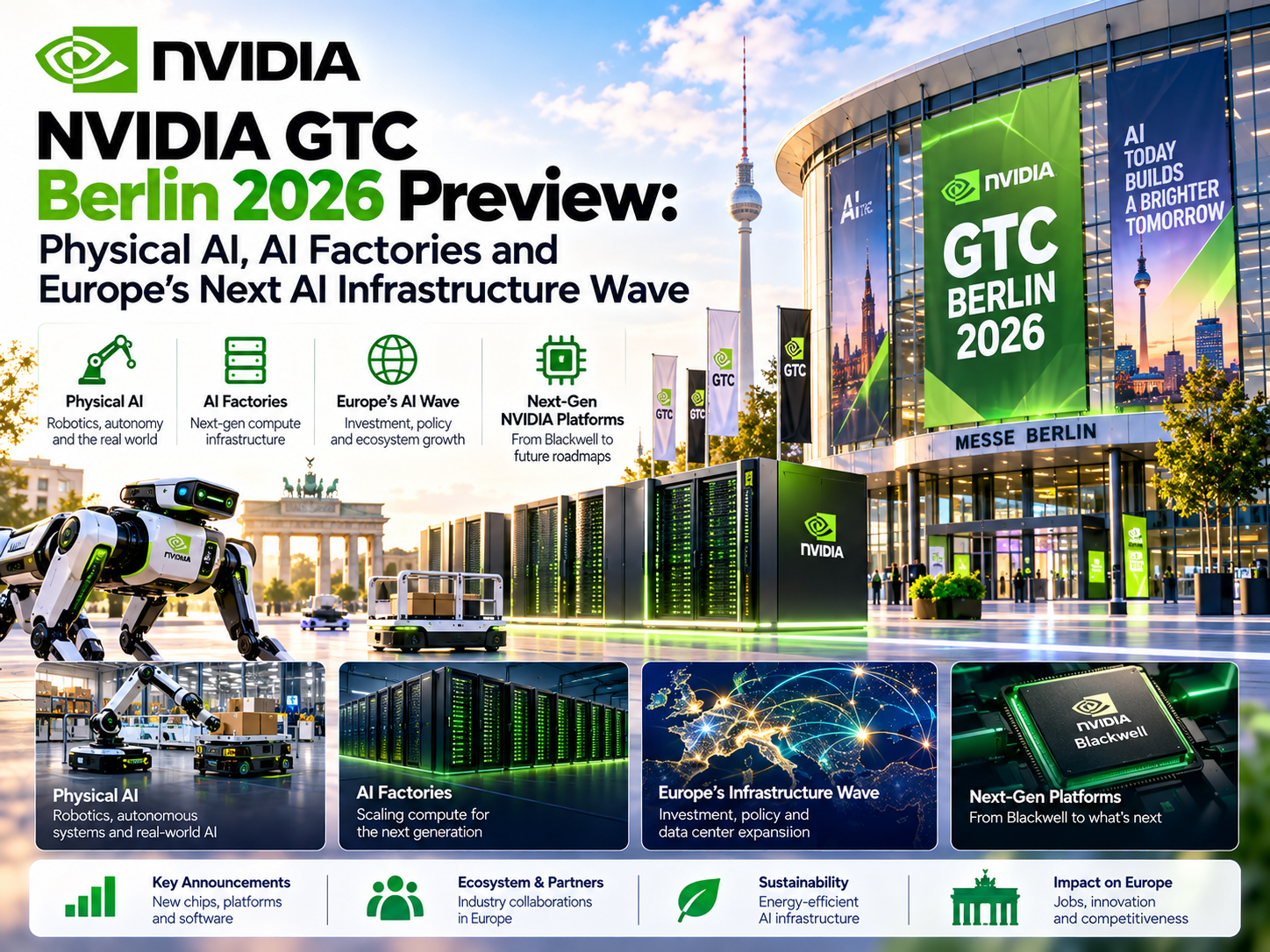
GTC Berlin arrives while Europe is moving from AI infrastructure plans to operating facilities and industrial pilots. Here is what NVIDIA has confirmed for the event, what already exists, and the practical questions to bring to the keynote.
Quick Take
- Confirmed event: Workshops are scheduled for 20 October; the conference and expo run 21–22 October 2026. Jensen Huang’s keynote is scheduled for 21 October, 11:00–13:00 CEST.
- Two linked themes: Physical AI needs robots, sensors, simulation and real-world testing; AI factories supply the computing, networking and software used to develop and serve those systems.
- Europe already has deployments: Deutsche Telekom launched its NVIDIA-enabled Industrial AI Cloud in Munich in February 2026. EuroHPC’s AI Factories are a separate European programme.
- Preview, not recap: Agenda themes are confirmed. Any new product, benchmark, customer milestone or construction timetable must be checked after the keynote.
What Is Confirmed for NVIDIA GTC Berlin 2026?
According to the official GTC Berlin schedule, workshops take place on 20 October 2026, followed by conference and expo programming on 21–22 October. The NVIDIA keynote listing schedules NVIDIA CEO Jensen Huang at the Tempodrom on Wednesday, 21 October, 11:00–13:00 CEST. Times and sessions can change, so readers planning to attend should check the organizer’s schedule.
NVIDIA lists a physical AI and robotics track, an industrial AI and manufacturing track and an AI infrastructure track. The programme also covers open models, inference, agentic AI and AI for science. A session topic tells us what the company plans to discuss; it is not evidence of a new product release or a completed customer deployment.
| Area on the agenda | Confirmed focus | What this preview will watch |
|---|---|---|
| Physical AI and robotics | Robots, autonomous vehicles and industrial AI. | Demonstrations tied to repeatable real-world tasks and safety evidence. |
| Industrial AI | Digital twins, engineering and manufacturing workflows. | Whether simulations lead to measurable shop-floor results. |
| AI infrastructure | Compute, networking, training and inference for AI factories. | Service availability, energy requirements and cost per useful workload. |
This article is a pre-event guide dated 10 October 2026. It will need a separate fact check after the keynote before any predictions are presented as announcements.
Physical AI: Why Europe’s Factories Make This a Natural Focus
Physical AI refers to models and software that perceive a changing environment and help a machine choose actions within it. A warehouse robot must detect people and pallets; an automotive inspection system must cope with glare and variation in parts; a mobile machine must act within mechanical and safety limits. Those jobs require more than a convincing answer in a chat window.
NVIDIA’s Isaac Sim developer documentation describes Isaac Sim as a framework for robotics simulation, testing and synthetic data. A team can import a robot and factory scene, vary lighting and object placement, train or test a policy, then compare simulated outcomes with physical trials. This is a way to find failures earlier. A digital twin can still miss friction, wear, sensor noise or an unexpected worker movement, so simulated success is not a safety certificate.
For a European component supplier, a bounded first project might be a camera-assisted picking station. Start with an existing cell and a clearly defined part set. Record failed picks and human interventions; build simulated variations from permitted plant data; validate the model on a segregated test cell; then expand only after an engineer signs off on performance and safety. That sequence is an illustrative workflow, not a reported GTC deployment.
From Digital Twin to Shop Floor: The Announced Industrial Stack
The Siemens–NVIDIA partnership announcement describes a partnership to combine Siemens industrial software and electrification experience with NVIDIA simulation libraries and AI infrastructure. It names the Siemens Electronics Factory in Erlangen as a planned 2026 blueprint for more adaptive manufacturing. Treat the blueprint as a stated goal until independently published site results show how it performs.
What would useful evidence look like? A before-and-after measure for commissioning time, scrap, changeover or inspection accuracy; a documented path from simulated change to tested control logic; and a record of where engineers approve or reject automated suggestions. Video of a robot completing one task cannot show reliability over thousands of shifts.
At GTC Berlin, watch for a clear explanation of how a design model, a factory simulation and an edge device exchange data. Ask whether a plant can retain its CAD files, control systems and safety processes if it changes compute suppliers later. That answer matters to the long life of European industrial equipment.
What Is an AI Factory, and Which Ones Already Exist in Europe?
An AI factory is a coordinated environment for data preparation, model training or tuning, inference and operations. It needs compute, storage, networking, software, people and a way for users to access the service. The phrase can describe a commercial GPU cloud or a public research facility; those have different operators, eligibility and funding.
| European initiative | Status by 10 October 2026 | Why it matters |
|---|---|---|
| Deutsche Telekom Industrial AI Cloud, Munich | Launched February 2026. Telekom describes infrastructure built on nearly 10,000 NVIDIA Blackwell GPUs; it reported that more than one-third of capacity was in use at launch. Munich Industrial AI Cloud launch | An operating commercial example for European industrial AI customers. |
| EuroHPC AI Factories | 19 established in the programme, with site and service availability varying. The EU describes tailored support and access paths for SMEs and startups. EuroHPC AI Factories programme | An EU-backed ecosystem with distinct access criteria and operating arrangements. |
| EuroHPC AI Gigafactories | Future projects. The tender deadline is 12 November 2026; selection is expected in 2027. EuroHPC AI Gigafactories call | A procurement initiative, not a claim that new gigafactories are already running. |
The distinction matters. An NVIDIA partnership with a European operator does not make every EuroHPC facility an NVIDIA project. Likewise, a tender for future gigafactories is not commissioned capacity. For a Swedish SME, the Sweden AI Factory offers a more immediate route to explore: its published services include specialist support and access to existing computing resources. A dedicated AI-optimised supercomputer in Linköping is planned for 2027.
Europe’s Infrastructure Wave: Beyond the GPU Count
The Munich launch shows that Europe can commission a sizeable industrial AI service. It also makes the next constraint visible: more accelerators require usable grid connections, cooling, high-bandwidth networks, storage and trained operators. In its IEA 2026 energy and AI analysis, the International Energy Agency projects that global data-center electricity use could rise from about 485 TWh in 2025 to 950 TWh in 2030. Those are global projections across data centers, not a measured GTC Berlin footprint.
Ask what electrical capacity is commissioned, how heat is removed and which measurements will be published after a facility is operational.
Ask when customers can actually book compute, what workloads are supported and how performance changes at scale.
Ask where data, backups, logs, support access and incident response are handled, not only where the servers sit.
Compare full project cost, GPU utilization and cost per validated task with smaller cloud or local alternatives.
Telekom says its Munich installation occupies a modernized existing data center and runs on renewable electricity, with future waste-heat reuse planned. The Munich Industrial AI Cloud launch is an operator account of the project; buyers should request measured energy and service data for their own workload. Hardware specifications by themselves do not establish energy efficiency or business return.
Where Smaller European Firms Can Find Value
The most immediate opportunity is often access, rather than ownership of a cluster. A manufacturer can rent capacity to test defect detection, use simulation to evaluate a robot workflow or fine-tune a model on its own permitted engineering data. The location and operating terms should match the sensitivity of that data.
Pilot detection on a single production line. Measure false rejects, missed defects and the time a technician spends correcting results.
Compare an accelerated simulation with a trusted engineering baseline. Measure accuracy, turnaround time and cost per design iteration.
Use a digital twin for unusual scenarios, then perform physical validation with stop controls and a documented release process.
Compare a commercial regional cloud with EuroHPC support and smaller on-premises systems against actual workload needs.
A successful pilot should give an engineering or operations manager a decision: adopt, change the design or stop. Counting generated videos, GPU hours or demos without a baseline makes that decision harder.
Five Questions to Take to the Keynote
| Question | A useful answer includes |
|---|---|
| Is it available now? | Release status, region, access route, documentation and what a customer can run today. |
| Does it work outside the demo? | Testing across edge cases, repeatability, failure rates and comparison with a practical baseline. |
| What does the full stack cost? | Compute, data preparation, simulation, networking, support and human review per completed task. |
| Can customers move their work? | Data export, model and file formats, deployment choices, and any third-party or license dependencies. |
| Who is accountable? | Safety boundaries, data access, monitoring, incident handling and the person who approves a physical rollout. |
If the answer relies on a future rollout, report it as a plan. If it is a supplier benchmark, describe the test and reproduce it on representative data before making a purchasing decision. Revisit the official GTC Berlin schedule after the event for session material and changes to timing.
EU AI Act, Data Rights and Safe Deployment
For a European robotics pilot, first decide what the AI actually does. Visualizing a production line, recommending maintenance and controlling a safety function have different risks. The European Commission AI Act update explains updated EU AI Act timelines, including a 2 August 2028 start for high-risk AI embedded in certain physical products under Annex I. That date does not suspend existing machinery safety, workplace or data-protection duties. Check classification and applicable product rules for the particular system.
Keep people able to stop or override equipment, test on site, log material failures and make release decisions reviewable. If plant video or worker information is used, document the purpose, access and retention of those data. If a provider stores or accesses personal data outside the EU, assess the actual transfers using European Commission data-transfer guidance. A claim of “European sovereignty” is useful only when the customer understands the data flow, contractual control and exit path.
For synthetic training data, confirm rights to the original CAD models, images, manuals and sensor captures. Generated examples can resemble source assets and can encode their flaws; assess both data permission and model performance before sharing them. This post is original editorial analysis with links to primary sources, not a reproduction of event or vendor copy.
MaGeN-AI View
The Takeaway
GTC Berlin should be judged by what an engineer or smaller business can deploy and verify after the stage lights are off. Europe has an operating industrial AI cloud and public AI Factory support; its proposed gigafactories remain future work. The strongest announcements will connect physical AI demos to repeatable plant results and AI factory capacity to real access, clear data controls and measurable costs.
Frequently Asked Questions
When is NVIDIA GTC Berlin 2026?
Workshops are scheduled for 20 October; the conference and expo take place on 21–22 October 2026. Jensen Huang’s keynote is scheduled for 21 October, 11:00–13:00 CEST.
What is physical AI at GTC Berlin?
Physical AI applies models, perception and control to robots, vehicles and industrial systems. The agenda includes robotics, autonomous vehicles, digital twins and manufacturing applications.
Is Europe’s Industrial AI Cloud already operating?
Yes. Deutsche Telekom announced the operational launch of its NVIDIA-enabled Industrial AI Cloud in Munich in February 2026. Check current capacity and service terms with the operator.
Are EuroHPC AI Gigafactories already live?
No. EuroHPC launched its gigafactory tender in July 2026, with proposals due in November 2026 and selection expected in 2027. These future projects are separate from the existing AI Factories programme.
Does a European AI factory automatically meet EU AI Act and GDPR requirements?
No. Compliance depends on the AI use case and how data and systems are handled. Customers should check provider terms, data flows, security controls and applicable product-safety requirements.