Inside Meta’s Gigawatt AI Data Centers: Why the AI Race Is Becoming an Infrastructure War
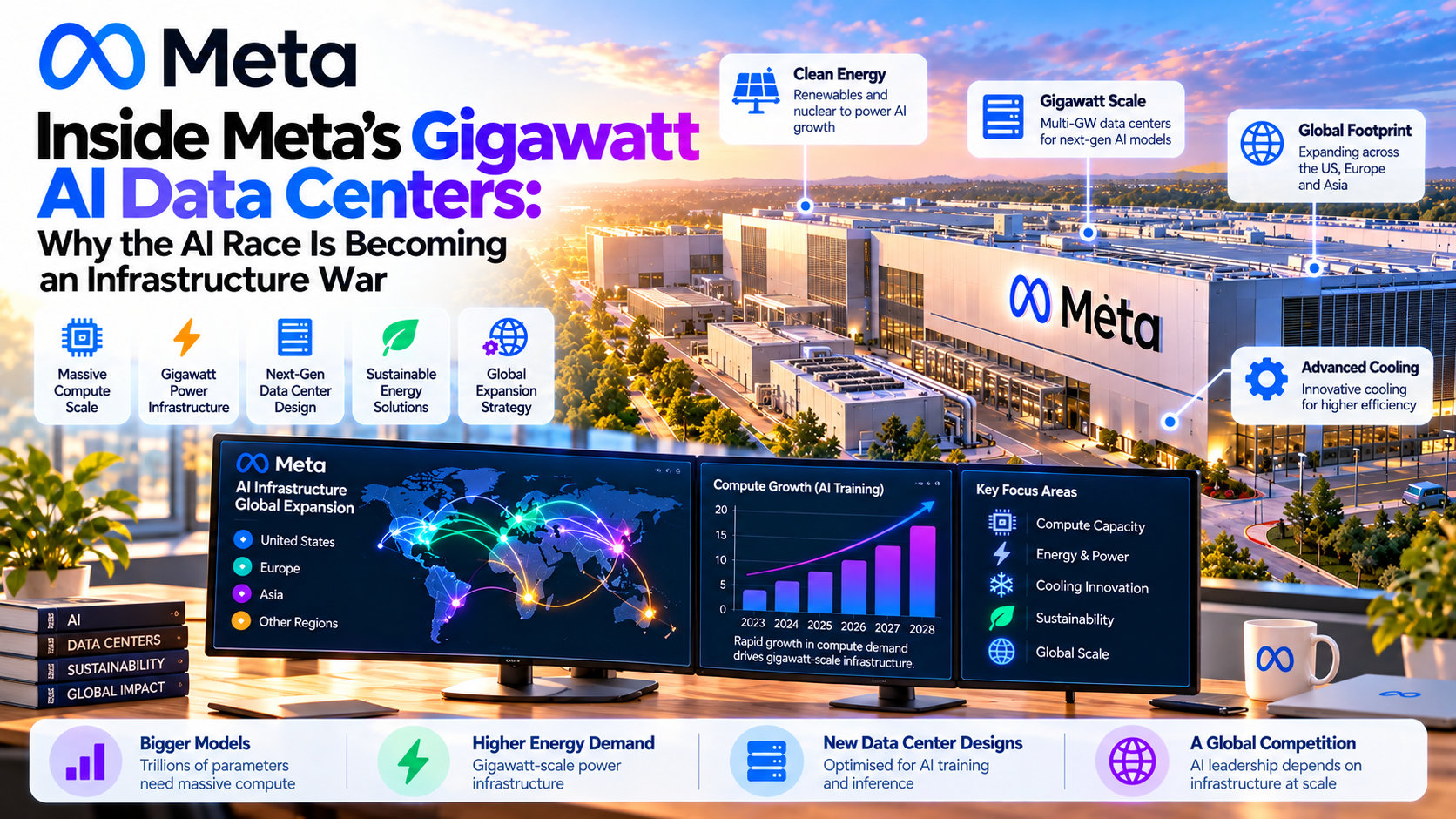
The next AI bottleneck may be a power connection, a cooling loop or a transformer delivery date. Meta’s planned gigawatt-scale campuses show why competing in AI increasingly means building the physical systems that can run it.
Quick Take
- Scale: Meta describes its expanding Hyperion campus in Louisiana as a planned 5 GW compute-capacity project; separate Indiana and Texas campuses are each designed for 1 GW. These are project plans, not readings from electricity meters.
- Why build? Training and serving AI need chips, high-speed networks, buildings, reliable electricity and cooling that reach the same site on schedule.
- What is scarce? Grid access, electrical equipment, construction capacity, capital and community consent can matter as much as the model itself.
- What to watch: Separate company targets from commissioned capacity, and compare energy and water promises with published operating results.
What Is a Gigawatt AI Data Center?
A gigawatt (GW) is a unit of power: one billion watts at a given moment. It is not a measure of model intelligence or computing speed. When Meta describes a campus as having gigawatt-scale compute capacity, read that as an intended infrastructure scale for power-hungry computing, subject to how the campus is built and phased in. It is not a report that a finished facility is drawing that much power today.
Power and energy are different. A hypothetical, constant 1 GW draw for all 8,760 hours in a non-leap year would use 8.76 terawatt-hours (TWh). That arithmetic illustrates the scale; it is not a forecast of any Meta site’s consumption. Actual use depends on the portion of the campus operating, workloads, cooling, utilization and the facility’s electrical design.
Meta’s October 2026 infrastructure discussion frames the company’s AI strategy around constructing and operating large-scale infrastructure. Globally, the IEA’s 2026 Energy and AI analysis projects that data centers could use about 950 TWh per year by 2030, up from an estimated 485 TWh in 2025. That is an IEA scenario for the entire data-center sector, not a published total for Meta or for AI alone.
Where Meta’s Gigawatt Campuses Stand
Project announcements often group facilities at very different stages. The table below keeps announced capacity and project timing separate.
| Campus | Meta’s stated scale | Status and timing |
|---|---|---|
| Richland Parish, Louisiana — Hyperion | Expanded toward 5 GW of compute capacity. | Campus under construction; Meta describes the target as a planned expansion. Richland Parish expansion update |
| Lebanon, Indiana | Designed for 1 GW once operational. | Meta announced the start of construction in February 2026; no operational completion is established here. Lebanon, Indiana announcement |
| El Paso, Texas | Planned 1 GW of compute capacity. | Under construction; Meta expects to begin bringing capacity online in 2028. El Paso announcement |
The figures describe project scope, not a sum of currently delivered electrical load. They should not be added to nuclear announcements, chip deployment commitments or other supply arrangements as if every gigawatt refers to the same asset.
Why Does the AI Race Now Depend on Infrastructure?
A frontier model may be conceived in software, but getting it into production requires a coordinated physical stack. Accelerator shipments are useful only if a site can supply electricity, remove heat and exchange data between servers quickly enough. A connection date set years away can delay a cluster even when the chips already exist.
Sites need generation, substations, transformers, transmission access and firm service agreements that work under real load.
GPU and custom-accelerator supply matters alongside memory, switches, optical links and software that keeps the cluster busy.
Denser racks shift cooling designs toward liquid loops and require attention to local water conditions and heat rejection.
Construction teams, financing, utility approvals and public support determine whether a campus moves from rendering to operation.
These are linked constraints: installing more chips without enough network bandwidth or cooling does not create the expected productive capacity. The IEA’s grid and supply-chain assessment identifies bottlenecks in electricity supply chains, advanced chips, equipment and local acceptance. The “infrastructure war” in this headline is a contest for that limited delivery capacity, not a claim that all announced projects will be completed.
Meta’s Vertical Stack: Buildings, Chips and Connectivity
Owning more of the stack may give Meta more control over the fit between its workloads and its facilities. The company says its work with Broadcom covers custom MTIA accelerators, packaging and networking; the Meta’s custom-silicon announcement describes a deployment commitment exceeding 1 GW for the initial phase. That commitment concerns a silicon deployment roadmap. It does not add a second, independent gigawatt of electricity use to a campus figure.
Custom chips may suit Meta’s recommendation and inference workloads, while other accelerators may serve different training or serving needs. On the network side, faster links help distribute data and synchronize large jobs. On the facility side, rack density influences how power and cooling reach those machines. The potential advantage is co-design: planning these layers together can reduce avoidable bottlenecks. The trade-off is a large, long-lived investment exposed to changes in chip technology and AI demand.
The Electricity Question: Who Builds and Pays for Power?
Hyperion makes the power problem concrete. Entergy’s 2026 Richland Parish agreement outlines agreements involving more than 5,200 MW of planned new gas generation across seven plants, batteries and other resources to serve regional demand and Meta’s project. Entergy says the contract is structured so Meta pays its full cost of service and projects customer savings. Those savings are forward-looking claims from the utility; realized bills, resource costs and emissions should be checked as assets come online.
Meta also announced agreements it says could support up to 6.6 GW of new and existing nuclear energy by 2035. Meta’s nuclear energy agreements include support for existing reactors and projects with future delivery targets. An agreement or proposed reactor should not be counted as electricity already delivered to an AI campus.
There is also a carbon-accounting distinction. Meta says it will match the Louisiana campus’s energy use with clean and renewable energy. That claim does not by itself tell a reader which generator supplies the site in each hour or what emissions its local grid produces at peak demand. To judge progress, look for project commissioning dates, verified annual electricity use, hourly grid effects where available, and changes in both regional generation and emissions.
Cooling, Water and the People Living Nearby
Meta’s data center water and cooling information says its typical 1 GW AI-optimized design uses closed-loop liquid cooling and dry coolers, with its first such design planned to operate later in 2026. Closed-loop circulation can reduce routine on-site water demand for heat removal, but it does not mean a campus uses no water. Water withdrawals for construction, other site systems and local conditions still matter.
At Richland Parish, Meta says a glycol mixture will circulate through data halls and dry cooling will remove heat for most of the year. The company also describes local infrastructure spending and water restoration efforts in its Richland Parish expansion update. Restoration targets are useful to examine, but a volume restored in one watershed or year is not automatically the same as a reduction in the water a specific community needs during a drought.
For a credible local assessment, request site-specific water withdrawals and consumption, the source of supply, drought plans, air and noise impact studies, the utility’s cost-allocation method and updates after commissioning. Jobs and tax receipts matter too; so do residents’ ability to see actual operating results.
Why Wall Street Is Part of the Buildout
The scale of these projects pushes data centers toward infrastructure finance. In its Hyperion financing announcement, Meta disclosed a joint venture with funds managed by Blue Owl Capital for Hyperion: approximately $27 billion in development costs for buildings and long-lived power, cooling and connectivity assets, with Blue Owl-managed funds owning 80% and Meta retaining 20% of the venture. That is a stated project financing arrangement, not Meta’s annual AI spending.
For El Paso, the El Paso announcement describes a venture with BlackRock-managed partners and roughly $14 billion in development costs for the campus’s buildings and long-lived infrastructure; Meta would be its initial sole occupant. The projects show that financing partners, lease terms and the expected useful life of the site are now part of AI strategy. If model economics change faster than the facilities can be repurposed, financial exposure can outlast the technology cycle.
A Scorecard for Separating AI Infrastructure Plans From Delivery
Executives and investors can ask the same questions of Meta, its peers or their own AI infrastructure providers:
| Question | Evidence to request | Why it matters |
|---|---|---|
| How much is actually online? | Commissioned buildings and metered power, broken out from announced campus capacity. | Prevents plans from being mistaken for available compute. |
| Is power physically ready? | Utility agreements, interconnection milestones, commissioned substations and supply dates. | Reveals grid and equipment delays. |
| What does it cost to serve a task? | Utilization, completed jobs, latency and total cost, including cooling and networking. | A larger campus is not automatically more productive. |
| Who carries local costs? | Ratepayer protections, water disclosures, emissions and permitting records. | Makes promised community benefits testable. |
The practical takeaway is to track capacity delivered and work completed, not only acres, announced gigawatts or capital commitments. None of those announcement metrics alone proves a better model or a profitable AI product.
What This Means for European Businesses and AI Governance
European SMEs may not build gigawatt campuses, but they buy services running on someone else’s infrastructure. When comparing AI providers, ask where processing and backups occur, how data moves between regions, what happens during outages, and whether model access depends on one cloud or hardware supplier. A resilient architecture should make data export and provider substitution practical.
For personal data, assess controller and processor responsibilities and any applicable international transfer arrangements using the European Commission data transfer guidance. The EU AI Act consolidated text addresses AI systems, providers and deployers based on the relevant activity and use case: the wattage of a data center does not by itself make an AI system high-risk. An organization using AI in a regulated decision still needs to assess its own obligations, oversight and evidence. These duties cannot be settled by an infrastructure provider’s energy pledge.
For sustainability procurement, request measured electricity, water and emissions data with clear reporting boundaries. Ask how annual clean-energy matching relates to the hours and regions where the service actually runs. That gives procurement and engineering teams facts they can compare without assuming that a glossy campus rendering is a performance report.
MaGeN-AI View
The Takeaway
The AI race now has a construction schedule. Meta’s gigawatt plans link model ambitions to grid connections, chips, cooling, finance and the communities that host the sites. The strongest evidence of progress will be commissioned capacity and useful AI work delivered at an accountable energy, financial and local cost—not the size of the next announced campus.
Frequently Asked Questions
What is a gigawatt AI data center?
It is a planned or operating data center campus described at roughly one billion watts of power-related capacity. Check whether the number refers to planned compute capacity, a power connection or measured electricity demand.
Is Meta’s Hyperion data center already using 5 GW?
Meta describes the expanding Richland Parish site as targeting 5 GW of compute capacity. That figure is not proof that 5 GW has been commissioned or is being drawn continuously.
When will Meta’s El Paso AI data center be online?
Meta says its El Paso campus is under construction and expects to begin bringing its planned 1 GW of compute capacity online in 2028.
Does clean-energy matching mean a data center runs on clean power every hour?
No. An annual matching claim alone does not show the hour-by-hour electricity mix at the local grid connection. Ask for regional and time-specific evidence.
Why do AI data centers need liquid cooling?
Higher-density AI hardware produces heat in a concentrated space. Liquid loops can move that heat efficiently, but the overall water and energy impact depends on the site and the rest of its cooling design.