Siri AI Global Expansion: Is Apple’s Personal-Context Strategy Finally Different From ChatGPT and Gemini?
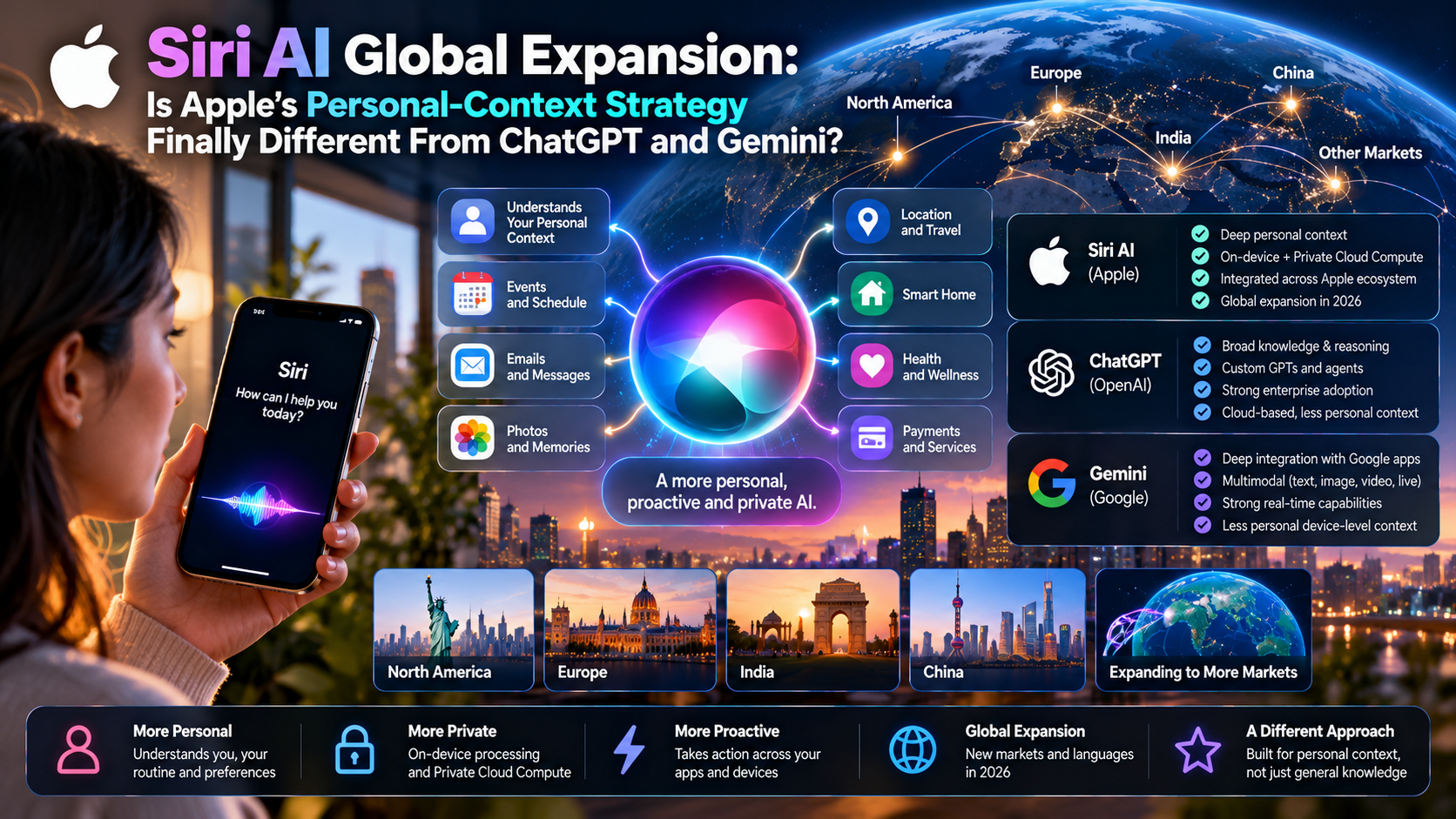
Apple’s new Siri can use messages, email, photos and what is on your screen to answer a more personal question. But “global expansion” needs a careful reading: the Siri AI beta, Apple Intelligence language support and availability in the EU are three different things.
Quick Take
- The rollout: Siri AI began its English-language beta on 14 September 2026. Apple announced French, Japanese, Korean, Portuguese and Spanish support for October; check current support before assuming each is live.
- The key difference: Apple combines system-level context and actions with on-device components and Private Cloud Compute. ChatGPT and Gemini also offer personal context through memory and connected apps.
- For Sweden: Apple currently lists Siri AI beta on eligible Macs and Vision Pro in the EU with English settings; EU iPhone, iPad and Apple Watch remain excluded.
- Our verdict: Apple has a distinct integration and processing design. The most useful assistant depends on your region, device, permitted data and whether it can complete a task accurately.
What Is Siri AI, and What Does “Global Expansion” Mean?
Siri AI is Apple’s conversational version of Siri in its 2027 software releases. Apple’s September Siri AI update describes personal context across messages, email and photos, awareness of content on screen, web answers and actions within supported apps. A dedicated Siri app also lets people return to conversations. These capabilities are part of Siri AI; they should not be confused with every feature marketed under the broader Apple Intelligence name.
Apple launched the Siri AI beta in English in September and said five more languages would follow in October: French, Japanese, Korean, Portuguese and Spanish. As of 10 October, Apple’s published requirements still list English. Apple Intelligence supports more languages, including Swedish, but that broader language list does not mean Siri AI itself works in Swedish. Availability also depends on an eligible device, software version, account region and location.
For a reader in Stockholm, the platform distinction is decisive. Apple’s Siri AI beta requirements lists Siri AI beta on macOS 27 Golden Gate and visionOS 27 in the EU when both the device and Siri languages are English. It says Siri AI is unavailable in the EU on iOS 27, iPadOS 27 and watchOS 27. Apple also lists restrictions for mainland China. “Global” therefore describes a phased international rollout, not identical access on every Apple device.
How Does Apple’s Personal Context Work in Practice?
Consider an original, illustrative example: “Find the hotel confirmation for my Barcelona trip and remind me what my colleague suggested doing after the conference.” A useful assistant needs to locate the right reservation in email, identify the relevant message, resolve which trip the question refers to, and present the evidence before adding any reminder. The difficult part is choosing the correct personal facts, not producing a polished paragraph.
Apple says Siri AI can search personal information in supported apps, respond to what a user is viewing and carry out more actions across the operating system. It also says third-party app context can be surfaced when developers integrate with Spotlight. Existing app actions and newly announced integrations are different: an app being installed does not guarantee that Siri can search all its content or perform every possible action. Ask the assistant to identify the source and review any outgoing message or changed calendar entry before confirming it.
The Architecture Behind Apple’s Approach
Apple says its new foundation models run on devices and on servers using Private Cloud Compute. According to Apple’s September Siri AI update, Apple’s on-device orchestrator uses capabilities such as the Spotlight index and App Toolbox. Apple says personal data sent to Private Cloud Compute for a request is not stored there or made accessible to Apple. Those are Apple’s published design claims, rather than an independent guarantee about every app, web request or third-party service a user might choose to involve.
There is a revealing nuance in the same announcement: Apple says the newer foundation models were developed in collaboration with Google and its Gemini models. Using related model technology does not make Siri AI and the Gemini app the same product. The relevant differences are how context is accessed, where a request is processed, which permissions govern it, and how the assistant reaches other apps. Compare those layers before treating “Apple versus Google” as a simple model contest.
Siri AI vs ChatGPT vs Gemini: Where Is Personalization Coming From?
| Question | Siri AI | ChatGPT | Gemini |
|---|---|---|---|
| Starting context | Supported device apps, onscreen content, Spotlight and permitted app actions. | Saved memories, eligible chat history, files and authorized connected apps. | Personal Intelligence with eligible connected Google apps plus available chat personalization. |
| Where it is encountered | Built into supported Apple system surfaces and a dedicated Siri app. | ChatGPT conversations and supported app experiences across devices. | Gemini app and supported Google surfaces, subject to feature availability. |
| What a person controls | Device and Siri settings, app permissions and approvals for consequential actions. | Memory settings, chat history, connected app authorization and workspace permissions. | Connected apps, activity controls and personalization settings. |
| Important limit | Siri AI beta remains unavailable on EU iPhone, iPad and Apple Watch. | Results depend on connected accounts, plan, memory and permitted app capabilities. | Personal Intelligence features and app eligibility vary by account and region. |
OpenAI’s ChatGPT memory guide describes how ChatGPT can use saved memories and, when enabled, relevant chat history; OpenAI’s connected-app guide explains access through connected services. Google’s Gemini Personal Intelligence guide describes Gemini Personal Intelligence using eligible Google app connections. These are documented features, so Apple is not the first assistant able to use personal information. The distinction is its chosen combination of operating-system access, on-device orchestration and Private Cloud Compute.
Is Apple’s Privacy Strategy Actually Different?
Yes, at the architecture level. Apple emphasizes on-device orchestration and a cloud-compute design it says does not retain personal data from requests. That deserves attention when an assistant can encounter messages, photos and screen content. It does not prove that every Siri request stays on the device or that privacy across all connected services is equivalent.
ChatGPT has memory and connected-app controls, and policies can differ between consumer and managed workspaces. Gemini lets eligible users choose connected apps. Google’s Connected Apps data controls says Gemini does not train directly on entire Gmail inboxes or Photos libraries, while also explaining that eligible activity, summaries, excerpts and inferences can be used for product improvement when relevant settings are on. Read each provider’s current data controls for the account and feature you intend to use; do not reduce the comparison to “private” versus “not private.”
Why the EU Rollout Is a Separate Story
Apple’s EU availability statement attributes the delay on EU iPhone and iPad to a disagreement over the Digital Markets Act and access for other assistants. The European Commission DMA Q&A disputes Apple’s interpretation: it says the DMA does not prohibit the launch of Siri AI and requires relevant interoperability subject to user consent. These are opposing public positions. Neither is evidence that Siri AI has a confirmed EU iPhone release date.
The practical result is clear today: someone in Sweden with an eligible Mac can check the English-language Siri AI beta; an eligible iPhone in Sweden does not offer the same new Siri AI capability. Mac availability should not be presented as an EU-wide iPhone launch. Recheck Apple’s regional support page before publishing a new availability claim or recommending a hardware purchase for this feature.
Which Assistant Fits Which Job?
A strong option to test when a task depends on Apple-native messages, photos, what is on screen or app actions and the beta is available in your region.
Useful when you want memory across conversations, files and authorized third-party services on different devices; verify the connected account and permissions.
Worth testing when the relevant information is in eligible Google services such as Gmail or Photos and Personal Intelligence is available for your account.
Use what is currently available on your device. Do not select Siri AI as the deciding feature for an EU iPhone until Apple confirms its launch there.
These are use-case starting points, not independent accuracy rankings. A fair comparison asks each assistant to find the same permitted item, show which source it used, avoid a wrong-person match and obtain approval before changing anything.
A Four-Step Test Before Trusting a Personal AI Assistant
- Check eligibility: confirm device, operating system, language, account region and actual feature access rather than the broader branding on a product page.
- Limit context: connect only the apps required for the task; separate personal and work accounts where your organization requires it.
- Verify evidence: test ambiguous names, outdated reservations and conflicting calendar entries; open the original email or message before acting.
- Confirm the result: review recipients and permissions, then verify that a reminder, booking or message was actually saved or sent.
For teams testing across Europe, include a supported Mac and an EU iPhone as separate cases. A product demo recorded in another region cannot establish local availability or your organization’s data-handling terms.
EU AI Act, GDPR and Responsible Use
A personal assistant may process information about the user and other people named in messages, photos or workplace documents. The European Commission GDPR principles sets out principles including lawful purpose, data minimization, accuracy, security and appropriate retention. An employer introducing connected assistants should assess its own lawful basis, access controls, vendor terms and rules for employee and customer information before enabling broad app access.
The EU AI Act and the Digital Markets Act answer different questions. The DMA dispute above concerns platform access and interoperability. The European Commission AI Act transparency guidance describes transparency duties for certain direct interactions with AI systems; further obligations depend on how the AI is used. A family travel lookup and an employer using an assistant to evaluate applicants should not be treated as the same risk scenario. Keep sensitive or consequential decisions under qualified human review.
MaGeN-AI View
The Takeaway
Apple’s advantage is the possibility of making personal context useful directly from the device and supported apps while keeping important orchestration on device. ChatGPT and Gemini already deliver meaningful personalization, so Apple’s claim to be different rests on execution: correct source selection, visible permissions, reliable actions and its promised privacy design. For European readers, the missing EU iPhone rollout remains a real limit on that promise.
Frequently Asked Questions
Is Siri AI available in Sweden on iPhone?
As of 10 October 2026, Apple says Siri AI beta is unavailable on iOS, iPadOS and watchOS in the EU, including Sweden.
Can I use Siri AI on a Mac in the EU?
Apple lists Siri AI beta for eligible Apple-silicon Macs running macOS 27 Golden Gate in the EU when both device and Siri languages are English.
Does Siri AI understand Swedish?
Apple Intelligence has Swedish language support, but Apple lists the Siri AI beta in English and has separately announced five additional languages for October. Swedish Siri AI support is not confirmed.
Does Apple use Google Gemini technology for Siri AI?
Apple says its new foundation models were developed in collaboration with Google and its Gemini models. Siri AI remains an Apple experience with its own system integration and published processing design.
Is Siri AI more private than ChatGPT or Gemini?
Apple describes a distinct on-device and Private Cloud Compute design. Privacy comparisons depend on the exact request, connected services, settings and account type; no universal ranking follows from the product name.