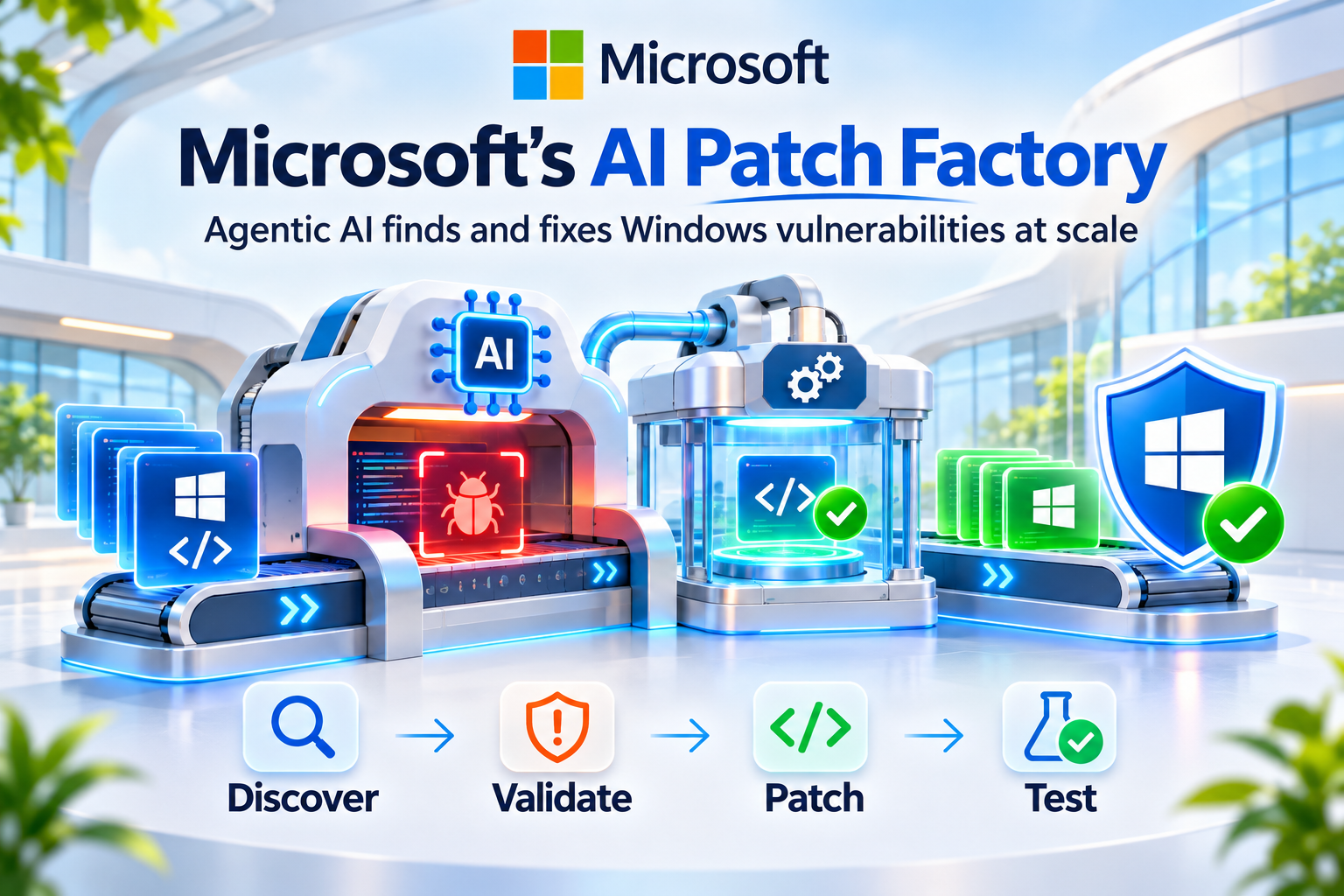
Microsoft is applying AI across Windows vulnerability discovery, remediation and update validation. “AI patch factory” is a useful description of that connected workflow, but it is not the name of a released autonomous product: engineers still decide which findings are real and which fixes ship.
Quick Take
- Discovery: Microsoft cites MDASH, a multi-model agentic scanner, to identify and validate potential code vulnerabilities.
- Fixing: AI assistance can help with affected-version analysis, patch options, backports and test generation.
- Release: Engineering reviews, compatibility checks and deployment controls remain essential.
- Number to interpret: Microsoft says an October 2026 Windows update addressed over 1,100 CVEs; it does not say AI discovered them all.
What is Microsoft actually doing?
In a 5 November Windows security update, Microsoft describes AI support across finding issues, assessing impact, creating fixes, testing and deploying updates. “Factory” is our shorthand for a coordinated process; Microsoft does not announce an unattended machine that repairs Windows without engineers. This matters because a security patch can break legitimate workloads even when it closes the original vulnerability.
Findings come from external researchers as well as internal teams. Microsoft names MDASH as an example of an agentic scanner that uses several models and specialized agents to examine code. Its teams review the output and make decisions. A higher discovery rate is valuable only if vulnerabilities are reproducible and patch teams can act without flooding release pipelines with false positives.
How could an agentic patch workflow operate?
The MDASH preview documentation describes a multistage scan: rank potentially risky code, use specialized agents to investigate, validate evidence and deduplicate findings. A candidate still needs a human security reviewer to reproduce it in an approved environment, determine customer impact and decide on remediation scope.
A patch team may use AI to identify related code paths, suggest a minimal fix, compare branches and produce regression tests. The change then goes through review, controlled builds, security tests and compatibility validation. Windows must support many configurations; testing against drivers, applications and OEM hardware is a major part of the cost of shipping a safe update.
What does the 1,100-CVE figure actually show?
Microsoft says its October 2026 Windows monthly update addressed more than 1,100 CVEs. A count of addressed identifiers is not a count of AI-found vulnerabilities, nor a direct measure of exploitability, patch quality or risk reduction. CVE volumes can reflect reporting practices, disclosure timing and how issues are grouped. Organizations should use the published advisory data to decide which fixes are relevant to their own devices.
Microsoft makes CVE data available through the Security Update Guide and machine-readable advisory formats. IT teams can combine exploitability information with asset exposure, application dependencies and deployment rings. A security team that can identify relevant patches but cannot deploy them remains exposed; time from disclosure to protected endpoint is a more useful operational measure.
What should a Windows administrator do?
Maintain an accurate inventory of supported Windows versions and high-value endpoints. Set testing rings for security updates, verify key applications and define rollback procedures. Optional preview updates and controlled pilot devices can help reveal compatibility issues before broad rollout, but emergency fixes still need a clear accelerated path when active exploitation is known.
For any AI-generated fix used inside your own engineering team, require reproducible evidence, tests covering the original bug and independent review. Keep a record of the agent’s tool access, code changes and rejected hypotheses. Distinguish safe acceleration from blindly trusting an automated patch that merely passes a limited test suite.
From an AI finding to a deployed fix
The workflow below separates possible AI assistance from accountable human and release decisions.
| Stage | Possible AI contribution | Required human / system check |
|---|---|---|
| Find | Rank code and suggest a vulnerability. | Reproduce and assess exploitability. |
| Fix | Propose code edits and affected-version paths. | Review backports and security behavior. |
| Validate | Generate tests and triage failures. | Run security, OEM and app compatibility checks. |
| Deploy | Summarize advisories and priorities. | Approve rollout rings, telemetry and rollback. |
Four measures that matter to a security leader
Track confirmed issues per reviewer hour, not raw agent alerts.
Measure the interval from reproducible report to reviewed patch.
Track installation success, regressions and effective rollback.
Measure how long affected Windows assets remain unprotected.
Security and EU governance
An agent reviewing proprietary code or telemetry may see secrets, personal information or vulnerability details. Restrict tool scope and retain logs under a defined policy. For European data, GDPR minimization guidance is relevant. Avoid publishing exploit reproduction steps before coordinated disclosure allows it.
The EU AI Act concerns a system’s actual intended use and responsibilities; using an AI-assisted code scanner does not by itself determine every obligation. Document who reviews findings, who approves fixes and which evidence supports a security claim.
MaGeN-AI View
Automation should reduce the exposure window
The useful outcome is a validated fix that reaches affected customers without introducing a new failure. MDASH and other AI-assisted steps may help Microsoft find and process vulnerabilities faster, but patch quality and deployment remain engineering responsibilities.
Frequently Asked Questions
Is “AI Patch Factory” a Microsoft product name?
No. It describes the connected AI-assisted Windows security workflow; Microsoft identifies tools such as MDASH.
Did AI discover all 1,100 October CVEs?
Microsoft did not say that. The figure describes CVEs addressed by its October 2026 Windows update.
What is MDASH?
A Microsoft preview agentic code scanner for finding and validating potential vulnerabilities.
Can AI fixes ship without engineers?
Microsoft says engineers review the work and own release decisions.
How can an organization measure success?
Track confirmed vulnerabilities, safe patch rollout and the time exposed assets remain unprotected.