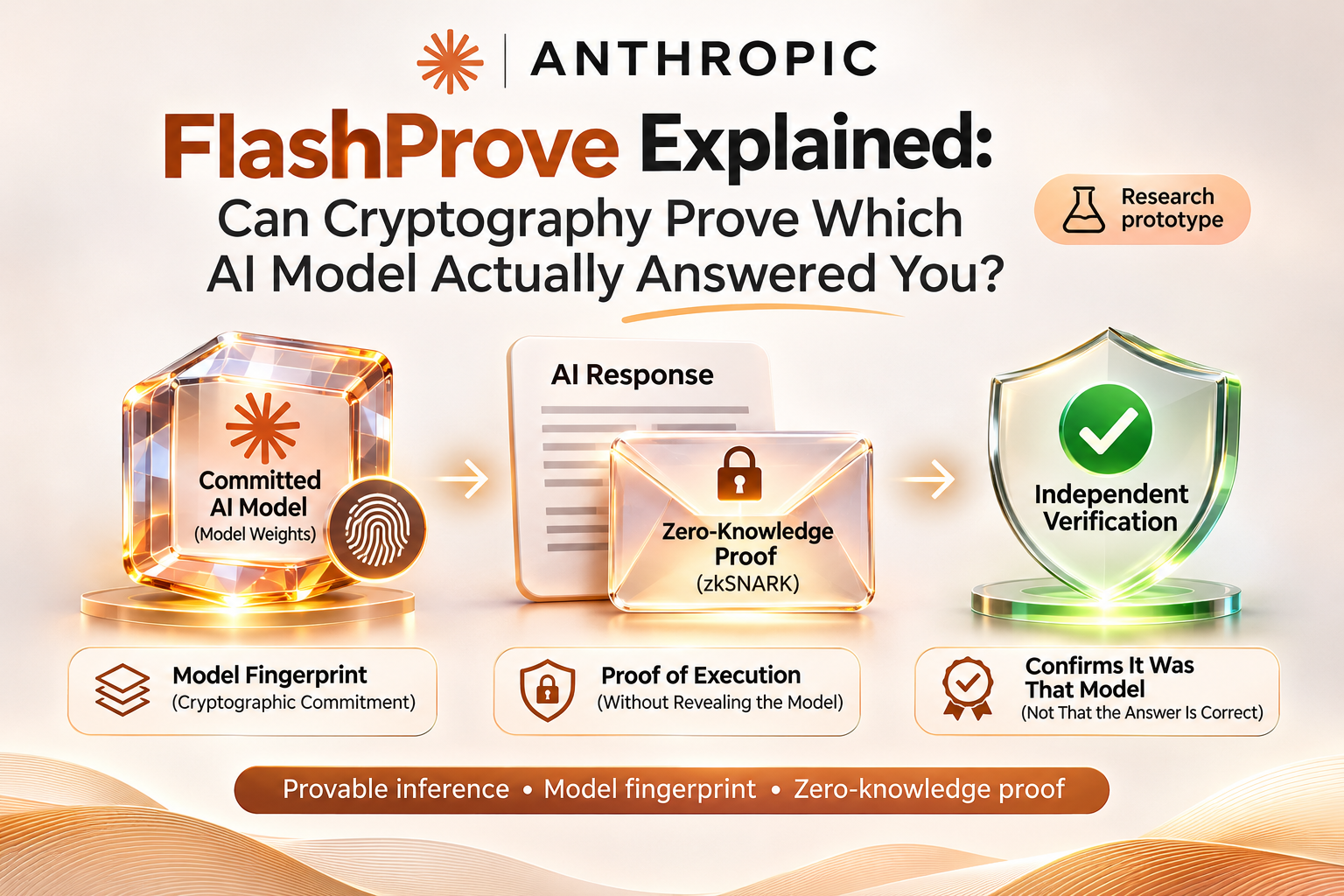
An AI provider may say that a specific model handled your request, while the user cannot normally verify the claim from the answer alone. Anthropic’s FlashProve research prototype explores a cryptographic receipt for the inference itself. It is an important technical step with significant cost and scope limits.
Quick Take
- Core idea: Bind a provider to committed model weights and verify that a particular response came from the committed computation.
- What was shown: Anthropic demonstrated a research prototype on quantized Llama 4 Maverick, not a generally available Claude feature.
- Trade-off: Its example generated roughly 19 MB of proof per 1,024-token request with substantial extra GPU work.
- Boundary: A valid proof cannot establish that a response is true, unbiased, safe or legally permissible.
What problem does provable inference solve?
Suppose a customer pays for a named AI model and a middle layer silently routes some requests to a different model. The text of a reply seldom proves which weights and computation produced it. Anthropic’s 2 November research proposes a proof attached to a response so a verifier can check the computation against an earlier commitment without receiving the model’s secret weights.
The provider first commits to a specific model; later, it produces a proof for a request and output. A verifier checks the proof against that commitment. This makes model substitution detectable within the proved setup. It does not identify a model merely by writing style, and it does not tell the reader whether the answer is helpful or factually correct.
How does FlashProve work in practice?
FlashProve uses a zero-knowledge proof approach called a zkSNARK. “Zero knowledge” means the verifier can check the relevant claim without seeing the proprietary weights. Anthropic describes an offline commitment phase and an online phase that produces proofs for actual model runs. The project also includes formal reasoning about its proof protocol, which helps reviewers evaluate what the system claims to guarantee.
A useful analogy is a tamper-evident calculation receipt: it shows that a declared calculation was followed, provided the commitment and software setup are trusted. It does not tell you whether the original prompt was appropriate, whether a retrieved document was accurate, or whether an application silently changed its instructions before invoking the model. Those checks belong to the wider service design.
What do the demonstration numbers mean?
Anthropic reports proving a 4-bit quantized, 400-billion-parameter mixture-of-experts model, Llama 4 Maverick, with integer arithmetic for prefill. In its example, a single H100 GPU produced proof work at roughly 110 tokens per second and a roughly 19 MB proof for a 1,024-token request. These figures describe a specified research configuration, not the cost or speed of every commercial LLM.
Anthropic says the proof-generation GPU time in that setup is around 70–95 times the GPU time of running the same prompt on vLLM. That overhead matters for a consumer chatbot handling millions of daily messages. It may still be worth studying for a selected high-value audit, a procurement claim or an independent evaluation, where proving origin matters more than the lowest inference bill.
Where are the limits and security assumptions?
A proof is only as useful as the statement it covers. If a system commits to model weights but routes a request through unproved retrieval, tools, filters or prompt templates, the receipt is not an audit of those surrounding steps. A buyer should ask whether the proof includes the exact input, output, model version, decoding behavior and any code that transformed either side.
The released research repository is described as a prototype rather than a maintained production service. It needs independent security review, reproducible performance testing, a clear trust model and operational handling for model upgrades before an enterprise can treat it as a procurement guarantee.
What can a cryptographic proof establish?
Keep the verified inference claim separate from all the judgments around an answer.
| Question | Can a model-inference proof answer it? | Additional check |
|---|---|---|
| Which model computation produced this output? | Potentially yes, within the committed and proved circuit. | Verify commitment and proof implementation. |
| Is this answer factually correct? | No. | Check sources and tests. |
| Was personal data used lawfully? | No. | Review collection, data flows and legal basis. |
| Were external tools and retrieval sound? | Only if explicitly included in the proved claim. | Audit the entire application chain. |
Four possible uses
Check a provider’s assertion that a specified model served a contracted class of requests.
Show an evaluator that answers came from the same committed model during a benchmark.
Attach proofs to selected consequential interactions for later verification.
Detect unauthorized substitution when an intermediary could swap a model for cost reasons.
Privacy, EU rules and honest communication
The proof protects a narrowly defined integrity claim; it is not a privacy policy. Providers must still protect prompts, outputs, logs and any personal data using appropriate controls. In Europe, GDPR principles remain relevant and the AI Act guidance depends on the actual use and actor role.
If a service advertises a “cryptographically verified answer,” it should specify exactly what was verified. Users might otherwise assume a quality or safety guarantee that mathematics did not provide. Do not confuse an interesting verifiable computation with verification of a medical, legal or financial conclusion.
MaGeN-AI View
Proof of origin is a new accountability tool
FlashProve makes the idea of checking which model computed a reply tangible. Its present demonstration is costly and narrow. The most promising near-term role is selective verification of model identity, combined with ordinary audits of data, tooling and the answer itself.
Frequently Asked Questions
What is Anthropic FlashProve?
A research prototype for cryptographically proving a model inference against committed weights.
Does FlashProve prove that Claude answered me today?
No. Anthropic demonstrated a research system on a specified Llama 4 Maverick configuration, not a general Claude proof service.
How large was the example proof?
Anthropic reported roughly 19 MB for a 1,024-token request in its stated setup.
Can the proof tell whether an answer is true?
No. It addresses how an answer was computed, not whether its claims are correct.
Are model weights revealed to the verifier?
The approach aims to verify the computation without revealing the proprietary weights.