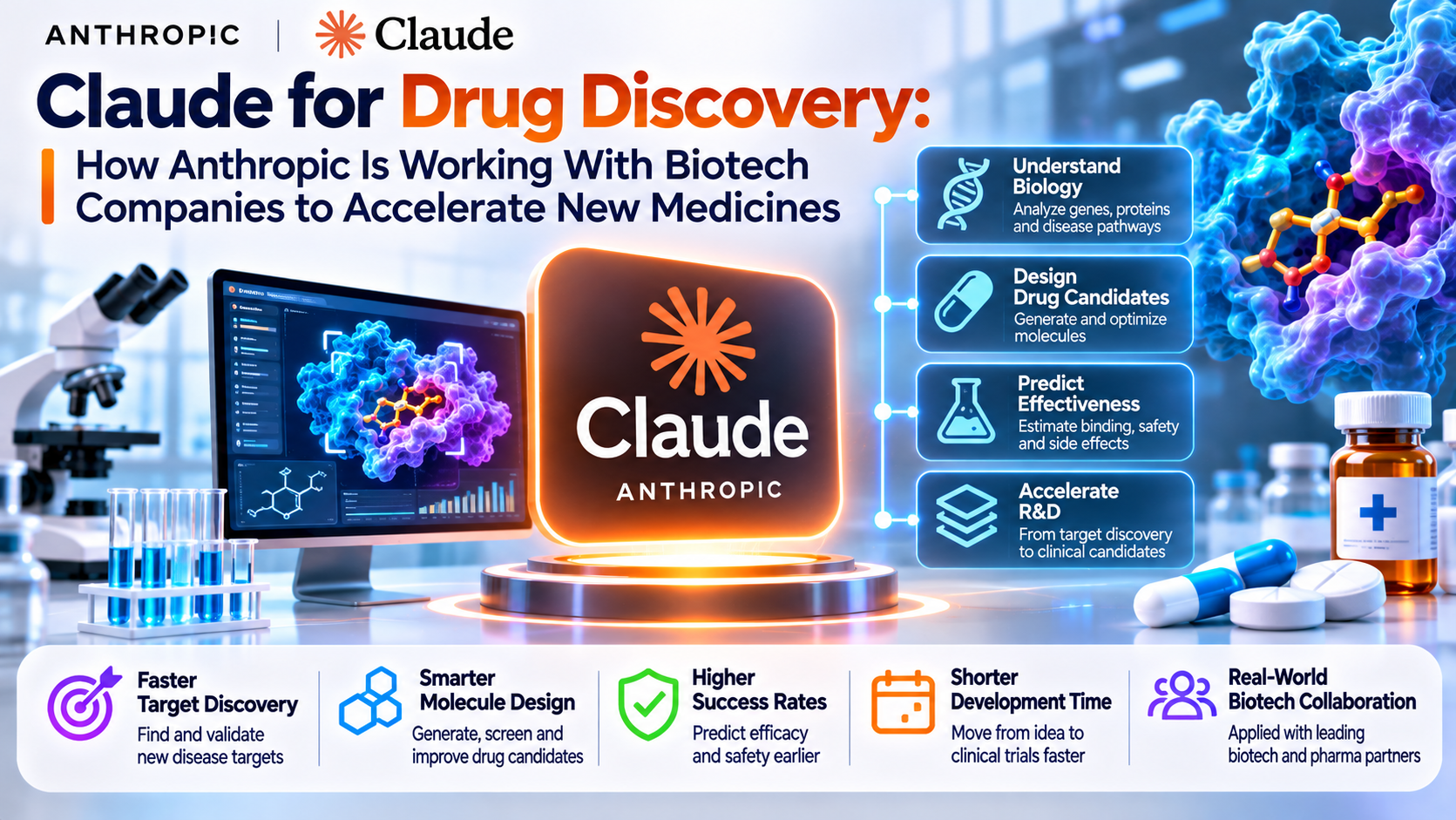
Anthropic has published case studies with biotech collaborators using Claude for molecule design, laboratory planning and manufacturing documentation. Some early laboratory results are promising; they are not approved medicines or proof of benefit in patients. This article follows the actual research steps and the checks that must come next.
Quick Take
- Scope: Anthropic describes collaborations with six organizations across distinct stages of medicine development.
- Specific evidence: Partners report laboratory tests of candidate designs, while one team reports faster review of manufacturing documentation.
- Clinical status: Anthropic says most work remains preclinical. A lab hit is not a demonstrated safe and effective treatment.
- Critical control: Scientists choose the objective, run experiments, interpret failures and decide whether a candidate deserves further testing.
What has Anthropic actually reported?
Anthropic’s research update describes partnerships with six organizations, as well as its own early projects. Claude’s roles vary: searching published evidence about a target, proposing molecular designs, helping interpret laboratory data, checking manufacturing records and drafting documents for human review.
The significant point is that these are different parts of a long pipeline. An agent that helps scientists prioritize a promising experiment does not replace the experiment. An agent that drafts regulatory paperwork does not validate the drug described in the paperwork. Read each partner result against the task that was actually tested.
Anthropic explicitly says most of the work remains preclinical. It hopes the projects may eventually contribute to medicines for serious conditions, but there is no basis to describe the case studies as newly approved drugs or successful human trials.
What happened in the molecule-design experiments?
At Generate Biomedicines, scientists used Claude Code to propose designs for part of a CAR T-cell engineering effort. Anthropic reports one shorter design that produced more receptors and stronger laboratory effects in the tests described by its partner. These are properties of an experimental construct, not evidence it treats patients with solid tumours.
Divergence Labs gave Claude a goal for a candidate targeting the IgE pathway. Anthropic says Claude generated roughly 35,000 antibody designs over about a month. Early tests found candidates that could bind or dislodge the intended target; the two desired functions still need to be combined and evaluated. The number of proposed designs measures search breadth, not the number of viable medicines.
A careful pipeline is define target → generate candidates → filter for plausibility → test in the lab → repeat → evaluate safety and effectiveness. Each step can fail. A promising binder may be unstable, difficult to manufacture, toxic or ineffective in a human body.
How did Claude help with experimental feedback?
Anthropic says BigHat Biosciences and an Anthropic researcher used Claude with BigHat’s laboratory data system to improve two antibody-fragment leads. Scientists made and tested about 1,010 variants in roughly ten weeks. The team also reconsidered whether its original stability metrics were appropriate, then tested a revised protocol.
The lesson is about the feedback loop, not a single impressive number. A model suggests a change, the lab measures a result, the team investigates unexpected outcomes, and new evidence affects the next design. Human scientists decide whether the measurement is trustworthy and whether the improvement holds outside the initial assay.
A sound evaluation should compare accepted candidates with prior baselines, repeat the key experiments and report failed designs alongside successes. Without that denominator, a few successful candidates can make an enormous search seem more effective than it really is.
Can AI also reduce paperwork in drug development?
At Enveda, Anthropic reports that Claude reviewed 1,061 pages of manufacturing documents and identified the 11 issues found by human reviewers plus seven additional flags. In that trial, reported human review time fell substantially. Those figures describe this company’s test process, not a universal guarantee about regulatory document quality.
For manufacturing, a missing entry or inconsistent batch record can delay an investigation. A document assistant can highlight discrepancies and prepare a draft, but qualified staff must check source records, sign off corrections and maintain an audit trail. A model’s confident explanation is not a substitute for compliant records or process validation.
Anthropic also describes work with The Column Group on a new biotech workflow and with Bristol Myers Squibb on clinical-planning questions. These are distinct collaborations. The article does not assume every partner used the same model, data access or level of automation.
What should biotech teams measure before scaling?
Track time to a laboratory-confirmed hit, cost per useful experiment, proportion of proposals that fail basic screening and whether repeat experiments preserve the reported improvement. Keep held-out data to test whether an agent is producing genuinely useful hypotheses rather than recycling known examples.
For document workflows, measure reviewer hours, errors missed, false alarms and the completeness of source citations. Require a trace from every AI suggestion to the original assay, record or publication. Restrict access to proprietary target information and separate draft generation from final scientific or regulatory approval.
Claude across the drug-development pipeline
Each example illustrates a different kind of work and a different standard of evidence.
| Stage | Reported example | Next verification step |
|---|---|---|
| Design | Generate and Divergence tested candidates proposed with Claude support. | Reproducibility, manufacturing feasibility, safety and later clinical studies. |
| Optimization | BigHat tested roughly 1,010 variants of two leads. | Repeat assays and independently confirm the intended properties. |
| Documentation | Enveda tested issue detection across manufacturing records. | Qualified sign-off, source traceability and quality-system validation. |
| Programme planning | TCG and BMS are exploring research and trial-planning workflows. | Measure whether decisions and trials improve against existing processes. |
Four safeguards for a real laboratory team
Scientists choose the disease question and reject designs that violate known biology or project constraints.
Run controlled assays, replicate promising findings and preserve unsuccessful experiments for analysis.
Define what private chemistry, patient and partner data an agent can read and how results are stored.
Treat a lead compound as the beginning of preclinical and clinical testing, never as a patient outcome.
How do European rules and research rights apply?
Lab work may involve licensed papers, proprietary molecules or patient records. Check rights to underlying datasets and publications before using them; preserve attribution in research notes. For EU personal health data, the European Commission’s GDPR guidance explains that health data receives additional protection.
The EU AI Act and applicable medicine or medical-device requirements depend on the system’s intended purpose and roles in deployment. A research assistant suggesting experiments and software used to make a clinical decision are different cases. Neither this article nor a successful lab assay establishes clinical validation or regulatory approval.
MaGeN-AI View
Faster science means more tests, not fewer
Claude’s early partner studies show where AI can reduce search and administrative work. Their value will be decided by replicated laboratory results, meaningful clinical outcomes and trustworthy records. The best use is to make good experiments easier to run and bad ideas easier to reject.
Frequently Asked Questions
Has Claude discovered an approved medicine?
Anthropic’s October 2026 case studies are largely preclinical and do not establish an approved treatment or a successful human trial.
How many organizations is Anthropic working with?
Anthropic says its research update describes partnerships with six organizations across stages of drug development.
What did Claude do at Divergence Labs?
Anthropic reports Claude generated about 35,000 antibody designs for a specific research goal; candidates were then narrowed and tested experimentally.
Can Claude replace laboratory scientists?
No. Scientists must set goals, run and repeat experiments, interpret results, evaluate safety and approve scientific and regulatory decisions.
Does a positive antibody test mean a drug is ready?
No. Early binding or assay results require further optimization, reproducibility testing, safety work and potentially clinical trials.