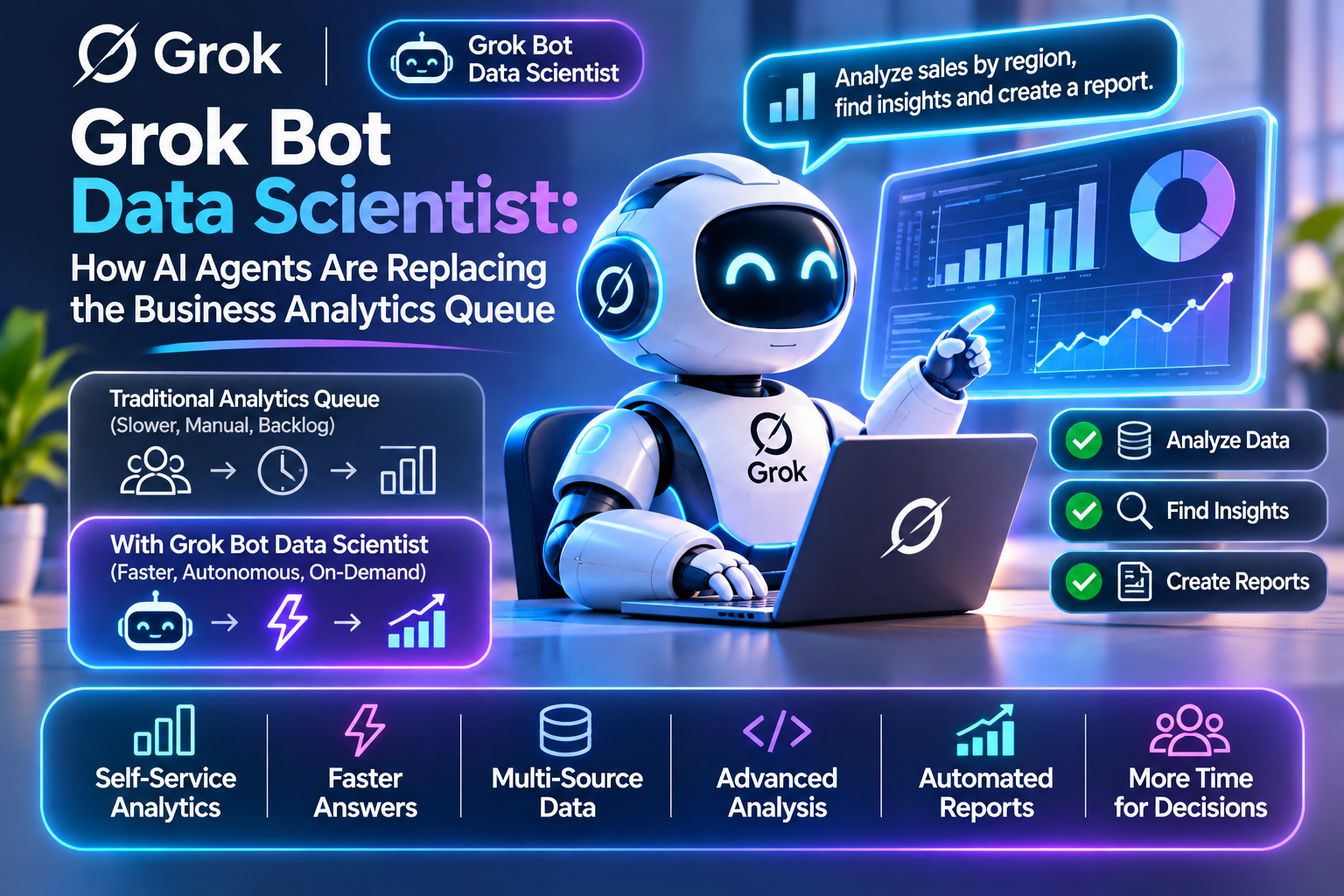
A product manager has a question about yesterday’s users; the data team has a two-week queue. An internal Grok Bot case study describes a different workflow: a shared Data Bot that can query approved warehouse data using team-maintained analytics skills. The human data team still owns definitions, access and difficult interpretation.
Quick Take
- Case study: A 2 November account describes SpaceXSI’s internal Data Bot, a shared Grok Bot Team Bot trained on the data team’s own practices.
- Work: It answers warehouse questions, investigates metrics and helps create charts or dashboards through approved tools.
- People: Analysts define metrics, review methods and handle ambiguous or consequential decisions.
- Evaluation: Measure verified answer quality and analyst time saved, not only time to a plausible chart.
What did the team actually build?
In a 2 November case study, SpaceXSI describes an internal Data Bot built with Grok Bot. It draws on shared, maintained team skills rather than relying on one person’s private prompting. Users ask questions about the business, and the agent can query a warehouse, perform analysis and return an answer in a useful format. The report is a company case study, not an independent controlled trial of agent productivity.
The bot can appear in Slack discussions, making it easier for a colleague to ask a follow-up where work already happens. Its designers say they want routine questions to be answered without waiting in an analyst queue, leaving specialists more time for novel problems. The model is therefore an interface to governed analytical practice; it does not make the responsibility for business numbers disappear.
What makes an analytics agent credible?
The case study says the data team encodes metric definitions, source tables and query logic as skills. A question about active users or revenue can otherwise produce inconsistent numbers depending on filters, identity stitching and event logging. A useful agent needs to show exactly which definition and period it used, then offer the query or trace needed for review.
The team also teaches experiment design, checking sample balance, and investigative habits. When a metric drops, the bot should consider logging changes, holidays and segment differences before attributing the change to a product release. It can generate a chart quickly, but a chart without a verified metric and population is a faster route to a wrong decision.
Which requests can move out of the queue?
Straightforward questions such as “Which region changed most last week?” are good candidates when the metric has an approved definition and the user is entitled to see the data. The case study describes product managers exploring usage and marketers measuring what customers did after a campaign. A bot that knows the warehouse joins and campaign IDs can make these investigations faster to initiate.
More difficult work remains with analysts: defining a new KPI, finding confounding factors in an experiment, building an audited financial report or explaining a causal conclusion. A bot should escalate when it lacks a trusted data source, a query returns unexpected gaps or a result would affect pricing, personnel or a regulated decision.
What could go wrong in production?
An agent with wide read access could reveal sensitive rows to somebody who cannot query them directly. Use the same identity, row-level permissions, masking and audit controls used for the underlying warehouse. Restrict writes to dashboards or dbt pipelines, and keep approval gates for a query that consumes excessive resources or exports customer data.
Shared memory can save useful team knowledge, but it can also preserve a mistaken conclusion or stale owner information. Version skills, review corrections and expire unsupported assumptions. Evaluate real questions against a human-reviewed answer set, record the SQL and source freshness, and measure how often a human has to correct the output.
Queue versus governed Data Bot: who does what?
A bot helps most where the data team has already defined the method and access boundary.
| Task | Agent can assist | Human responsibility |
|---|---|---|
| Known metric lookup | Query approved tables and show the method. | Own metric definition and access. |
| Segment investigation | Test period, region and cohort differences. | Interpret anomalies and missing data. |
| Experiment readout | Prepare checks and summaries. | Approve causal conclusions. |
| Production data change | Draft tests and documentation. | Review and deploy changes. |
Four useful rollout checks
Compare bot results with the official dashboard for identical filters.
Require a query, data timestamp and definition for every material answer.
Test that users cannot infer restricted rows through follow-up questions.
Count validated routine tickets avoided and complex work handed back to analysts.
Privacy, rights and responsible use
Customer tables often contain personal data. Apply GDPR data-minimization principles and do not assume that access to a bot grants permission to republish data or reuse customer content. Keep data within the approved boundary and provide people a way to challenge a decision based on automated analysis.
Under the EU AI Act, obligations depend on the actual system and intended use, not the label “data scientist.” An internal exploratory chart and an agent recommending employment decisions need different analysis and oversight.
MaGeN-AI View
Move routine access to insight, retain expert ownership
The compelling part of Data Bot is its shared, maintained analytical context. An enterprise can reduce wait times when analysts set the definitions and an agent handles well-scoped questions. The real test is fewer incorrect decisions per hour of work, not more charts per hour.
Frequently Asked Questions
What is Grok Bot Data Bot?
An internally described Team Bot that uses shared data-science skills to answer approved business analytics questions.
Can it query an enterprise warehouse?
The SpaceXSI case study says its Data Bot queries their internal warehouse through controlled tools.
Does it replace data scientists?
No. Human analysts still own definitions, access, interpretation and complex analysis.
What should every material answer include?
A metric definition, data period, source or query and a clear uncertainty or escalation path.
What is the biggest deployment risk?
Incorrect conclusions or unauthorized exposure of underlying customer data.