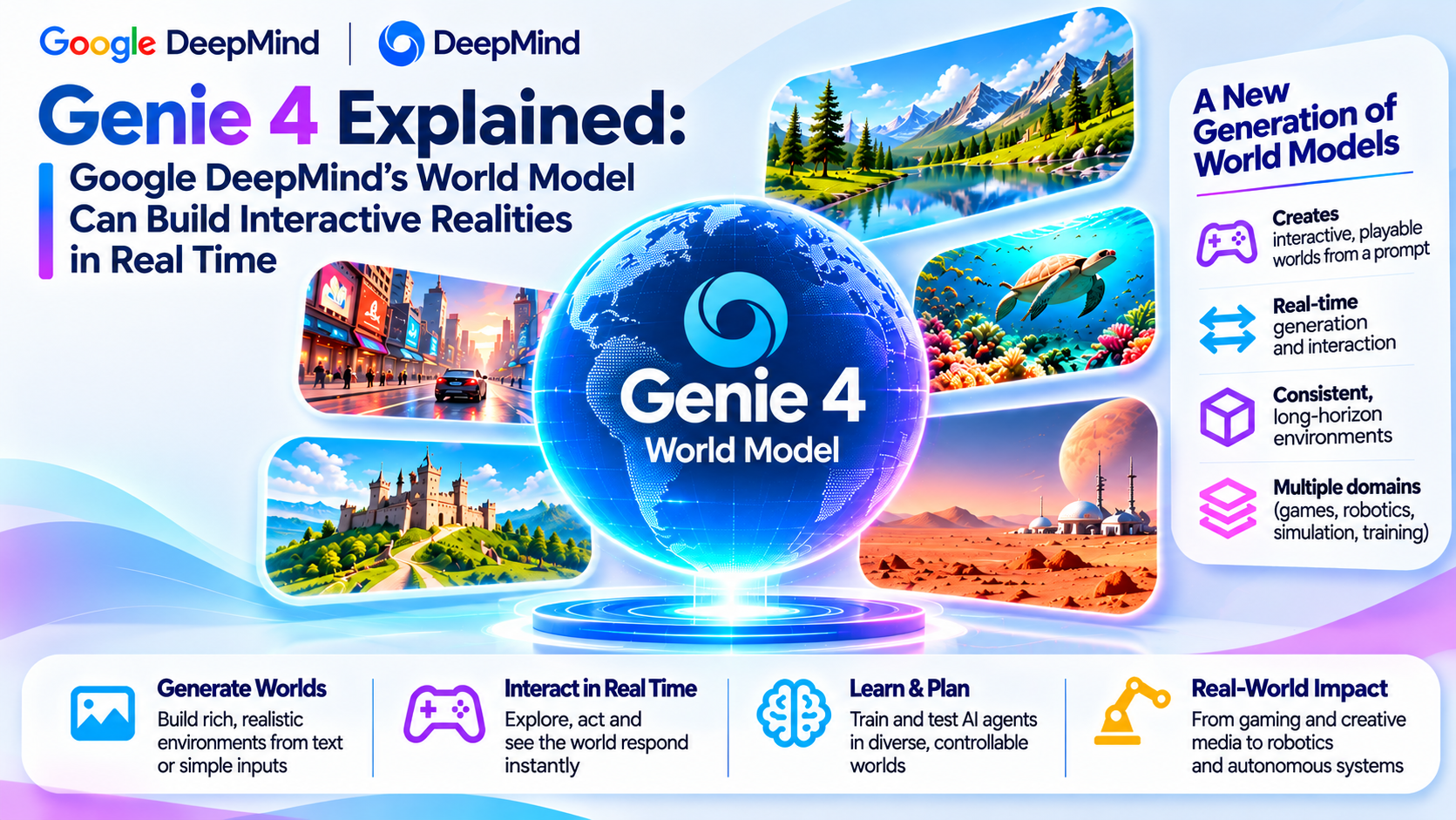
Genie 4 turns a prompt and ongoing controls into a generated scene that can respond as a user moves and changes it. Google DeepMind calls it a research preview. The interesting question is whether an explorable video world can become a dependable tool for game prototypes, agent training and engineering simulations.
Quick Take
- What it does: DeepMind demonstrates real-time interactive scenes with generated visuals, sounds and dialogue, guided by keyboard controls and text.
- Access: Genie 4 is being tested with trusted partners; wider Project Genie and Gemini developer access is planned, not a general launch.
- Opportunity: Rapidly explore creative concepts or generate varied environments for agent research.
- Limit: DeepMind acknowledges object drift, imperfect physics, illegible text and weak consistency as scenarios grow longer.
What is Genie 4, and what is a world model?
Google DeepMind describes Genie 4 as a model that generates an interactive simulation as a person navigates and edits the environment. It produces visual content and accompanying sounds, and it can respond to directions such as moving the camera or changing conditions. This differs from generating a fixed video: the next view depends on what happens in the simulation.
DeepMind says Genie 4 incorporates capabilities from its Gemini models to anchor appearance and support scene coherence. That does not mean it is a traditional game engine calculating exact rigid-body physics. A world model predicts plausible changes in a scene; a high-stakes simulator must prove that those changes match relevant real-world dynamics.
A useful mental picture is a draft environment that unfolds as you explore. It can accelerate a concept review because collaborators can move within a scene and ask for changes. It does not automatically create a shippable game, legally cleared assets or a scientifically validated digital twin.
What does “real time” mean for this preview?
DeepMind shows recordings of interactions controlled by a keyboard and ongoing text prompts. The generated view updates as the camera moves, weather changes or a character is introduced. Audio and dialogue can be produced along with the environment, making the experience more than silent image generation.
The practical measurement is responsive continuity: the scene should react quickly, keep recognizable objects in place and remain consistent after several edits. Ask whether a changed object stays changed when you turn away and return. Repeat a prompt with different routes through the same world to learn where it holds up and where it drifts.
Published demonstrations are chosen examples. For procurement or research, measure frame rate, latency, session duration, failure frequency and resource cost under your own tasks. DeepMind’s material does not establish dependable performance on every real-world simulation.
Where could generated worlds add value?
DeepMind describes early testing across games, creative work, journalism, education and engineering. A game designer could sketch a layout, walk through it and test whether a proposed interaction is intuitive before artists build final assets. A film team could previsualize camera angles and pacing. Both examples are experiments in early ideation, not evidence that production pipelines have already been replaced.
For robotics and agents, varied environments might offer more encounters with obstacles and unusual situations. But a robot trained on synthetic scenes can learn shortcuts that fail in physical settings. Compare performance on withheld real-world tasks and document where the simulation lacks accurate geometry, force, sensing or timing.
For teaching, a controlled interactive scene could help students explore a concept. If the scene depicts history, disasters or engineering systems, a subject expert must distinguish illustrative content from verified fact; plausible generated details are not historical evidence.
What are the model’s known limitations?
DeepMind explicitly describes object permanence and visual consistency as still imperfect, especially in longer sessions and after complex prompt changes. It also flags physics, spatial accuracy, audio, legible text and long-term coherence as open research problems. A character appearing to pick up an object is not proof that collisions, balance and causality are simulated accurately.
Teams should create a failure log: count contradictory object locations, text that changes between frames, implausible interactions and actions the model refuses or misinterprets. A simulator used to train or evaluate an agent needs a stable definition of success. If the world changes the rules mid-test, the resulting score can mislead.
The company says it applies safety rules and SynthID watermarking to generated audio and video. Marking synthetic output can help with provenance, but it does not by itself verify that every generated scene is accurate or that all inputs were used with permission.
How does Genie 4 differ from a video generator or physics engine?
A video model produces a sequence for viewing; an interactive world model reacts to new actions during the sequence. A physics or game engine implements explicit geometry, states and rules designed by developers. Genie 4 emphasizes learned visual and audio continuity plus prompt steering. Each method is useful for a different stage of product development.
A team might use Genie 4 to explore a room design, then implement the chosen layout in a standard engine with repeatable physics. For a safety-critical training simulation, the engineering model and measured environmental parameters would remain the source of truth, while generated worlds could provide ideas for scenarios to test.
Where Genie 4 fits in a simulation workflow
Compare purpose and evidence required before choosing the tool for a project.
| Approach | What it gives you | What still needs verification |
|---|---|---|
| Genie 4 preview | An explorable, generated audiovisual concept responding to controls. | World persistence, spatial accuracy, latency and input rights. |
| Fixed AI video | A pre-rendered sequence useful for communicating an idea. | Whether a viewer can interact with the experience at all. |
| Traditional engine or simulator | Explicit rules, geometry and repeatable test conditions. | Quality of authoring, asset rights and fidelity to the real system. |
Four experiments worth trying
Explore a level and record where visual consistency fails before rebuilding selected ideas in a real engine.
Generate varied environments, then test whether learned policies transfer to controlled physical tasks.
Let a teacher guide a generated scene, while labeling unverified details and checking all factual content.
Review a proposed layout visually, then validate dimensions and physical constraints with established tools.
What about rights, privacy and European use?
An interactive scene can depict a person or resemble copyrighted art. Verify the rights to photographs, audio, characters and other source material before using them as prompts or publishing outputs. Google says Genie 4 includes generated-media watermarking; teams still need consent and editorial review for sensitive scenes.
If a simulation contains personal data, the GDPR principles apply in relevant EU workflows. The EU AI Act assesses intended use and actor responsibilities; a casual game concept differs from a system used to assess people or support regulated decisions. Neither research-preview status nor a watermark proves a deployment is compliant.
MaGeN-AI View
A powerful draft world still needs ground truth
Genie 4 makes interactive prototyping easier to imagine, but its most valuable early use is likely to be rapid exploration followed by verification. The wider story is whether generated environments can become sufficiently controllable and stable for real agent training or engineering, beyond striking demos.
Frequently Asked Questions
What is Genie 4?
Genie 4 is a Google DeepMind world model research preview that generates interactive visual and audio environments as a user navigates or edits a scene.
Can anyone use Genie 4 today?
DeepMind says it has begun a research preview with trusted testers and plans wider access later, including Project Genie and developer partners.
Does Genie 4 simulate exact physics?
No such guarantee is established. DeepMind identifies complex physical interactions and spatial accuracy among continuing research challenges.
How is Genie 4 different from video generation?
A fixed video is watched in sequence. Genie 4 updates a generated scene as a user navigates with controls or changes it through prompts.
Can Genie 4 replace a game engine?
It can help explore concepts, but production games and safety-critical simulations still need predictable mechanics, testable state and validation.