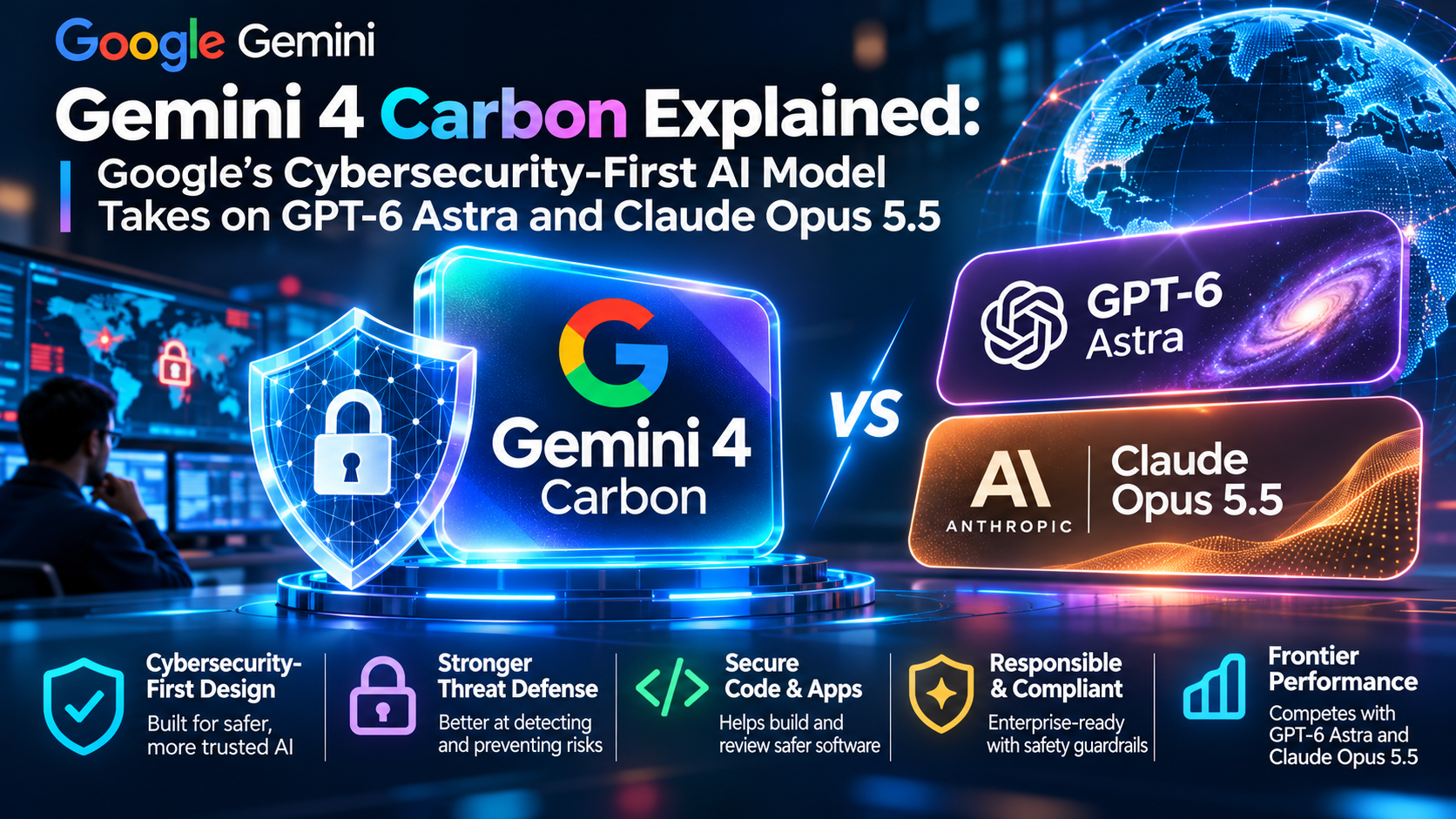
Gemini 4 Carbon puts vulnerability discovery, exploit validation and patching at the centre of Google’s latest frontier-model pitch. Its early rollout is limited to selected cyber defenders. Here is what Google has measured, what a comparison with GPT-6 Astra and Claude Opus 5.5 can actually tell us, and why a security team must still validate every finding.
Quick Take
- What changed: Google announced Carbon on 28 October 2026 with cybersecurity and long-running engineering as prominent targets.
- Who can use it: Google says an initial group of cyber defenders gets access first; broad developer, business and consumer access is still planned.
- What the scores mean: Google reports 88.2% on SEC-bench Pro, 54.8% on ExploitGym and 71.0% on CWE-bench. These are distinct tasks, not a single universal security score.
- How to compare: GPT-6 Astra and Opus 5.5 also target coding and complex work, but separate vendor benchmarks are not a controlled three-model evaluation.
What is Gemini 4 Carbon, and can you access it?
Google’s 28 October announcement calls Carbon its strongest model and highlights cybersecurity defense and long-horizon engineering. Google says selected cyber defenders will receive access first, through a staged programme, while it works on safeguards before expanding availability. A public price announcement is not the same thing as a generally available API.
The model is positioned to help with the cycle of identifying a defect, deciding whether it could be exploited and proposing a repair. These stages have different ground truths: a plausible finding is not necessarily reachable, and a patch that silences a scanner may still break software. Model output should become a hypothesis for reproducible testing, code review and a normal release process.
Google also describes internal agents working for days on multi-step engineering problems. That is a company description of its testing; users should ask for run logs, test coverage, time spent on retries and a record of which actions required human approval before treating it as a production capability.
How do the reported cybersecurity results fit together?
Google reports 88.2% on SEC-bench Pro for vulnerability finding, 54.8% on ExploitGym for exploitability tasks and 71.0% on CWE-bench for patching. Each benchmark probes a different skill under its own evaluation setup. The three percentages should never be added or averaged to predict the chance of fixing a real enterprise issue.
To test a security assistant, take a held-out set of your own permissioned repositories. Require every alert to name the affected code path, reproduce the issue under controlled conditions and show why a proposed change removes the root cause. Track false positives, false negatives, reviewer minutes, regression failures and fixes accepted into the main branch.
A model that produces more findings can create extra triage work. A genuinely useful system helps defenders find the consequential issues sooner without overwhelming them or quietly making high-risk code changes.
Carbon versus Astra and Opus 5.5: what is a fair comparison?
OpenAI describes GPT-6 Astra as capable across cybersecurity, software engineering and computer use. Anthropic presents Claude Opus 5.5 as an agentic coding model with its own tool-use and security assessments. None of those descriptions proves one model wins on your codebase or in the same cost bracket.
Run the same authorized tasks, tools, repository snapshot, review budget and stopping rules across models. Separate vulnerability recall from patch quality and distinguish a complete accepted fix from a report that merely sounds persuasive. Report the distribution of outcomes rather than a single best demo.
If Carbon is not generally accessible to your team, any head-to-head buying recommendation is premature. Mark an internal pilot as an early-access evaluation and revisit it when reproducible access and stable pricing are available.
What safeguards matter when an AI model can investigate exploits?
Cybersecurity capabilities are dual-use. Google says Carbon builds on a stack that includes training safeguards, misuse controls, prompt-injection defenses and monitoring. Its release strategy begins with trusted defenders. These are Google’s described controls, not a guarantee that every malicious request will be stopped.
Defensive deployments should give the agent only approved repositories and test systems. Separate reading from write permissions, restrict network access, log the evidence used to claim a vulnerability and gate exploit reproduction in isolated environments. A patch should pass security review, unit and integration tests, and an owner’s approval before deployment.
Prompt injection is also relevant here: a hostile README or issue comment could try to turn a code-search agent toward a secret or unrelated repository. Treat repository content as data, apply least privilege, and inspect tool calls when a proposed action appears outside the task.
What will a production evaluation cost?
Google lists an introductory $2 per million input tokens and $10 per million output tokens for its planned launch, with a different price after the introductory period. Check actual availability and current terms when procuring the service. Token prices alone omit agent retries, tool execution, sandbox infrastructure and engineers reviewing results.
For each confirmed vulnerability, record model calls, total tokens, analysis time and time saved or added for security reviewers. For each accepted patch, add test execution and production verification. Compare these end-to-end costs with the existing combination of static analysis, dependency scanning and human investigation.
The decision criterion is not a benchmark rank. It is whether defenders close meaningful vulnerabilities faster while preserving evidence, ownership and audit trails.
A fair model-comparison checklist
These are public positioning statements and checks for your own evaluation, not a claim of comparable benchmark scores.
| Model | Public positioning | What your pilot should measure |
|---|---|---|
| Gemini 4 Carbon | Google emphasizes cyber defense, coding and long-running tasks; access starts with selected defenders. | Reproducible findings, patch regression rate and access terms. |
| GPT-6 Astra | OpenAI presents a broadly capable model for cybersecurity, coding and computer use. | Same repository and tool permissions; total cost per accepted fix. |
| Claude Opus 5.5 | Anthropic emphasizes agentic coding, efficiency and model safety. | Review burden, prompt-injection resilience and reliable tool use. |
Four practical uses to pilot
Ask the model to prioritize a queue of suspected flaws; require file references and a reproducible test before escalating.
Request a minimal change with a regression test. A maintainer checks behavior, dependencies and unintended effects.
Use approved logs and code to draft a timeline and potential root cause. Investigators verify each cited event.
Compare model suggestions against existing static-analysis rules and human reviews to discover where it adds unique value.
What about EU data protection and the AI Act?
Security teams may expose personal information, customer secrets and proprietary source code during review. Limit access to approved projects and establish what information reaches a provider. The European Commission’s GDPR guidance explains purpose limitation and data minimization. Secure permissions and retention need to be evaluated for the real workflow.
The Commission’s AI Act guidance connects obligations to the intended use and provider/deployer role. A cybersecurity assistant is not automatically a high-risk AI system because it uses a frontier model. If deployed in another regulated decision workflow, assess that use separately. This original article reproduces no vendor charts or benchmark graphics.
MaGeN-AI View
The hard part is proving a secure fix
Carbon’s security scores make it worth testing when access permits, but the outcome is a verified repair, not a striking percentage. Compare it with Astra and Opus 5.5 on the same authorized repository, record human corrections and demand evidence for every accepted fix.
Frequently Asked Questions
What is Gemini 4 Carbon?
Gemini 4 Carbon is a Google frontier model announced in October 2026 with a strong emphasis on cybersecurity defense, coding and long-running tasks.
Is Gemini 4 Carbon available to everyone?
No. Google describes an initial rollout to selected cyber defenders and plans broader developer, business and consumer availability later.
Did Carbon beat GPT-6 Astra and Claude Opus 5.5?
Google reports strong scores on named security benchmarks, but separate vendor evaluations do not establish a controlled comparison on the same enterprise tasks.
What do the Carbon cybersecurity scores measure?
Google reports separate scores for vulnerability finding on SEC-bench Pro, exploitability tasks on ExploitGym and patching on CWE-bench. They are not a universal security-success rate.
Can Carbon patch vulnerabilities without review?
A production team should independently reproduce a finding, review a proposed patch and run tests and approvals before deploying it.