Deterministic vs. Generative Security: Why Your Firewall Needs Both in 2026
The cybersecurity landscape of 2026 is unrecognizable compared to just a few years ago. We are no longer just fighting human hackers; we are fighting Autonomous Attack Agents that can mutate their code in real-time to bypass traditional defenses.
To survive this era, the "walls" around your business can’t just be high—they have to be smart. This requires a hybrid approach: Deterministic Security paired with Generative Security. Here is why your firewall needs this "dual-engine" setup to protect your data today.
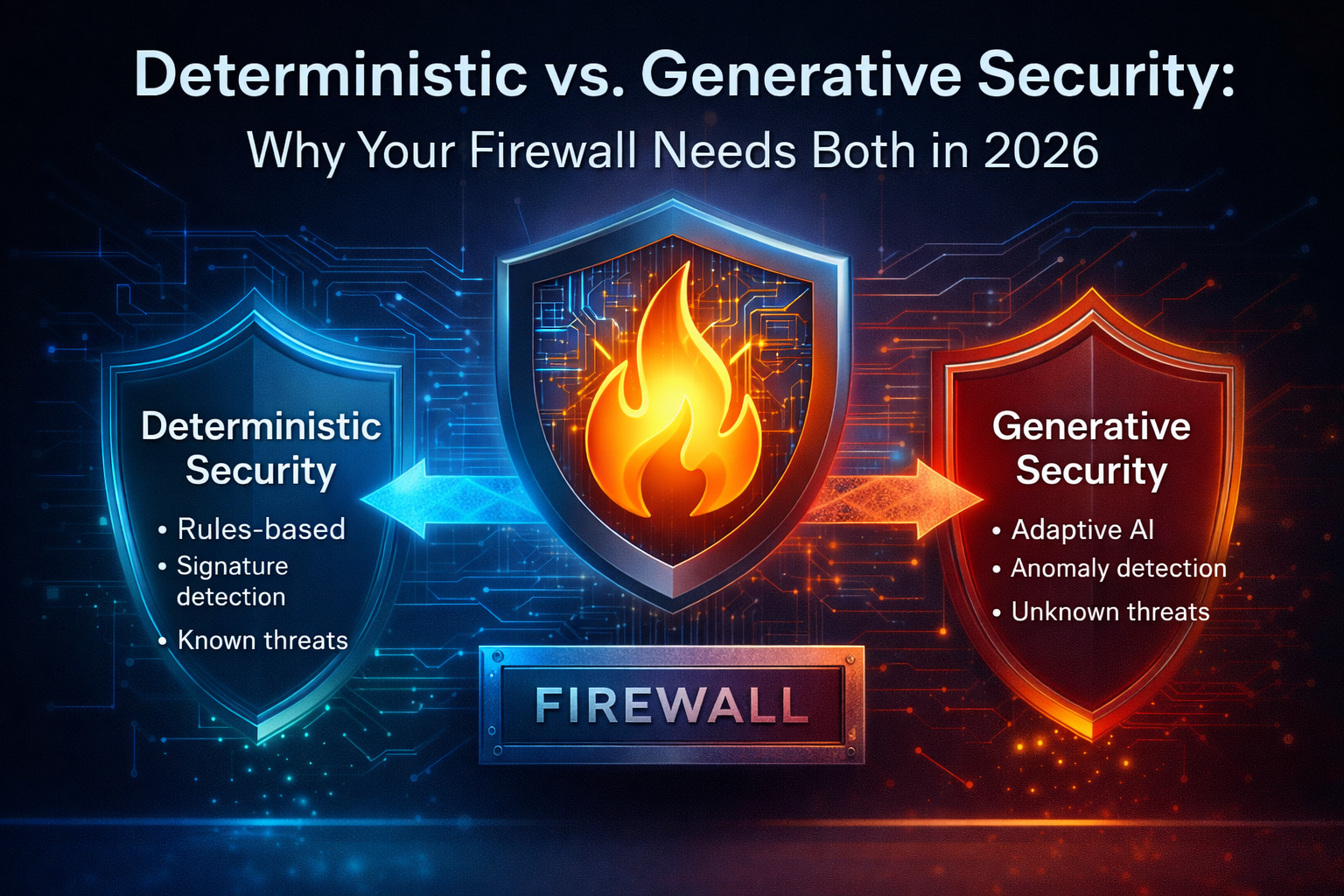
The Old Guard: Deterministic Security
Deterministic security is the traditional foundation of every firewall. It operates on a simple logic: "If X happens, then do Y."
It relies on a set of pre-defined rules, blacklists, and known signatures.
The Strength: It is incredibly fast, reliable, and has zero "hallucinations." If a known malware signature tries to enter, a deterministic firewall slams the door shut instantly.
The Weakness: It is "blind" to anything new. If a hacker creates a brand-new (Zero-Day) exploit that isn't in the database yet, a deterministic firewall will let it walk right through the front door because it doesn't break any existing rules.
The New Frontier: Generative Security
Generative Security (GenSec) uses Large Language Models and neural networks to understand intent rather than just matching patterns.
Instead of looking for a specific "signature," GenSec looks at the behavior of the incoming traffic.
The Strength: It can predict and block attacks that have never been seen before. It understands the "vibe" of a malicious request. If an incoming packet looks like a legitimate login but "feels" like a SQL injection attempt based on its structure, the Generative engine flags it.
The Weakness: It can be computationally expensive and occasionally produces "false positives," blocking legitimate traffic because it looked slightly unusual.
Why 2026 Demands Both
In 2026, relying on just one of these is a recipe for disaster. Here is how they work together in a modern "Hybrid Firewall":
1. Fighting "Polymorphic" Malware
Today’s malware can change its own signature every time it replicates. A deterministic firewall will miss it because the "ID card" keeps changing. A generative engine, however, recognizes the underlying strategy of the malware and kills the process before it can execute.
2. The Speed vs. Intelligence Balance
You can’t run every single packet through a generative AI model—it would slow your internet to a crawl.
The Deterministic Engine acts as the "Bouncer" at the door, quickly filtering out 99% of known threats at lightning speed.
The Generative Engine acts as the "Detective" inside the club, watching the remaining 1% of sophisticated traffic for suspicious behavior.
3. Real-Time Patching
When a new vulnerability is discovered globally, a generative firewall can instantly "generate" a temporary virtual patch for your specific network architecture before the software vendor even releases an official update. It buys your IT team the most valuable commodity in security: Time.
The Bottom Line: Intelligence is the New Perimeter
In 2026, the perimeter of your business is no longer a static line; it’s a living, breathing intelligence.
Deterministic security provides the stability and speed, while Generative security provides the adaptability and foresight. If your firewall is still just a list of "blocked IPs" and "allowed ports," you aren't just behind the curve—you're an open target.
Is your current security stack "Generative-Ready"? The transition doesn't require a total overhaul, but it does require a shift in how we think about "trust" on the network.