European AI Innovation Month 2026: How Can Europe Turn AI Research into Real SME Results?
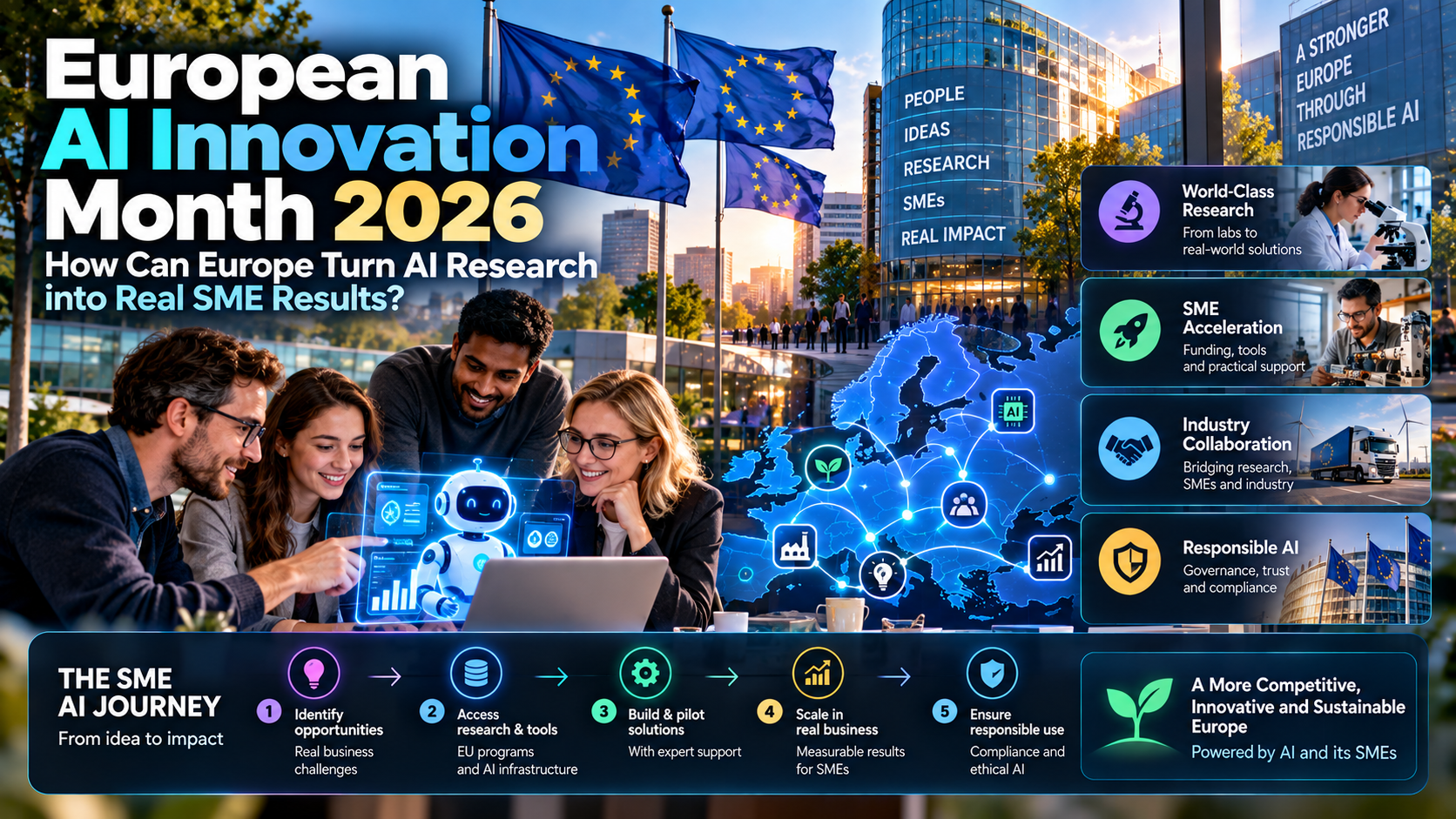
European AI Innovation Month opens in Dublin on October 14 and runs through November 17. Its real test is whether research infrastructure, business support and trustworthy deployment turn into measurable value for smaller companies.
Quick Take
- Confirmed window: the Commission schedules October 14 to November 17, 2026, with an opening summit in Dublin.
- AI in Science follows: a separate October 15 summit addresses scientific discovery and responsible investment.
- Business question: can SMEs actually access skills, usable compute, relevant data and buyers?
- Avoid announcement counting: judge pilots by cost, adoption, safety and outcomes rather than the number of events.
What Is European AI Innovation Month?
The European Commission’s programme schedules a series of online and in-person events from October 14 to November 17, 2026. The International AI Summit in Dublin is set to open the initiative; an AI in Science Summit follows on October 15, while the Apply AI Summit in Brussels and online closes it on November 17. Specific speaker claims and event outcomes are still future information and should be updated after the events.
Europe already has ambitious AI research and regulation. The harder economic question is conversion: can smaller businesses obtain the compute, sector knowledge, personnel and customer confidence needed to build useful systems? A calendar full of events helps only when it leads to accessible services, practical partnerships and repeatable work.
The Adoption Gap for a European SME
A mid-sized manufacturer may want a system that searches maintenance histories and helps technicians diagnose recurring faults. A healthcare supplier may need to triage documentation while maintaining strict clinical boundaries. Both have a narrower and potentially more valuable use case than training a frontier model. Their problems are data preparation, integration, worker trust and procurement.
Many firms also lack a team to evaluate hallucinations, handle privacy contracts or measure model drift. An accessible European ecosystem should offer clear entry points, reusable templates, independent guidance and opportunities to start with limited pilots. Funding or compute credits alone do not deliver a working service if the data and workflow are not ready.
Infrastructure, Data, Skills and Customers
| Requirement | What Europe is discussing | SME question |
|---|---|---|
| Compute | AI factories and shared infrastructure. | How do we apply, what does access cost, and what support comes with it? |
| Data | Sector datasets, sharing and interoperability. | Do we have rights, quality and governance to use the relevant records? |
| Talent | Research-to-industry mobility and practical training. | Who owns evaluation, security and long-term maintenance? |
| Adoption | Sector pilots and public or private customers. | Can we measure a real improvement and find a buyer? |
| Trust | Safety, privacy and transparency by intended use. | Which duties apply to this particular workflow? |
In its April 2026 progress update, the Commission reported 19 AI factories and 13 regional antennas and described funding calls aimed at adoption. Those are Commission-reported infrastructure and programme figures, not evidence that 19 factories have already solved SME access or produced a fixed number of successful products.
Where Applied AI Could Create Measurable Value
Retrieve prior fault histories and propose checks, with a technician responsible for the repair.
Forecast equipment demand and support decisions that operators can inspect and override.
Classify forms or draft routine replies while protecting citizen and customer data.
Move a validated method through engineering, testing, licensing and a viable business model.
Pick a baseline before running any pilot: processing time, error rate, staff effort or customer delay. Measure outcomes on representative cases, including failure and exception handling. An AI demo that works for a conference audience is not yet an enterprise service.
Questions to Ask at the Dublin and Science Summits
Will shared AI infrastructure have a realistic application route for a small firm? Are there advisory services for selecting a model or data strategy? Who pays for integrating a model into existing IT systems? How can a company publish evidence of safety and usefulness without exposing trade secrets?
At the science summit, ask how research outputs are validated and moved into applications. The existence of a model or promising publication does not imply a deployable service. Support for replication, standard evaluation and sector specialists may matter as much as raw computing power. Throughout the month, track which announcements include a named owner, delivery date and measurable adoption target.
A Practical Adoption Plan for MaGeN-AI Readers
Define one workflow with a clear owner and a measurable pain point. Map where data lives and who may use it. Test a small set of representative cases, including difficult and sensitive ones. Compare three approaches: a familiar software improvement, a bounded AI assistant and a more autonomous workflow. Sometimes the simplest tool will win.
Then document model choice, cost, acceptable error, human review and change control. Consult available national innovation support and European programmes only after the use case is concrete. For a Stockholm-based SME, this approach turns a broad European initiative into a sequence of local decisions: who benefits, what evidence is required and who will maintain the result after the pilot funding ends.
EU AI Act, Privacy and Responsible Use
The EU AI Act is not a blanket ban or an automatic high-risk label for every AI pilot. Classify each system by intended use and role; address transparency, human oversight and documentation where applicable. GDPR governs personal-data processing, and sector obligations may add more. Avoid framing access to an AI factory or participation in an EU event as regulatory approval. Give employees and affected users a way to report errors and obtain human help.
For regulatory transparency requirements, consult the European Commission AI transparency guidance. This is general information and should be checked for the particular application before deployment.
MaGeN-AI View
The Takeaway
European AI Innovation Month can be useful if it turns attention into access and adoption. For smaller organizations, the strongest outcome is not another strategy document. It is a validated workflow that saves time, remains accountable and can be maintained after the event. Ask every October speaker for the path from research to a working customer case.
Frequently Asked Questions
When is European AI Innovation Month 2026?
The European Commission lists October 14 through November 17, 2026, with an opening summit in Dublin.
What happens on October 15?
The programme lists an AI in Science Summit focused on scientific discovery, investment and responsible development.
Do AI factories guarantee free compute for every SME?
No. The existence of shared infrastructure does not establish eligibility, pricing or access for a specific company; check each programme.
How should a smaller business begin with AI?
Choose a bounded use case, define a baseline, check data rights, test difficult cases and assign an owner for ongoing review.
Does participation in an EU AI event certify compliance?
No. Compliance depends on the specific AI system, deployment context and applicable laws.