Claude 5 Sonnet: Features, Benchmarks, and Best Use Cases
Anthropic has officially expanded its model lineup with the release of Claude 5 Sonnet. As the mid-tier option in the Claude 5 generation, Sonnet is engineered to sit at the intersection of high performance and operational efficiency. Instead of serving merely as a basic chat companion, this model introduces key architectural updates focused on advanced text coding, complex logic puzzles, multi-lingual data mapping, and direct visual analytics.
This comprehensive overview examines the notable features, early industry benchmarks, and practical applications that define Claude 5 Sonnet’s role in the current enterprise space.
Key Technical Features of Claude 5 Sonnet
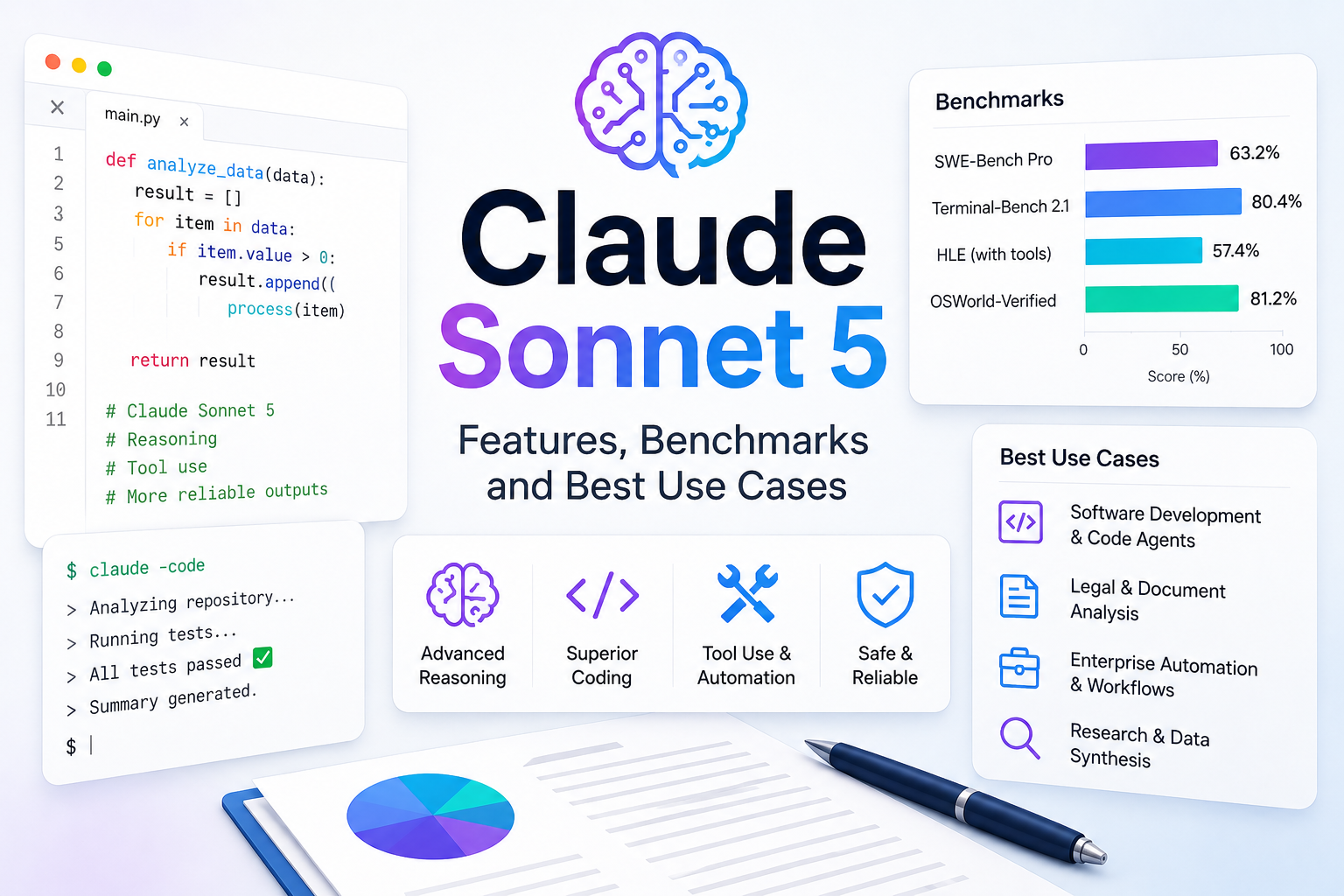
Claude 5 Sonnet introduces significant updates designed to improve deep reasoning without triggering massive increases in inference time or processing costs.
1. Expanded Interactive Visual Context
Sonnet features advanced multimodal vision parsing. While typical vision models struggle with noisy or low-contrast input documents, Claude 5 Sonnet can ingest technical schematics, hand-drawn wireframes, architectural blueprints, and financial ledger dense charts. It maps visual data directly into clean structural text formats, reducing the translation step between physical documentation and software systems.
2. Multi-Stage Code Architecture Integration
Building on Anthropic's established history with programmatic logic, Claude 5 Sonnet features an improved understanding of extensive codebases. Rather than merely writing isolated snippets, it is designed to hold entire application structures in focus, making it easier to identify deep-seated bugs, trace code logic across separate repositories, and map out microservices integrations.
3. Dynamic Artifact Controls
The workspace environment leverages a streamlined structure for running live previews. When users prompt Claude 5 Sonnet to design dashboards, interactive components, documentation frameworks, or data models, the asset is populated in a distinct interactive panel. This allows creators to iterate on design patterns or functionality controls rapidly without disrupting the central conversation.
Best Use Cases for Enterprise and Technical Teams
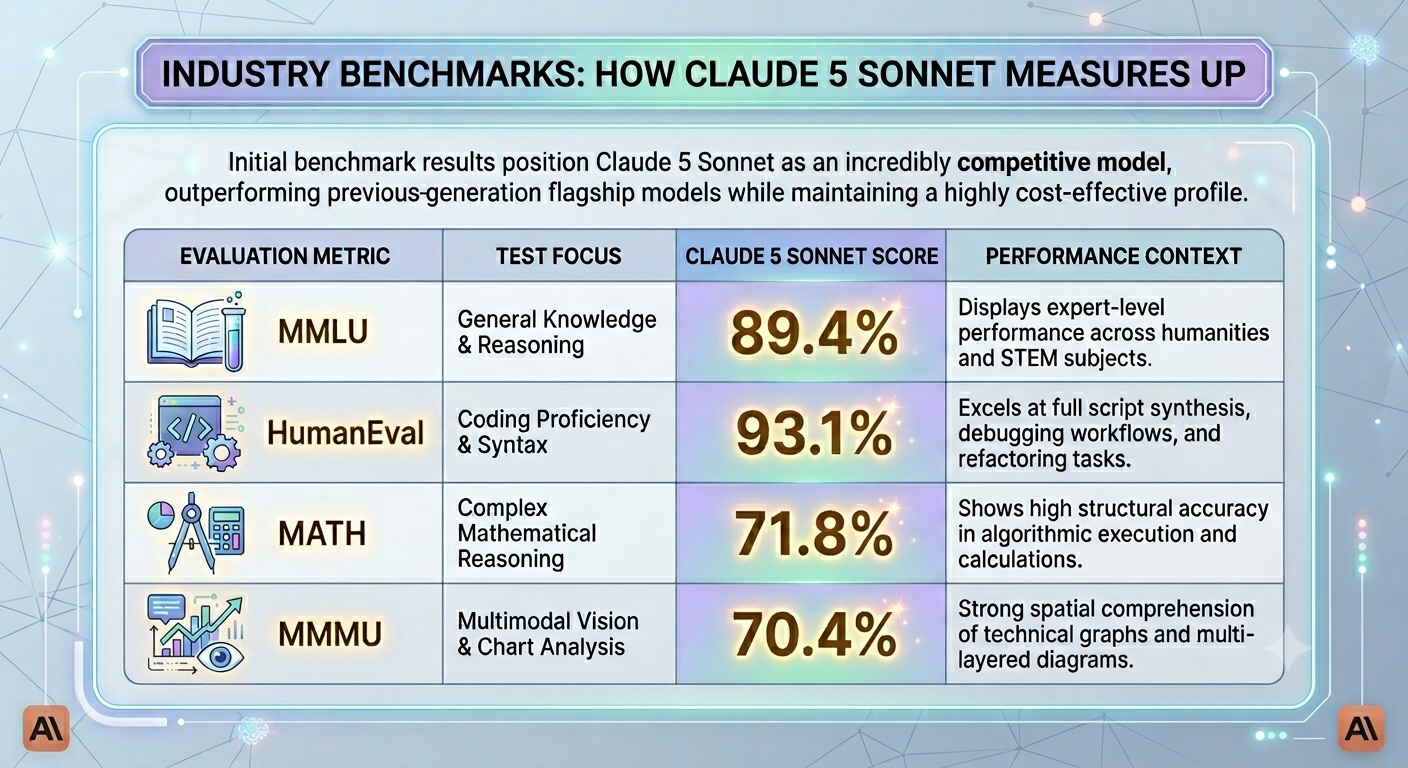
The best applications for Claude 5 Sonnet rely on workflows requiring precision, contextual awareness, and high-quality document or asset outputs.
1.Full-Stack Engineering & Code Refactoring:
Sonnet serves as a powerful pair-programmer for developers. It excels at scanning legacy repositories, translating old scripts into modern framework languages, writing comprehensive unit tests, and designing boilerplate documentation.
2.Data Synthesis & Multimodal Business Auditing:
Operations and financial teams can utilize Sonnet's vision capabilities to ingest complex files—such as supply chain maps, complex billing statements, and quarter-over-quarter financial balances—converting them into clear markdown tables, data arrays, or operational summaries.
3.Prototyping Interactive Layouts & Web Frameworks:
Product managers and UX/UI designers can provide a rough sketch image or an asset requirement sheet, prompting Claude 5 Sonnet to draft fully responsive React, Tailwind, or HTML5 frontend code directly visible within the interactive workspace.
4.High-Fidelity Content Architecture & Editing:
For publishing, technical writing, and localized translation tasks, the model avoids generic text tropes. It maintains strict adherence to tone documentation, structural rules, complex stylistic blueprints, and regulatory copywriting parameters.
Limitations to Consider
While Claude 5 Sonnet introduces distinct processing improvements, businesses should implement structured validation frameworks. The model can still make subtle assumptions when given highly ambiguous logic problems, misinterpret unlabelled axes on poor-quality image scans, or experience normal retrieval errors if relevant documentation parameters are not strictly outlined in the prompt context.
The ultimate operational balance is to trust the model for automated structure and synthesis while relying on human verification for structural approval and deployment tasks.
Frequently Asked Questions
Where does Claude 5 Sonnet sit in the model family?
Claude 5 Sonnet represents the balanced mid-tier model option, sitting alongside a lighter, high-speed model variant and a larger, complex flagship model meant for massive-scale organizational architecture problems.
How does Claude 5 Sonnet handle privacy and enterprise data?
In accordance with standard commercial enterprise terms, data passed through the official Anthropic API or enterprise workspaces is protected under strict security guidelines and is not utilized to train foundation models.
Can Claude 5 Sonnet execute code directly?
Sonnet creates functional code architecture, tests scripts, and builds web components within its visual preview layer, but it does not execute system-level operations or command-line server deployment tasks on its own without integrated developer sandboxes.
Tags
#Claude5Sonnet #ClaudeAI #Anthropic #GenerativeAI #ArtificialIntelligence #AIModels #LLM #AIForCoding #CodingAssistant #EnterpriseAI #AIProductivity #AIInnovation #MachineLearning #SoftwareDevelopment #AIAgents #AIComparison #LegalTech #BusinessAI #AIResearch #FutureOfAI #TechNews #AITrends2026 #DeveloperTools #Claude5 #AI