Amazon Nova 2.5 Sonic vs Gemini Live vs GPT-Live: Who Leads the Voice AI Agent Race?
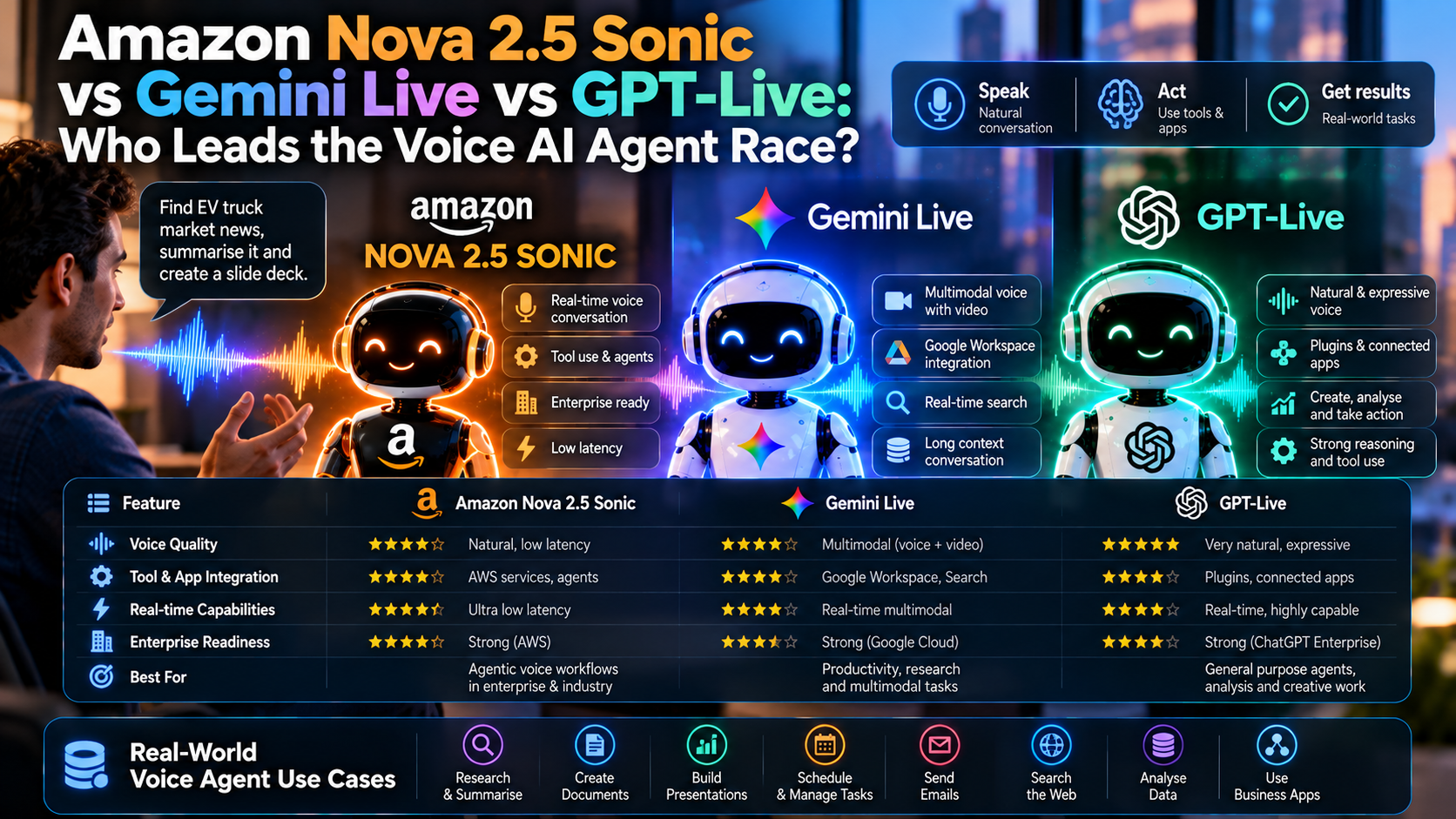
The best voice agent must do more than sound natural. It needs to understand a caller, handle interruptions, use tools correctly and confirm what actually happened. Three recent platforms take different approaches to that job.
Quick Take
- AWS: Nova 2.5 Sonic focuses on speech-to-speech service workflows, asynchronous tools and Bedrock deployment, including Stockholm.
- Google: Gemini 3.8 Live combines voice, live video, multilingual switching and an optional avatar; Extended Thinking is still in private preview.
- OpenAI: GPT-Live-1 provides full-duplex conversation and delegates deeper reasoning and actions to a separate backend agent.
- No universal winner: test your languages, interruptions, tool accuracy, data location and cost per successfully completed task.
What Are These Three Voice AI Products?
AWS’s October 5 announcement describes Nova 2.5 Sonic as an Amazon Bedrock speech-to-speech model for real-time agents. It can follow multi-step spoken instructions, call tools and continue a conversation while external operations run. AWS lists a 256,000-token context window, seven languages for expressive speech and availability in Europe (Stockholm), among other regions.
Google’s Gemini 3.8 Live developer guide describes Gemini 3.8 Live as a bidirectional audio and video model. It can process camera or screen input, switch languages during a session and call tools without ending the conversation. Google’s availability announcement says the base Live model with Live Avatar is generally available, with US and EU endpoints; its separate Extended Thinking version remains in private preview.
OpenAI’s GPT-Live-1 announcement introduces GPT-Live-1 for the API as a full-duplex voice layer: it can listen and speak at the same time, manage pauses and interruptions, and delegate demanding reasoning or actions to another model or agent. “GPT-Live” in this headline refers to that currently documented gpt-live-1 API model, rather than every OpenAI Realtime offering.
Side-by-Side: Where Each Platform Stands Out
| Question | Amazon Nova 2.5 Sonic | Gemini 3.8 Live | OpenAI GPT-Live-1 |
|---|---|---|---|
| Primary fit | AWS-centered voice service and task completion. | Voice plus camera, screen or optional avatar. | Fluid full-duplex dialogue with delegated backend work. |
| Tools | Asynchronous calls; app manages authorization and results. | Non-blocking calls and configurable blocking behavior. | Voice frontend delegates reasoning and tools to backend. |
| Multilingual design | Seven languages for expressive output listed at launch. | Google says 97 languages, with switching within a session. | Multiple voice accents and languages; test required language coverage. |
| Published billing signal | AWS says same pricing as Nova 2 Sonic; check Bedrock rates by modality and region. | Audio input/output billed by tokens; video and text have separate rates. | Voice session $0.05/minute billed per second; backend extra. |
| Deployment signal | Bedrock regions include Stockholm. | US and EU endpoints listed by Google. | Check the API deployment and data-handling options for your account. |
These rows summarize supplier documentation, not independent performance results. Tool accuracy, response time and language quality depend on the actual application, network and caller population.
Who Leads on Conversation and Interruption Handling?
OpenAI has the clearest published full-duplex design among these products: GPT-Live-1 is meant to listen while speaking and leave room for hesitation or interruption. That makes it a plausible starting point for tutoring, phone conversations and other experiences where natural turn-taking is central. OpenAI’s examples and customer results are vendor-reported; a buyer still needs to test noisy rooms, delayed backends and abrupt topic changes.
Google emphasizes a different interaction strength. Gemini 3.8 Live can react to a live camera or screen stream while a person talks. Its guide describes polite interruption scheduling and audio that continues while a tool runs. For troubleshooting equipment or guiding someone through an interface, seeing the same problem the user sees may matter more than a voice demo judged without visual input.
Amazon’s pitch combines controlled turn-taking and asynchronous tool calls with a Bedrock deployment path. In customer service, a useful response may be “I’m checking your order” followed by a verified result. Natural voice helps, but the decisive test is whether the agent makes the right tool call and waits for confirmation before claiming success.
Which One Is Best for a Real Business Workflow?
Imagine a travel-support caller who wants to change a reservation. The agent must recognize the booking reference, check policy and availability, explain any fee, ask for clear approval, submit the change and read back the confirmed result. The database transaction is the source of truth; a friendly spoken promise is not proof that the reservation changed.
When you already use AWS/Bedrock, need a supported region such as Stockholm and want asynchronous voice tools.
When camera or screen understanding, frequent language switching or a visual avatar matters to the service.
When natural full-duplex speech is central and you want to choose the backend reasoning model separately.
Use identical caller goals, languages, tool permissions and success checks before choosing a provider.
These are starting recommendations based on documented product design, not a benchmark ranking. A Swedish service team should test Swedish and English speakers, regional accents and code switching explicitly. AWS lists seven expressive output languages, so do not infer Swedish speech support from the Stockholm hosting region.
Pricing: Why a Per-Minute Winner Is Hard to Declare
The public price units are different. OpenAI’s GPT-Live-1 model page lists $0.05 per minute for the GPT-Live-1 voice session, metered by the second; separate backend models and tools add to that bill. A five-minute conversation therefore has a $0.25 voice-layer charge before backend use. Google’s Agent Platform prices list Gemini 3.8 Live at $3 per million input-audio tokens and $12 per million output-audio tokens for the listed non-global tier, with separate text and video rates. AWS says Nova 2.5 Sonic retains Nova 2 Sonic pricing; check the selected Bedrock region and modalities for a current quote.
Comparing those figures alone would be misleading. Include microphone time, generated speech, backend reasoning, tool calls, telephony, idle sessions, retries and human transfers. Track cost per resolved call and cost per accurate action. A cheaper voice minute can become more expensive if it increases handoffs or repeats a failed transaction.
A Fair Evaluation: Five Tests That Matter
| Test | What to measure | Failure to watch for |
|---|---|---|
| Interruptions | Time to stop, resume and retain the requested action. | A new request cancels a tool response without telling the caller. |
| Tool accuracy | Correct API, arguments, authorization and result confirmation. | Agent claims a booking changed when the backend rejected it. |
| Language and noise | Accuracy by language, accent, environment and code switching. | Names, serial numbers or safety details are transcribed incorrectly. |
| Latency | Median and 95th-percentile time to meaningful speech and completed task. | Speech sounds fast but the actual workflow stalls. |
| Governance and cost | Retention, region, incident logs and full cost per resolved request. | Voice recordings or personal details outlive their purpose. |
Use a representative set of consented test calls with the same prompts and permitted tools. Record both what callers heard and what target systems actually did. Include long silences, corrections, weak connections, consent withdrawal and a human handoff. A vendor benchmark on model speech quality cannot replace those operational checks.
EU AI Act, Privacy and Responsible Deployment
For European deployments, tell people when they are interacting directly with an AI voice agent where the AI Act requires it; the European Commission AI Act transparency guidance explains relevant Article 50 transparency duties. A generated voice or avatar can sound or look human, so clear disclosure is especially important. Extra labeling or marking obligations for synthetic content depend on the provider and deployer roles and what content is published.
Voice calls can contain names, account numbers, health details and other personal information. The European Commission GDPR principles call for a lawful purpose, data minimization, proportionate retention and appropriate security. Check recording practices, access to transcripts, cloud region, vendor terms and deletion behavior separately for each product. If the agent affects credit, employment, insurance or health outcomes, review the complete use case for further legal and sector duties before allowing it to decide or act.
Do not clone an identifiable person’s voice without appropriate rights and authorization. Keep callers able to reach a person and make the system disclose uncertainty rather than invent a policy or transaction result. The model’s safety settings do not replace application-enforced tool permissions.
Who Leads the Voice AI Agent Race in October 2026?
There is no defensible overall champion yet. Amazon currently offers an appealing Bedrock route for service teams that need supported regions and asynchronous tools. Google offers the broadest documented visual interaction in this comparison, with voice, live video and avatars. OpenAI gives builders a clearly separated conversational frontend and backend agent, which is compelling when interruption handling and independent model choice matter.
The leader for your product is the one that can understand your users, complete the authorized task and prove it did so, at an acceptable total cost. Select a small pilot, measure the five tests above and revisit the decision as models, regions and prices change.
MaGeN-AI View
The Takeaway
The voice race is moving from “which assistant sounds most human?” to “which system can finish a spoken task safely and verifiably?” An excellent voice interface cannot compensate for wrong permissions or unconfirmed backend actions. Judge the whole service, including the handoff to a human.
Frequently Asked Questions
What is Amazon Nova 2.5 Sonic?
It is Amazon’s speech-to-speech model for real-time voice agents on Bedrock, generally available since October 5, 2026.
What is the difference between Gemini Live and GPT-Live-1?
Gemini 3.8 Live supports live audio and visual input, with optional avatar output. GPT-Live-1 focuses on full-duplex voice and can delegate reasoning and tools to a backend agent.
Which voice AI model is best for customer service?
Choose by language coverage, tool accuracy, data location, latency and cost per correctly resolved call; none has been proven the universal winner.
Does GPT-Live-1 cost only $0.05 per minute?
That is the voice-session rate. Backend models and tools are billed separately.
Can Nova 2.5 Sonic be used in Sweden?
AWS lists Europe (Stockholm) as a Bedrock region for Nova 2.5 Sonic. Verify supported speech languages and your account configuration separately.