AI PCs and Local Agents: The Return of On-Device Intelligence
For the past few years, artificial intelligence has mostly felt like something that lives far away. You type a prompt, your request travels to a cloud server, a large model processes it, and the answer comes back through your browser or app.
That model changed how we write, search, code, summarize, design, and work. But it also created a new set of questions: What happens when the internet is slow? What data leaves the device? How much does every AI request cost? And why should every small task need a round trip to the cloud?
The next shift in personal computing is not about replacing cloud AI. It is about balancing it. AI PCs and local agents are bringing intelligence back onto the device, creating a hybrid future where some AI runs locally, some runs in the cloud, and the user gets the best of both worlds.
Microsoft describes Copilot+ PCs as Windows devices with high-performance neural processing units, or NPUs, capable of more than 40 trillion operations per second. These chips are designed specifically for AI-heavy tasks such as real-time translation, image generation, and other local AI experiences. Apple has taken a similar hybrid direction with Apple Intelligence, describing a system that can move between on-device processing and Private Cloud Compute for larger tasks.
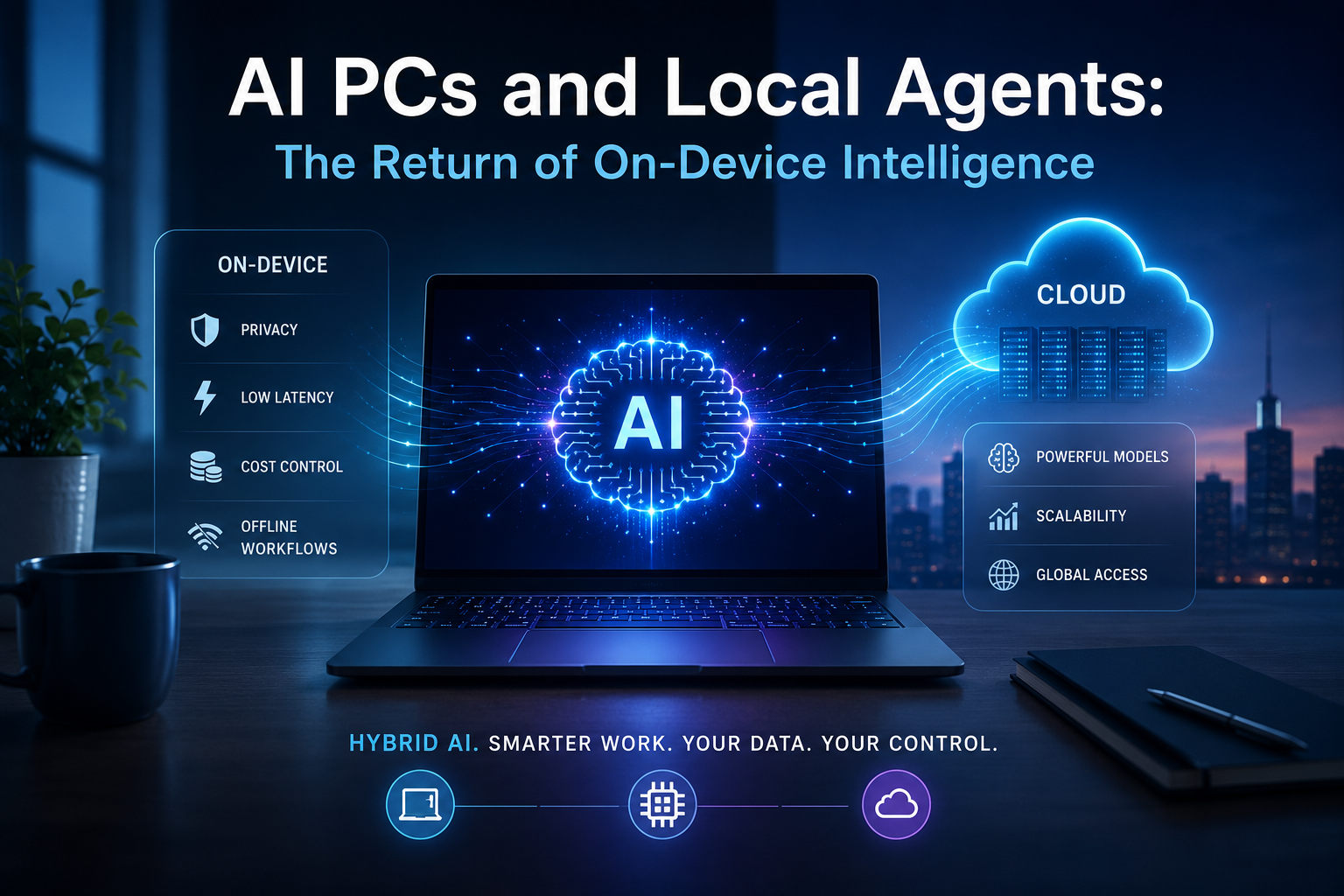
From Cloud-First AI to Hybrid AI
The cloud made modern AI accessible. Without cloud infrastructure, most people would never have been able to use large language models, image generators, voice tools, or advanced coding assistants. Cloud AI gave users access to massive models without needing expensive hardware.
But cloud-first AI has limits.
Every request depends on connectivity. Every interaction may involve sending data away from the device. Every query has a cost for the service provider. And every response must travel across a network, which can add delay.
Hybrid AI changes the pattern. Instead of sending everything to the cloud, the device handles what it can locally. The cloud is still available for large, complex, or highly specialized tasks, but everyday work can happen directly on the PC, phone, or workstation.
This is the return of on-device intelligence.
What Makes an AI PC Different?
A traditional PC is built around the CPU and GPU. The CPU handles general computing. The GPU handles graphics and parallel workloads. An AI PC adds another important piece: the NPU.
An NPU is built to run AI models efficiently. It is especially useful for tasks that need to happen often, quietly, or in real time. Microsoft says NPUs can process large amounts of data in parallel and are more efficient for AI tasks than CPUs or GPUs.
That matters because local AI is not just about raw power. It is about power efficiency, battery life, speed, and privacy. A laptop that can run AI features without constantly waking up the CPU, draining the battery, or sending data to a server becomes more useful in everyday work.
The Rise of Local Agents
The next step is the local agent.
A local agent is an AI assistant that can understand your files, apps, preferences, and workflows while running mainly on your own device. Instead of being a generic chatbot in a browser, it becomes a practical helper inside your computer.
A local agent might help you:
Rewrite a document without uploading it.
Search your local files using natural language.
Summarize meeting notes stored on your device.
Organize screenshots, PDFs, and project folders.
Draft emails based on local context.
Automate repetitive desktop tasks.
Work offline while traveling.
Protect sensitive business or personal data.
This is different from asking a cloud chatbot a general question. A local agent can be closer to your actual work because it can operate where your work already lives: on your device.
Why Local AI Matters
The shift to on-device intelligence is happening for four major reasons.
1. Privacy
Many AI tasks involve personal or sensitive information: emails, contracts, medical notes, financial files, internal company documents, code, customer data, or private messages.
When AI runs locally, more of that data can stay on the device. This does not solve every privacy issue, but it reduces the need to send raw information to external servers for routine tasks.
For businesses, this is especially important. Companies want AI productivity, but they also need control over confidential data. Local models can help organizations use AI in environments where cloud-only processing is too risky or too restricted.
2. Latency
Cloud AI can be fast, but it still depends on a network. Local AI can respond immediately because the model is already on the device.
That is valuable for real-time use cases: live captions, voice commands, camera effects, search, translation, note cleanup, and interface assistance. The less waiting involved, the more natural AI feels.
The best AI experiences often do not feel like “using AI” at all. They simply make the computer respond faster and smarter.
3. Cost Control
Cloud AI is expensive to operate. Every prompt, image, summary, and response consumes computing resources somewhere. At scale, those costs matter.
Local AI can reduce the number of cloud requests by handling smaller tasks on the device. A business may still use cloud models for heavy analysis, advanced reasoning, or large-scale generation, but local models can take care of routine work.
This creates a more sustainable AI model: use the device for common tasks and reserve the cloud for moments when bigger intelligence is truly needed.
4. Offline Workflows
Cloud AI is powerful until the connection disappears.
Local AI makes AI useful on airplanes, trains, remote job sites, secure facilities, and areas with unreliable internet. A local agent that can summarize documents, search files, draft text, translate content, or organize work without a connection becomes a real productivity tool instead of just another online service.
Offline capability is not only convenient. For some industries, it is essential.
The Cloud Is Not Going Away
The return of on-device intelligence does not mean the end of cloud AI.
Large cloud models will still matter. They are better suited for complex reasoning, huge context windows, advanced multimodal work, large-scale research, and tasks that require the latest model updates. Cloud platforms also make it easier to deploy AI across teams, integrate business systems, and access specialized tools.
The future is not local versus cloud. It is local plus cloud.
Simple, personal, private, and time-sensitive tasks can happen on the device. Bigger, heavier, or less sensitive tasks can move to the cloud. The user should not need to think about the split. The system should choose the best place to run the task.
That is the real promise of hybrid AI.
What This Means for Businesses
For businesses, AI PCs and local agents could change how employees work.
Instead of relying only on web-based AI tools, organizations can build AI into the endpoint itself. Employees may get assistants that understand local documents, company-approved workflows, and security rules. IT teams may gain more control over where data is processed. Developers may create smaller models and agents designed for specific departments, roles, or tasks.
The biggest opportunity is not replacing workers with AI. It is reducing the friction inside daily work.
Think of the repetitive tasks that slow people down: searching for old files, summarizing long documents, formatting reports, preparing meeting notes, responding to routine messages, extracting information from PDFs, or switching between apps to complete simple workflows.
A local agent can help with these tasks without forcing every action through a remote service.
What This Means for Users
For everyday users, AI PCs may make computers feel more personal again.
The PC has always been the place where people keep their work, memories, projects, and tools. Local AI gives the device a better way to understand that context.
You may not need to remember the exact file name. You may be able to ask, “Find the presentation I made about the product launch last spring.” You may not need to manually clean up a messy folder. You may ask the agent to group files by project. You may not need to copy text into a chatbot. You may highlight something and ask your PC to explain, rewrite, translate, or summarize it instantly.
This is where AI becomes less like a separate app and more like part of the operating system.
The Challenges Ahead
Local AI still has limitations.
Small local models are usually less capable than the largest cloud models. Devices need enough memory, storage, and AI hardware to run good experiences smoothly. Battery life must be protected. Security must be strong. Users need clear controls over what the agent can see and do.
There is also a trust issue. If an AI agent can access files, summarize private content, or take actions across apps, users need transparency. They should know when AI is running locally, when data is sent to the cloud, and what permissions the agent has.
The companies that win this shift will not be the ones that simply add “AI” to a laptop box. They will be the ones that make local intelligence useful, safe, fast, and easy to control.
The New Personal Computer
The personal computer is becoming personal again.
For a while, the center of intelligence moved away from the device and into the cloud. Now it is coming back, not as a replacement for the cloud, but as a partner to it.
AI PCs and local agents point toward a future where your device can understand more, respond faster, protect more of your data, and continue working even when the internet is not available.
The cloud gave AI scale. On-device intelligence gives AI presence.
The next generation of computing will be defined by both.
Tags
#AI #AIPCs #OnDeviceAI #LocalAI #EdgeAI #AIAgents #DeviceIntelligence #AIHardware #PersonalAI #GenerativeAI #EdgeComputing #PrivacyFirstAI #IntelligentComputing #AIInnovation #FutureOfComputing #DigitalTransformation #AgenticAI