Zero-Trust for LLMs: A Blueprint for Modern AI Security Architecture
Introduction: Why Traditional Security Fails for AI
Large Language Models (LLMs) are rapidly becoming core enterprise infrastructure—embedded in search, customer support, analytics, software development, and decision-making workflows. Yet most organizations are attempting to secure them using legacy security assumptions designed for static systems.
That approach no longer works.
LLMs are:
Dynamic and probabilistic
Data-hungry and context-aware
Often connected to tools, APIs, and agents
Capable of autonomous or semi-autonomous action
In this environment, implicit trust is the enemy.
What enterprises need is a Zero-Trust architecture purpose-built for LLMs.
What Zero-Trust Means in the Age of LLMs
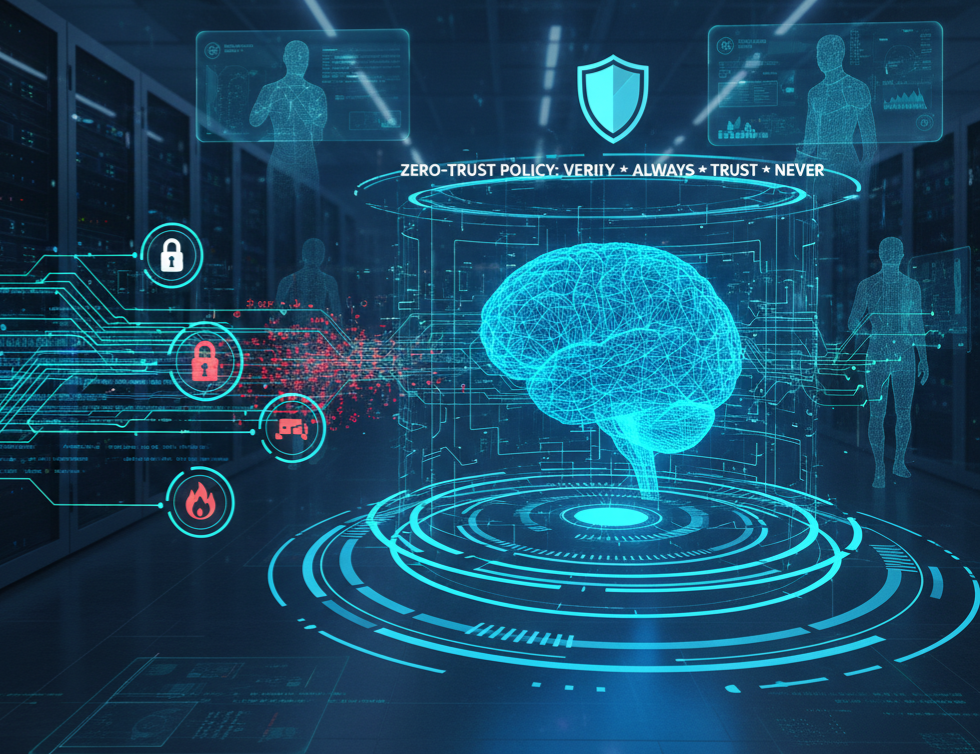
Traditional Zero-Trust is built on a simple principle:
Never trust, always verify.
For LLMs, this principle must be extended beyond users and networks to include:
Prompts
Data sources
Model behavior
Tool access
Outputs
Zero-Trust for LLMs assumes that every interaction is potentially hostile—by default.
Why LLMs Create a New Security Attack Surface
1. Prompts Are a New Input Vector
Prompts can:
Exfiltrate sensitive data
Override system instructions (prompt injection)
Trigger unsafe or unauthorized actions
In Zero-Trust terms, every prompt is untrusted input.
2. LLM Outputs Are Not Deterministic
LLMs can:
Hallucinate facts
Generate unsafe recommendations
Produce biased or non-compliant content
Trusting raw outputs without validation creates operational risk.
3. Tool-Enabled LLMs Can Act, Not Just Respond
Modern LLMs can:
Call APIs
Execute workflows
Modify databases
Send messages or trigger transactions
This turns LLMs into execution engines, not just interfaces.
4. Data Context Is Fluid and Difficult to Control
LLMs often access:
Internal documents
Customer data
Knowledge bases
External tools
Without strict controls, data boundaries dissolve.
Core Principles of Zero-Trust for LLMs
A Zero-Trust LLM architecture rests on five foundational principles.
1. Never Trust Prompts by Default
Blueprint Controls:
Prompt validation and sanitization
Injection detection (system prompt override attempts)
Input classification (PII, IP, regulated data)
Context isolation per session
Rule:
Every prompt must be inspected before it reaches the model.
2. Least-Privilege Model Access
LLMs should not have unrestricted access to data or tools.
Blueprint Controls:
Role-based model access
Scoped context windows
Task-specific models (not one model for everything)
Just-in-time permissions for tools
Rule:
An LLM should only see what it absolutely needs—nothing more.
3. Zero-Trust for Tools and Agents
When LLMs are connected to tools, the risk escalates.
Blueprint Controls:
Explicit allow-lists for tool calls
Human-in-the-loop for high-impact actions
Rate limiting and execution boundaries
Full audit logs of agent decisions
Rule:
LLMs may suggest actions—but must earn the right to execute them.
4. Assume Outputs Are Unreliable Until Verified
LLM outputs must be treated as claims, not facts.
Blueprint Controls:
Output validation layers
Policy and compliance filters
Grounding against trusted data sources
Confidence scoring and uncertainty flags
Rule:
No LLM output should reach users or systems without validation.
5. Continuous Monitoring and Auditability
Zero-Trust is not static.
Blueprint Controls:
Full prompt and response logging
Anomaly detection in model behavior
Drift detection (model or data changes)
Incident response workflows for AI failures
Rule:
If you cannot observe it, you cannot secure it.
Reference Architecture: Zero-Trust LLM Stack
A modern Zero-Trust LLM architecture typically includes:
User / Application Layer
AI Gateway (Security Control Plane)
Prompt inspection
Data redaction
Policy enforcement
LLM Layer (Private / Hosted / Hybrid)
Tool & Agent Layer (Scoped Execution)
Monitoring, Logging & Governance Layer
The AI Gateway becomes the equivalent of a firewall for LLMs.
Common Mistakes Enterprises Make
❌ Treating LLMs as Just Another API
LLMs are decision systems, not static services.
❌ Relying on Vendor Promises Alone
Model providers do not replace internal governance.
❌ Blocking AI Instead of Securing It
Bans drive Shadow AI and increase risk.
❌ Ignoring Model Behavior Drift
An LLM that was safe yesterday may not be safe tomorrow.
Zero-Trust Enables AI Adoption—Not Slows It Down
Contrary to common belief, Zero-Trust does not reduce AI velocity.
It enables safe scale.
Organizations with Zero-Trust LLM architectures:
Deploy AI faster
Reduce compliance risk
Enable autonomous workflows responsibly
Build trust with customers and regulators
Security becomes a business accelerator, not a bottleneck.
The Future: From Zero-Trust to Zero-Assumption AI
As LLMs evolve into:
Autonomous agents
Multi-model systems
Long-running decision loops
Security must move from trust-based to assumption-free design.
Zero-Trust for LLMs is not optional—it is the baseline for modern AI architecture.
Final thoughts
LLMs are not just tools—they are actors inside your systems.
Treating them with implicit trust is the fastest way to introduce invisible risk.
A Zero-Trust approach gives enterprises a clear path forward:
Enable AI
Control risk
Maintain compliance
Scale responsibly
The organizations that master Zero-Trust for LLMs will define the next generation of secure, AI-native enterprises.