What Happens When Every Company Has an AI Co-Worker?
By January 2026, the term "digital transformation" has been officially retired in favor of a new reality: the Agentic Workforce. We have moved past the era of "AI as a tool" (like a calculator) and into the era of "AI as a colleague" (like a teammate).
In 2026, an "AI Co-worker" isn't just a chatbot you ask for help; it is a persistent digital entity with its own corporate identity, access permissions, and a seat at the virtual table. Here is how this shift is fundamentally rewiring the way we work.
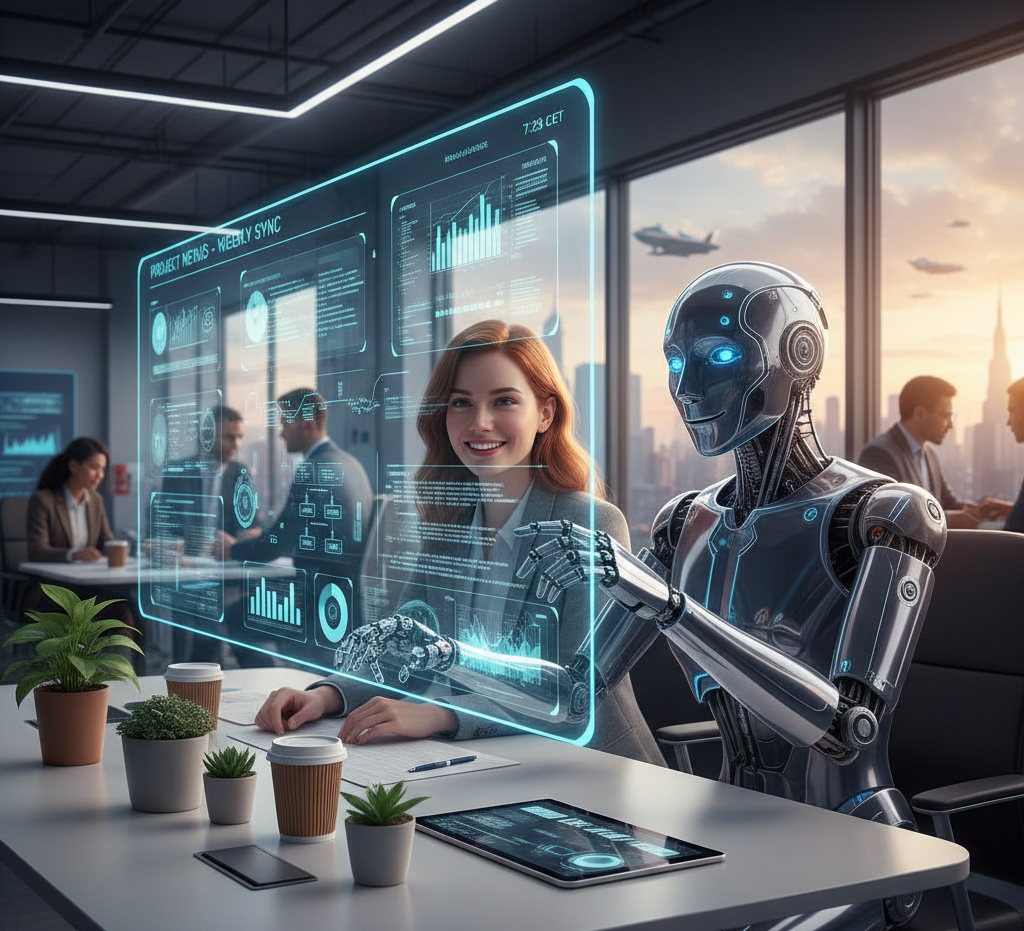
1. From "Prompting" to "Delegating"
In 2024, we spent our days "prompting" AI to write emails or summarize meetings. In 2026, we delegate outcomes.
Instead of saying "Draft an email to the client," a manager tells their AI agent: "Project X is falling behind. Coordinate with the logistics team’s agent, find a new delivery window, and update the client once the solution is confirmed." * The Shift: The AI doesn't just suggest text; it executes across systems. It logs into the CRM, checks the ERP, sends the Slack message, and reports back when the task is done, not just drafted.
Impact: The "busywork" of coordination—the meetings about meetings—is being absorbed by these agents, leaving humans to focus on high-stakes negotiation and creative strategy.
2. The Rise of "Agentic Identity" and Governance
In 2026, HR departments aren't just managing people; they are managing Digital Employee Records.
Because these AI co-workers can take actions (like moving funds or signing off on supply orders), companies have had to implement strict Agent Identity Management. Every agent has a unique "ID" and is bound by the same security protocols as a human.
"In 2026, you don't just 'turn on' AI. You onboard it. You give it a scope of authority, a budget limit, and a human 'supervisor' who is legally responsible for its actions."
3. The "Manager-to-Orchestrator" Evolution
The most profound change is felt by middle management. In 2026, a manager’s "team" is likely a hybrid mix of four humans and twelve specialized AI agents.
The New Skillset: Success is no longer about managing tasks; it’s about Orchestration. Managers must ensure that the AI agents (which are 100x faster) don't create bottlenecks for the humans (who provide the necessary "gut check" and emotional intelligence).
The "Junior Gap": With AI agents handling 90% of entry-level research and data entry, companies are rethinking how they train the next generation of leaders. The "learning-by-doing" grunt work is gone, replaced by "learning-by-auditing" AI outputs.
4. 24/7 Operations Without the Burnout
The global economy of 2026 never sleeps, but its humans finally can. AI co-workers operate in "Shadow Shifts."
While the human team in London is asleep, their digital twins are triaging global support tickets, running code tests, and prepping the morning's briefing notes. Humans arrive at 9:00 AM to a pre-processed day, where the most important decisions are already surfaced and the "low-level noise" has been handled overnight.
The Big Challenge: Maintaining the "Human Core"
As AI agents become indistinguishable from the background hum of the office, the biggest risk in 2026 is the erosion of social capital. If an agent can handle the "check-in" email, do we stop talking to our colleagues?
The most successful companies this year are those that use the time saved by AI to double down on radical humanity—prioritizing in-person offsites, deep-thinking sessions, and mentorship programs that a machine simply cannot replicate.
Summary: The 2026 Hybrid Workforce
Role of AI: Persistence, execution, and 24/7 data orchestration.
Role of Human: Judgment, ethics, empathy, and final accountability.
The Result: A 30–50% increase in operational velocity for companies that successfully bridge the two.