"Vibe-Coding" Democratizes Software Development: A New Era of Accessibility
The world of software development has long been perceived as an exclusive club, requiring years of specialized training and a deep understanding of complex syntax. However, a revolutionary new approach, dubbed "Vibe-Coding," is rapidly changing this narrative, promising to democratize software development and open its doors to a much broader audience.
What is "Vibe-Coding"?
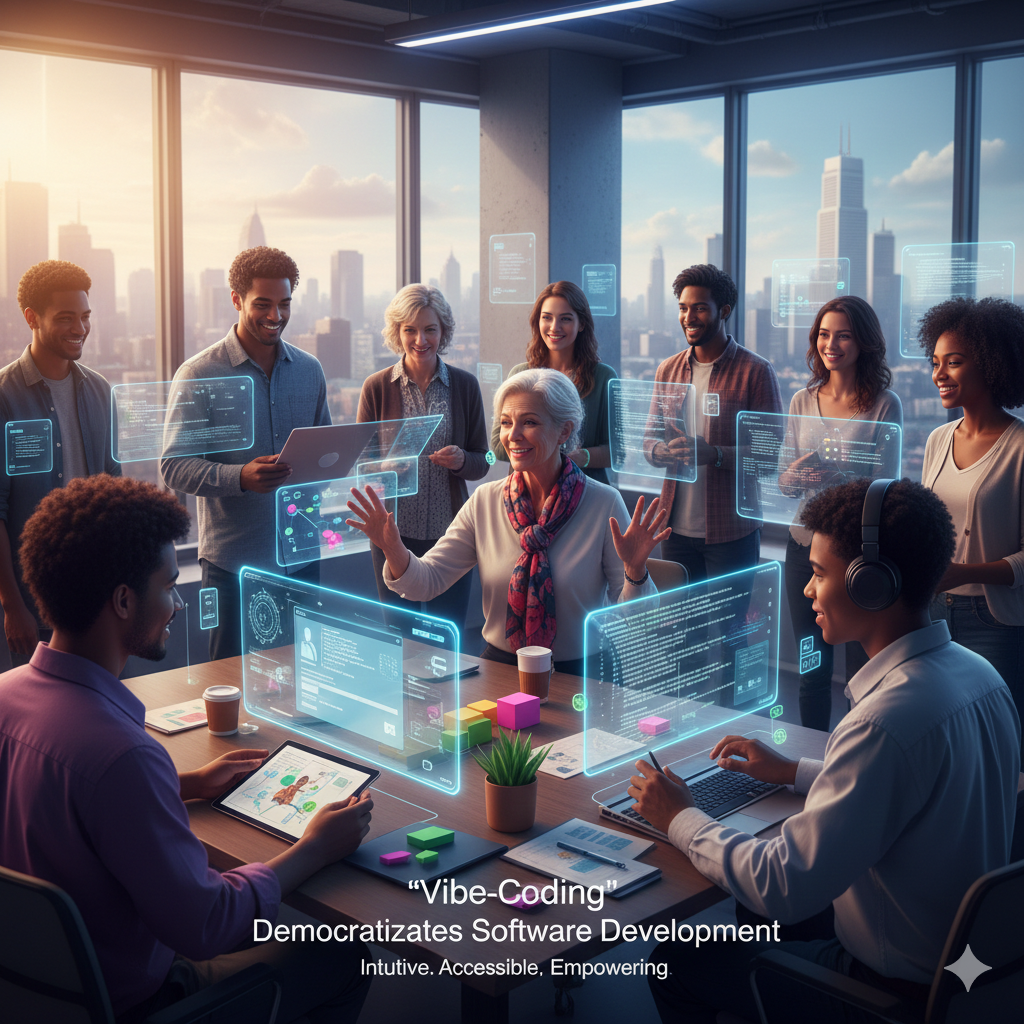
At its core, Vibe-Coding refers to an intuitive, often visual or natural language-based method of creating software that significantly lowers the barrier to entry. Instead of painstakingly writing lines of code, developers (or "vibe-coders") leverage tools and platforms that allow them to express their intentions through:
Natural Language Prompts: Imagine simply telling an AI what you want your software to do in plain English, and watching it generate the underlying code.
Visual Programming Interfaces (VPIs): Drag-and-drop elements, connect nodes, and configure workflows graphically, abstracting away the complex code.
Intent-Based Development: Focusing on the desired outcome or "vibe" of the software, rather than the intricate technical steps to achieve it.
Low-Code/No-Code Platforms on Steroids: While low-code/no-code platforms laid the groundwork, Vibe-Coding takes it further by integrating advanced AI and intuitive interfaces that understand context and intent, not just predefined actions.
How Does "Vibe-Coding" Democratize Development?
The implications of Vibe-Coding are profound, as it addresses several key challenges that have historically limited access to software creation:
Eliminates Coding Language Barriers: The need to master specific programming languages like Python, JavaScript, or Java becomes less critical. Individuals can articulate their ideas in a way that is natural to them.
Reduces Learning Curve: Traditional coding requires a steep learning curve. Vibe-Coding significantly flattens this, allowing non-technical individuals to build functional applications in a fraction of the time.
Empowers Domain Experts: Business analysts, marketers, designers, and other domain experts can now directly build tools and solutions tailored to their specific needs without relying on a development team. This speeds up innovation and ensures solutions truly fit the problem.
Fosters Rapid Prototyping and Innovation: Ideas can be quickly transformed into working prototypes, tested, and iterated upon with unprecedented speed. This agile approach accelerates innovation cycles.
Boosts Digital Literacy and Inclusion: As more people gain the ability to create software, digital literacy expands, fostering a more inclusive technological landscape.
The Impact on the Software Industry
While some might fear that Vibe-Coding diminishes the role of traditional developers, it's more likely to evolve it. Professional developers will likely shift towards:
Building the Vibe-Coding Tools: Creating the sophisticated AI and platforms that enable intuitive development.
Handling Complex Integrations: Managing the intricate backend systems and integrations that Vibe-Coded applications rely on.
Optimizing Performance and Scalability: Ensuring that Vibe-Coded solutions are robust, secure, and performant at scale.
Architecting Enterprise-Level Solutions: Designing overarching software architectures that leverage both traditional and Vibe-Coded components.
The Future is Intuitive
"Vibe-Coding" is not just a trend; it represents a fundamental shift in how software is conceived and built. By making development more intuitive and accessible, it promises to unleash a wave of creativity and innovation from individuals and teams who previously lacked the technical expertise. We are entering an exciting era where the ability to "code" will be less about syntax and more about vision and intent.
Are you ready to embrace the vibe?