Understanding MCP (Model Context Protocol): The New Language of Secure AI Integration
Introduction
As AI systems evolve from simple chatbots to autonomous agents, a critical challenge emerges:
How do you safely connect AI to real-world systems, data, and tools?
Most current integrations are messy, insecure, and hard to scale. That’s where MCP (Model Context Protocol) comes in.
MCP introduces a standardized, secure way for AI to interact with external environments—making AI not just smarter, but safer and more reliable in production systems.
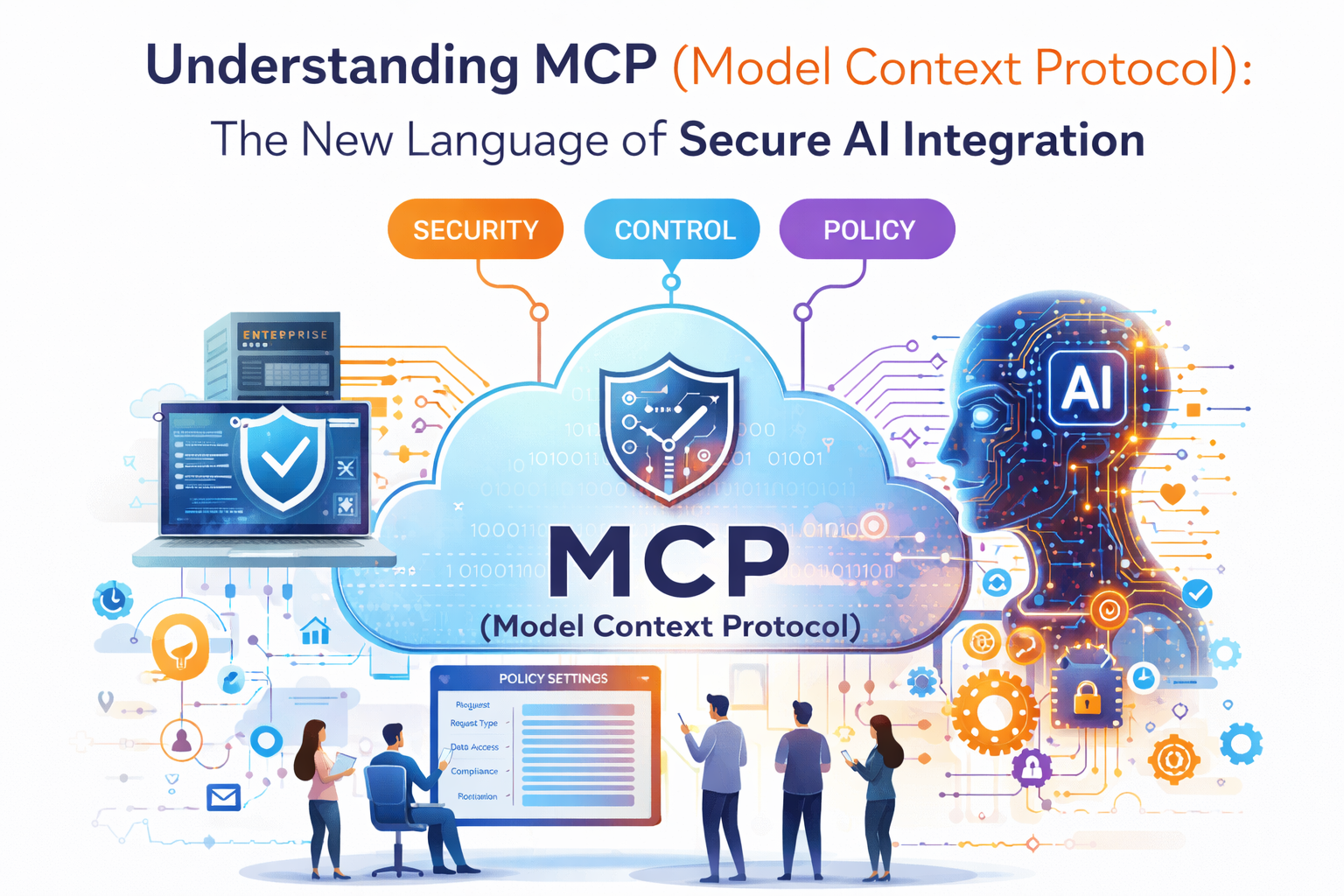
What Is MCP (Model Context Protocol)?
MCP is a structured protocol that defines how AI models receive context and interact with external tools and systems.
In simple terms:
MCP is the bridge that allows AI to safely access data and perform actions in the real world.
Instead of relying on unstructured prompts, MCP creates a clear interface between AI and external systems.
Why MCP Is Needed
Traditional AI integrations face several problems:
Sensitive data is often exposed in prompts
Integrations are custom-built and inconsistent
Limited control over what AI can access or execute
Difficult to scale across teams and systems
MCP solves these issues by introducing:
Structured communication
Controlled access
Defined permissions
Standardized integrations
How MCP Works
MCP brings structure to AI interactions through a clear flow:
Context is defined and scoped
Tools are registered and made available
AI selects actions instead of guessing
Requests are validated through permissions
Responses are structured and predictable
This creates a controlled environment where AI can operate safely.
Core Components of MCP
1. Context
Context is the information provided to the AI.
Examples include:
User data (limited and relevant)
Documents or knowledge bases
Application state
The key idea is controlled exposure, not full access.
2. Tools
Tools are the actions the AI is allowed to perform.
Examples:
Query a database
Send emails
Call APIs
Trigger workflows
With MCP, AI can only use approved and predefined tools.
3. Permissions and Policies
This layer ensures security and governance.
You can define:
What data can be accessed
Which tools can be used
When actions are allowed
This prevents unauthorized or risky operations.
4. Structured Communication
Unlike traditional prompts, MCP uses structured messages.
Benefits include:
Predictable outputs
Easier debugging
Better system reliability
MCP vs Traditional AI Integration
Without MCP:
Unstructured prompts
Limited control
Security risks
Unpredictable behavior
With MCP:
Structured context
Controlled tool usage
Strong permission layers
Reliable and scalable systems
Real-World Use Cases
Enterprise AI Assistants
AI can securely access internal systems and generate reports without exposing sensitive data.
Customer Support Automation
AI can retrieve customer data and perform actions like refunds within controlled limits.
Developer Copilots
AI can read code, suggest changes, and interact with CI/CD pipelines safely.
Multi-Agent Systems
Multiple AI agents can collaborate using MCP as a shared communication standard.
Why MCP Matters
MCP represents a shift from:
AI as a responder → AI as a system operator
It enables:
Secure automation
Scalable AI integrations
Enterprise-ready AI systems
Challenges to Consider
MCP is powerful but not without trade-offs:
Requires thoughtful system design
Needs governance and monitoring
Adds an additional layer of complexity
However, these are necessary steps for building production-grade AI systems.
How to Get Started with MCP
If you want to implement MCP concepts today:
Identify a clear use case
Define what tools the AI can access
Limit the context provided
Add validation and permission checks
Keep a human in the loop initially
Start small and expand gradually.
The Bigger Picture
MCP signals a broader evolution in AI:
From prompt engineering to system architecture
From generating text to executing tasks
From experimentation to real-world deployment
Conclusion
MCP is more than just a protocol—it’s a foundation for building secure, scalable AI systems.
As AI becomes more integrated into business operations, protocols like MCP will play the same role that APIs once did for software.
The future of AI isn’t just intelligent—it’s structured, controlled, and trustworthy.