The AI Agent Economy in 2026: How Autonomous AI Is Transforming Every Industry
What Is the AI Agent Economy?
The AI Agent Economy refers to the growing ecosystem where autonomous AI agents perform complex tasks, collaborate with humans, and interact with software and other AI systems with minimal supervision. In 2026, these intelligent agents are transforming industries by improving productivity, reducing costs, and enabling businesses to automate entire workflows instead of individual tasks.
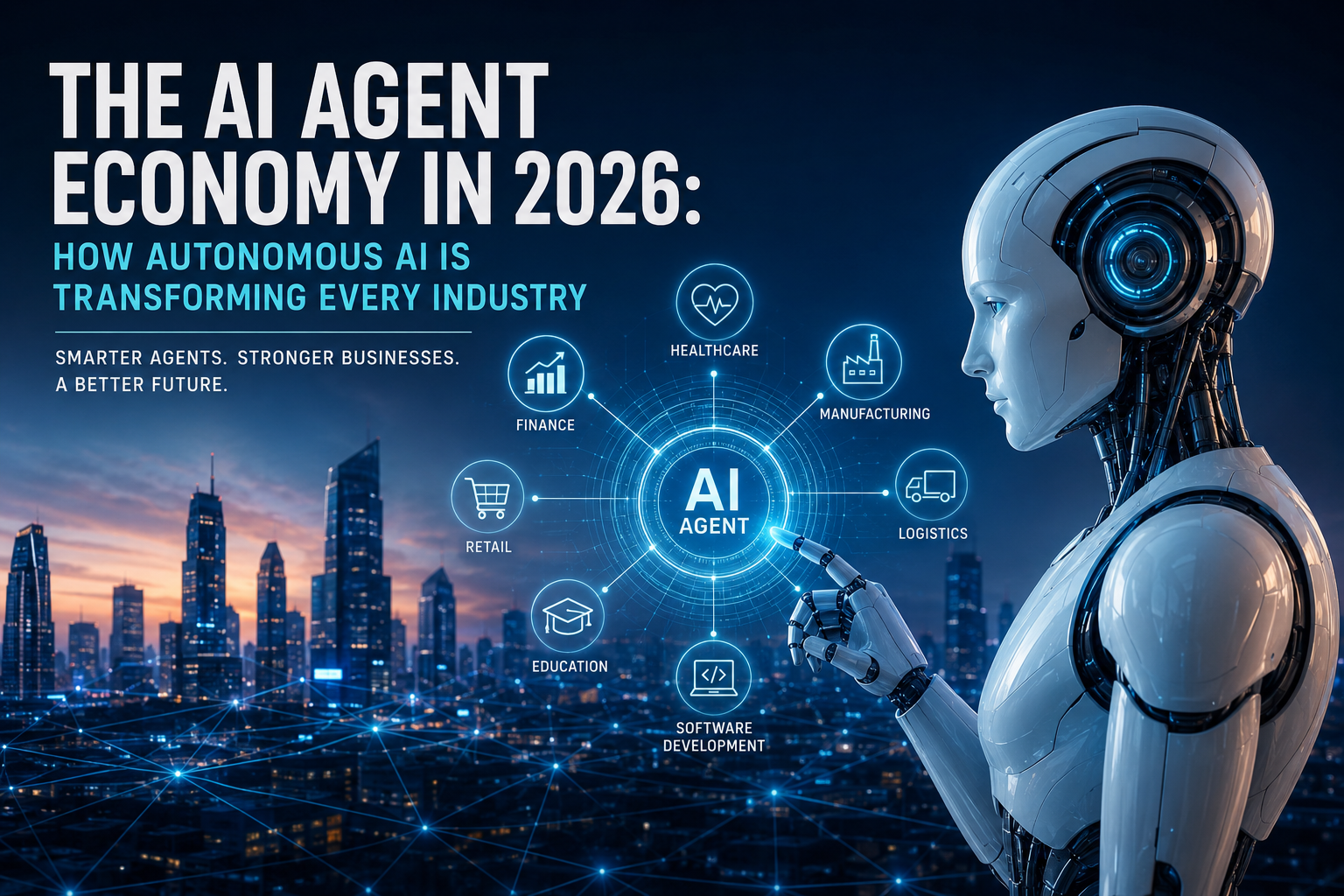
Artificial intelligence has evolved rapidly over the past decade, but 2026 marks a significant shift. Businesses are moving beyond simple chatbots and task automation toward intelligent AI agents that can reason, plan, execute, and collaborate with minimal human input.
This evolution is giving rise to what many experts call the AI Agent Economy—a new era in which software is no longer just a tool but an active participant in business operations.
Unlike traditional automation, AI agents can analyze information, make decisions, coordinate with other systems, and continuously improve through feedback. Organizations across healthcare, finance, manufacturing, education, retail, logistics, and software development are already integrating AI agents into everyday workflows to enhance efficiency and unlock new opportunities.
For business leaders, understanding the AI Agent Economy is becoming essential for maintaining a competitive advantage. Companies that embrace autonomous AI are discovering new ways to improve customer experiences, accelerate innovation, and reduce operational costs.
This guide explores what the AI Agent Economy is, why 2026 is a defining year, how AI agents function, and how they are reshaping nearly every industry.
What Is the AI Agent Economy?
The AI Agent Economy describes a digital ecosystem in which autonomous AI systems perform meaningful work independently or alongside humans. Rather than simply responding to prompts, AI agents are designed to pursue goals, adapt to changing conditions, and complete multi-step tasks.
For example, a customer service AI agent can receive a support request, analyze account information, retrieve documentation, communicate with billing systems, generate a personalized response, and schedule follow-up actions—all without requiring constant human intervention.
This represents a major evolution from earlier forms of automation that relied on predefined rules and workflows.
Key Characteristics of AI Agents
Modern AI agents typically demonstrate several capabilities:
Goal-oriented decision-making
Long-term memory and context retention
Planning and task decomposition
Integration with enterprise software
Continuous learning through feedback
Collaboration with other AI agents
Natural language communication
Autonomous execution of workflows
Together, these capabilities enable AI agents to function as digital coworkers rather than passive software tools.
Why the AI Agent Economy Matters
The emergence of autonomous AI is changing the economics of work itself.
Instead of automating individual tasks, organizations can now automate complete business processes.
Examples include:
Processing insurance claims
Managing marketing campaigns
Coordinating supply chains
Conducting financial analysis
Performing cybersecurity monitoring
Handling HR onboarding
Scheduling appointments
Generating software code
Managing procurement
This shift allows employees to focus on strategic thinking, creativity, and relationship-building while AI agents manage repetitive and data-intensive activities.
As a result, organizations can improve productivity, reduce operational costs, and deliver faster, more personalized services.
Why 2026 Is the Breakthrough Year
Although AI technologies have existed for years, several developments have converged to make 2026 a pivotal moment.
Better Foundation Models
Large language models have become more accurate, context-aware, and capable of reasoning across multiple domains. They now understand complex instructions, maintain context over longer conversations, and interact with external systems more effectively.
Mature Enterprise Integration
Businesses increasingly connect AI agents with:
Customer relationship management (CRM) platforms
Enterprise resource planning (ERP) systems
Cloud infrastructure
Internal knowledge bases
Productivity tools
Databases
Communication platforms
This connectivity enables AI agents to work across departments rather than within isolated applications.
Multi-Agent Collaboration
Instead of relying on a single AI system, organizations now deploy networks of specialized agents.
For example:
One agent gathers customer data.
Another analyzes purchasing behavior.
A third recommends products.
A fourth creates marketing content.
A fifth evaluates campaign performance.
Together, these agents form intelligent digital teams capable of managing complex business operations.
Lower Adoption Costs
Cloud computing, open-source frameworks, and AI platforms have significantly reduced implementation costs.
Small businesses that once lacked access to advanced AI technologies can now deploy sophisticated autonomous systems with minimal infrastructure investment.
How AI Agents Actually Work
Although AI agents appear conversational on the surface, their operation involves several interconnected components.
Understanding Goals
Every AI agent begins with an objective.
Examples include:
Increase sales conversions
Resolve customer complaints
Detect fraud
Schedule meetings
Generate financial reports
Monitor cybersecurity threats
The objective determines how the agent plans and prioritizes its actions.
Planning
Rather than immediately responding, an AI agent breaks large objectives into manageable tasks.
For example, an AI recruiting agent might:
Review job requirements.
Search candidate databases.
Rank applicants.
Draft interview invitations.
Coordinate calendars.
Notify hiring managers.
This planning process enables more sophisticated decision-making than simple automation.
Memory
Modern AI agents maintain context across interactions, allowing them to remember preferences, previous conversations, and historical data.
This memory supports more personalized and efficient experiences over time.
Tool Usage
AI agents frequently interact with external tools, including:
Email platforms
Databases
Business intelligence software
Cloud services
APIs
Project management applications
Customer support systems
By accessing these tools, agents can perform real-world tasks instead of merely generating text.
Continuous Learning
Many AI systems improve through user feedback, operational data, and performance metrics.
As organizations refine prompts, workflows, and governance, AI agents become increasingly effective at achieving business objectives.
Why Businesses Are Investing in AI Agents
Organizations adopting autonomous AI consistently pursue several strategic goals:
Improve operational efficiency
Reduce manual workloads
Enhance customer experiences
Accelerate decision-making
Increase scalability
Lower operating costs
Improve data utilization
Enable continuous innovation
Rather than replacing employees, many companies are using AI agents to augment human expertise by automating repetitive processes and providing actionable insights.
Key Takeaways
The AI Agent Economy represents a shift from software that assists people to software that actively participates in achieving business outcomes. As AI agents become more capable of planning, reasoning, and collaborating, organizations across every sector are rethinking how work is performed.
For business leaders, developers, and professionals alike, understanding this transformation is no longer optional—it is becoming a critical part of preparing for the future of work.
Tags
#AIAgents #AgenticAI #AutonomousAI #AIEconomy #ArtificialIntelligence #AI2026 #FutureOfAI #EnterpriseAI #DigitalTransformation #BusinessAutomation #IntelligentAutomation #AutonomousAgents #AIWorkforce #FutureOfWork #GenerativeAI #MachineLearning #LLMs #MultiAgentSystems #AIInnovation #BusinessStrategy #EnterpriseTechnology #Productivity #WorkflowAutomation #AITransformation #TechTrends2026 #FutureTech #Automation #AIStartups #OpenAI #Anthropic #GoogleAI #MicrosoftAI #MetaAI #NVIDIA #AmazonAWS #CloudAI #AIInfrastructure #DataInfrastructure #DataCenters #AIChips #EnterpriseSoftware #SaaS #DigitalEconomy #Innovation #Technology #Industry40 #SmartBusiness #EconomicTransformation #EmergingTech #TechLeadership