The EU AI Act Is Here: Is Your Model Actually Legal?
The era of optional AI ethics and best practices is officially over. With the EU Artificial Intelligence Act now progressing through phased enforcement, regulators are moving from encouragement to enforcement—and the penalties for non-compliance are real. Companies building, deploying, or shipping AI systems that touch the European market must now ask a fundamental question: Is my model actually legal?
In this piece, we unpack what the EU AI Act requires, why it matters beyond Europe, and how organizations can assess whether their models are compliant.
What Is the EU AI Act?
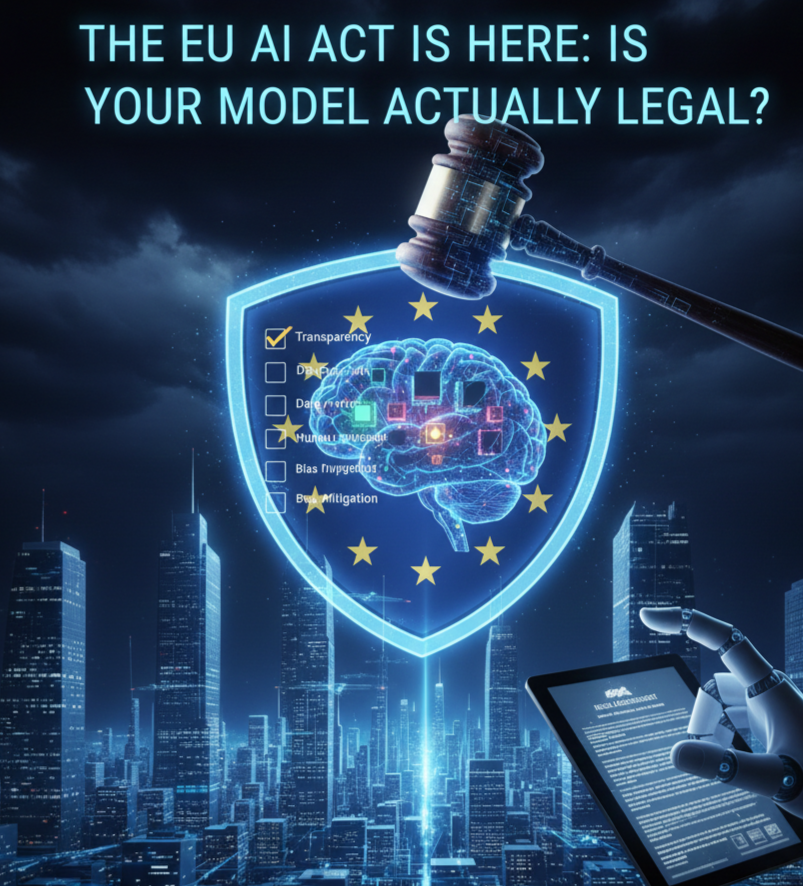
The EU AI Act is the first comprehensive, risk-based AI regulation in the world. It categorizes AI systems by potential risk to human rights and safety and assigns legal obligations accordingly.
Unlike data protection laws that regulate data, the AI Act regulates function—how systems behave, what they’re used for, and how they’re governed.
Key points:
It entered into force on 1 August 2024 and becomes fully applicable in phases through August 2026–2027.
The Act applies to AI offered in the EU market—whether your company is headquartered in the EU or not.
Violations can lead to steep fines (up to €35 million or 7 % of global turnover).
Put bluntly: If your AI touches the EU, this law could apply to you.
How AI Is Classified Under the Act
The Act uses a risk-based approach—not a one-size-fits-all regulatory model. Broadly, systems fall into four categories:
Unacceptable Risk – Banned outright.
Examples include social scoring, subliminal manipulation, emotion recognition in schools or workplaces, and some predictive policing tools.High-Risk AI – Allowed but heavily regulated.
Includes systems used in critical infrastructure, healthcare diagnostics, employment decisions, credit scoring, and more. These require pre-market conformity assessment, documentation, risk management, and ongoing monitoring.Limited-Risk AI – Transparency obligations.
Models here (e.g., chatbots or generative AI outputs) must disclose their nature so users know they are interacting with a machine.Minimal or No Risk – Essentially unregulated for now.
This includes low-risk AI like spam filters or non-critical tools.
The heavier the risk category, the more documentation, testing, and governance you must have.
When Is an AI System “Legal” Under the Act?
A model or system is legally compliant only if it fulfills the obligations tied to its risk category.
Here’s what that typically involves:
1. Risk Classification
You must determine what risk category your AI falls into before anything else. Misclassifying your system is not just an oversight—it's a compliance breach.
2. Documentation & Quality Management
For high-risk systems, you must demonstrate:
Robust data governance (representative, accurate datasets)
Technical documentation suitable for audits
Lifecycle risk management processes
Traceability and logging mechanisms
These are legal requirements, not best practices.
3. Transparency & User Notice
Many systems must clearly tell end-users “this is AI output.” For generative AI, this can include watermarks or clear labels identifying AI-generated text or images.
4. Monitoring & Reporting
If your model has systemic risk or is high-risk, you may need to:
Perform ongoing evaluation
Report serious incidents
Facilitate regulatory audits
…before and after deployment.
If you are not doing these things already, your AI may not be legally marketable in the EU.
Who Has to Comply?
It’s broader than you might think.
Affected parties include:
Providers – those who develop, import, or place AI on the EU market
Deployers – organizations that use AI in operations or services in the EU
Third parties whose AI outputs reach EU citizens, regardless of headquarters location
Even if you use a third-party model (OpenAI, open source, etc.), your use case, your data, and how you deploy it can bring you into scope of the AI Act.
Common Missteps That Kill Compliance
Many firms assume “we just need transparency or a label,” but this misses deeper legal triggers:
✅ Assuming only EU companies are affected — false.
Your AI is regulated if EU users use it.
✅ Thinking generative AI is low-risk by default — wrong.
Limited and high-risk designations apply depending on use case and impact.
✅ Assuming training data issues don’t matter — not true.
Representativeness, bias mitigation, and documentation are required for regulated systems.
Practical Steps to Check if Your Model Is Legal
Here’s a concrete compliance checklist you can use:
Inventory All AI Systems
Create an AI catalog with use cases, risk profiles, and data flows.
This is non-negotiable.Map Risk Category
Use the risk definitions in the Act to assign each system a category.
High-risk = strict obligations; limited risk = transparency; minimal risk = light touch.Assess Documentation
Do you have:Technical documentation?
Model evaluation and testing reports?
Data governance logs?
Human oversight mechanisms?
If not, you’re not compliant.
Implement Transparency
Ensure user notices, model cards, and output flags are in place where required.Monitor & Report
Establish monitoring for performance drift, incidents, and systemic risk — and a chain of reporting.Engage Legal & Governance Early
Compliance is cross-functional — engineering, security, legal, and governance teams must collaborate.
Beyond Europe: Why This Matters Globally
Like GDPR before it, the EU AI Act is shaping global norms. The practical reality is that many non-EU businesses will adopt EU standards by default to avoid duplicated work, conflicting regimes, and potential market exclusion.
Other jurisdictions are already watching and drafting their own frameworks, meaning your compliance work now pays dividends beyond European borders.
Take aways
The EU AI Act is no longer theoretical—it is legal reality with real deadlines, real obligations, and real penalties. Whether you are a model developer, SaaS provider, or an enterprise AI deployer, you must confront one question:
Is your model actually legal under the EU AI Act?
If the answer isn’t a confident yes, you owe it to your business (and your users) to fix that — before regulators and fines arrive. Compliance is now a strategic necessity, not an afterthought.