The Energy Wall: Why Power, Not Compute, is AI’s New Bottleneck
The relentless march of artificial intelligence continues to astound, with models growing ever more complex and capabilities expanding at an exponential rate. For years, the conversation has revolved around "compute"—the sheer processing power needed to train and run these sophisticated algorithms. We’ve seen incredible advancements in GPUs and specialized AI chips, pushing the boundaries of what's possible.
But a new, less-discussed bottleneck is rapidly emerging, one that threatens to slow the pace of AI innovation if not addressed proactively: energy.
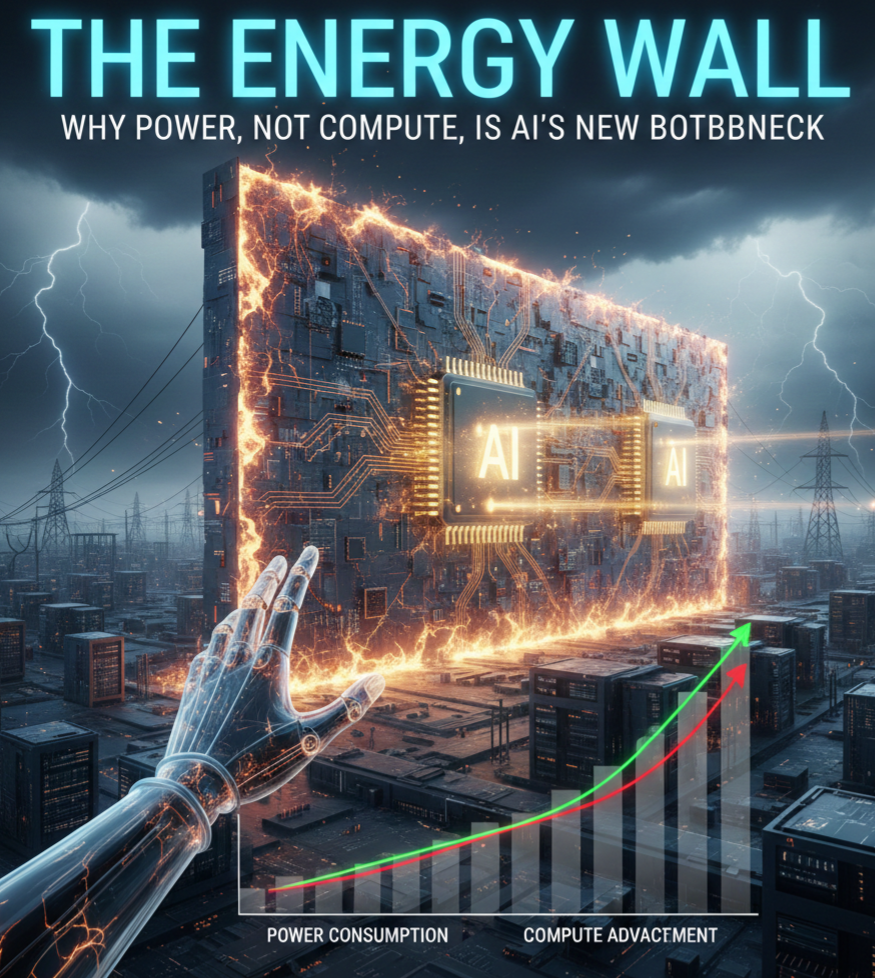
The hunger of large AI models for electricity is truly staggering. Training a single large language model can consume the equivalent energy of several homes for a year, sometimes even more. This isn't just about the financial cost; it's about the very infrastructure required to deliver that power. Data centers, the physical homes of these AI behemoths, are already massive energy consumers, and their demands are only intensifying.
Think about it: every calculation, every data transfer, every neural network layer being processed requires electricity. As models scale from billions to trillions of parameters, the energy footprint swells proportionally. We're reaching a point where the physical limitations of power grids and the environmental impact of energy consumption are becoming critical concerns.
Why is this happening now?
Scaling Laws: AI research has consistently shown that larger models often lead to better performance. This incentive drives a continuous push for bigger and bigger architectures.
Increased Training Runs: Not only are models larger, but researchers also perform numerous training runs, fine-tuning, and experimentation, each demanding significant energy.
Inference at Scale: Once trained, these models are then deployed for inference (making predictions or generating content). If an AI model is used by millions or billions of people, even small energy consumption per inference adds up to a massive total.
Hardware Efficiency Limits: While hardware has become more efficient, the growth in model size often outpaces these gains, leading to a net increase in energy demand.
What are the implications?
Environmental Impact: The carbon footprint of AI is a growing concern. As the world strives for sustainability, the energy demands of AI present a significant challenge.
Infrastructure Strain: Power grids in many regions are already under pressure. Building new data centers with the necessary power supply can be a lengthy and expensive endeavor.
Economic Barriers: The cost of electricity can become a prohibitive factor for smaller research labs or startups, further concentrating AI development among well-funded giants.
Geopolitical Considerations: Access to reliable, affordable, and green energy sources could become a strategic advantage in the AI race.
Looking Ahead: Solutions and Strategies
The good news is that researchers and engineers are acutely aware of this challenge and are exploring various avenues to address it:
Algorithmic Efficiency: Developing more energy-efficient algorithms and model architectures that can achieve similar performance with less computation.
Hardware Innovation: Continued innovation in specialized AI chips that are designed for maximum energy efficiency, perhaps moving beyond traditional silicon.
Renewable Energy Integration: Powering data centers directly with renewable energy sources like solar and wind, or strategically locating them in areas with abundant green power.
Cooling Innovations: Reducing the massive energy overhead associated with cooling data centers.
"Green AI" Practices: A growing movement within the AI community to prioritize energy efficiency and sustainability in all stages of AI development.
The future of AI is undeniably bright, but its path will be heavily influenced by how we address the "energy wall." The next frontier in AI innovation won't just be about smarter algorithms or faster chips; it will be about creating intelligent systems that are also intelligent about their power consumption.