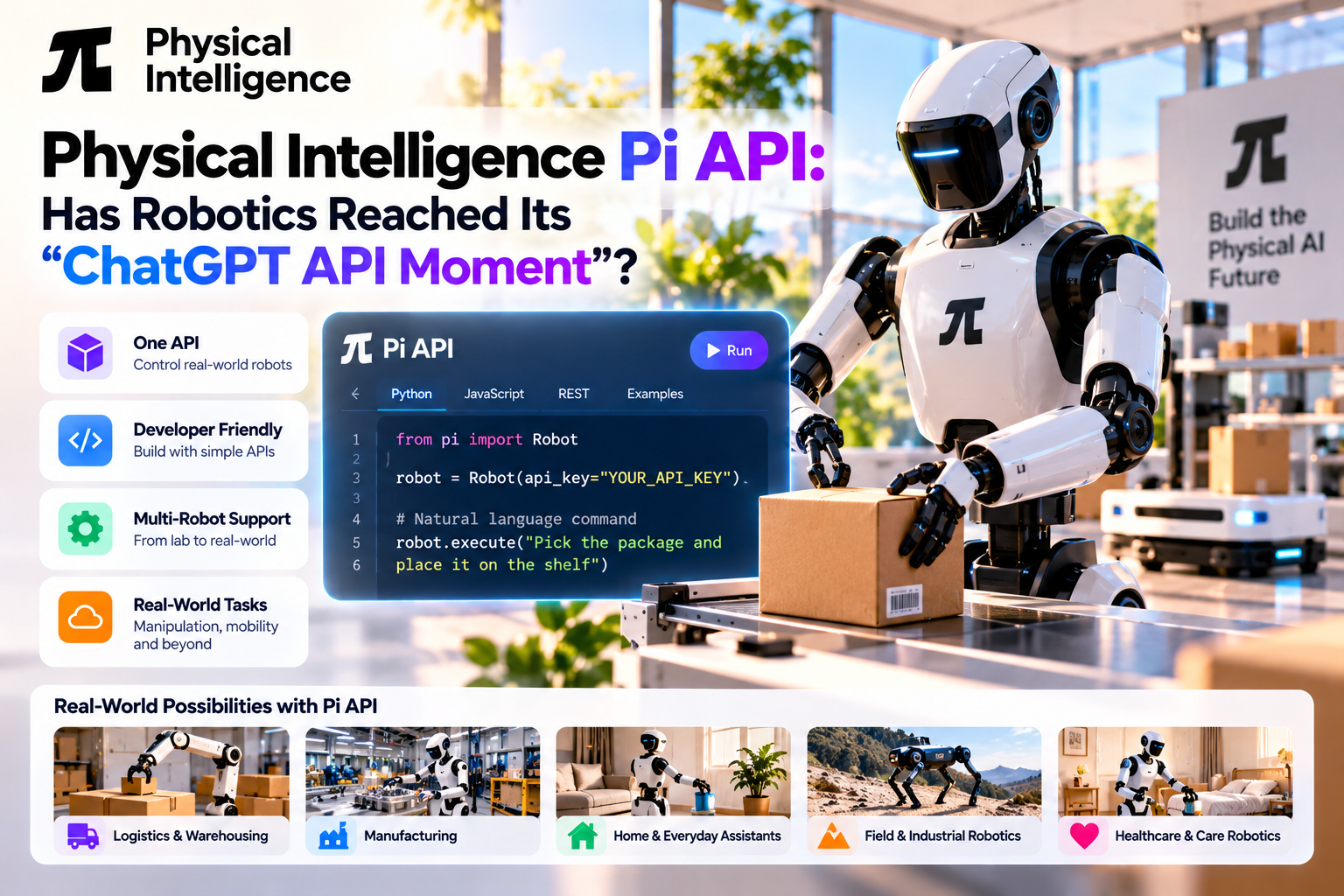
Physical Intelligence has opened a beta API for adapting its robot models to new machines and tasks. It makes a powerful idea more accessible: bring your robot data, fine-tune a model and test it on hardware. But building a useful robot still takes more than an API key.
Quick Take
- The launch: Physical Intelligence announced the Pi API beta on 13 October 2026. Access starts with a waitlist and onboarding in batches.
- The workflow: A team uploads robot data, fine-tunes a model on managed compute, calls a hosted inference gateway and evaluates the result on its own machine.
- The proof so far: Physical Intelligence shows early partner work, including an Almond robot deburring a part after four days of API iteration. That example does not establish an industry-wide deployment rate.
- The verdict: The beta could make advanced robot models easier to adapt. It remains early because data collection, cloud reliability, hardware integration and physical safety still determine success.
What Is the Physical Intelligence Pi API?
The Physical Intelligence Pi API is a beta service that gives outside robotics teams a route to adapt the company’s foundation models. In its 13 October announcement, Physical Intelligence describes three service steps: upload data from your robot, launch fine-tuning on infrastructure it manages, and access the adapted model through hosted inference.
That matters because a robot developer may understand the grippers, cameras and factory task, yet lack the GPUs, training pipelines and specialist staff needed to adapt a large model. The API moves part of that machine-learning infrastructure behind a service. The developer still supplies a robot, demonstrations, an integration with its control stack and repeated physical evaluation.
This is a waitlisted beta. The company’s access application says onboarding is happening in batches and asks about available robots, teleoperation and simulation data, desired inference location and task success criteria. That is a different level of accessibility from signing up for a mature, unrestricted developer service.
How Does the Pi API Work on a Real Robot?
The launch post describes an iteration loop rather than a single instruction that makes a machine autonomous. In practical terms, the team collects demonstrations of a robot doing a target task, supplies usable training data, fine-tunes a policy, runs it through hosted inference and studies the failures. The next dataset should address what the machine got wrong, such as an object slipping or a part landing in an unexpected position.
Specify the robot, workspace, objects, acceptable outcome and situations where it must stop.
Capture actions and observations that represent the real task and its relevant variations.
Fine-tune with Pi-managed compute and connect the resulting policy to hosted inference.
Test on hardware, record failures, collect targeted examples and compare with the previous policy.
In this context, a robot policy maps observations and task information to proposed actions. It is one part of a larger system that also needs sensors, actuation, safe motion limits and monitoring. Physical Intelligence has not published a universal recipe in its announcement for every robot embodiment or every industrial safety scenario.
Why Call This a “ChatGPT API Moment”?
The analogy is about developer access to a capable foundation model. Software teams could build new products when they were able to call powerful language models rather than train comparable ones themselves. The Pi API proposes a related shift for robotics: use a shared base of physical capabilities, then adapt it to the machine and task you actually have.
| Question | Language model API | Pi API robotics beta |
|---|---|---|
| What does the developer bring? | Software, instructions, data and application logic. | A physical robot, task definition, demonstrations, integration and tests on hardware. |
| What does the provider manage? | A hosted model and inference infrastructure. | Foundation-model fine-tuning infrastructure and a hosted inference gateway. |
| What does failure affect? | Outputs or software actions, depending on the product. | Motion and interaction with people, objects and equipment. |
| What proves value? | Useful, accurate outcomes at acceptable cost and speed. | Repeatable task success, safe failure handling and throughput under real conditions. |
| How open is access now? | Depends on the service and account. | Physical Intelligence currently accepts beta applications and onboards in batches. |
Our assessment: the launch is a credible platform step, but “ChatGPT API moment” remains a question, not a milestone already demonstrated across robotics. The API reduces one barrier; it does not remove the cost of making a robot reliable in an unpredictable physical environment.
What Do the Early Robot Examples Actually Show?
Physical Intelligence’s launch examples span different kinds of hardware and work. Almond’s dual-arm Axol robot is shown deburring spacers used in its own assembly; Physical Intelligence says the team iterated with the Pi API for four days to obtain the model in that demonstration. That is evidence of a specific partner’s rapid iteration, not a published success rate for every factory, robot or material.
The announcement also describes an Actor autonomous wheel loader scooping material into a dump truck during a commercial deployment. Physical Intelligence discusses that example in the context of earlier partner collaborations. It should not be conflated with the later, separate Almond example of beta teams iterating independently through the API.
The company says most of the showcased applications used cloud-hosted inference, including work across the United States, Japan and Switzerland, and reports network connectivity challenges in some settings. Short demonstrations can show capability. To judge production readiness, ask how many uninterrupted hours the system ran, what percentage of attempts passed, how often people intervened and what happened on a network failure.
Why Cloud Inference Is Harder for Robots
A text answer can arrive late and still be useful. A robot may need timely decisions while a tool is moving, a person enters its workspace or the network becomes unreliable. Physical Intelligence explicitly notes connectivity challenges in its early Pi API examples. Its application form asks teams whether they need cloud, local or both kinds of inference. That question signals real deployment choices; it does not announce that local Pi API inference is available to every applicant.
A responsible architecture separates the hosted policy’s proposed behavior from the machine’s local safety functions. Engineers should measure end-to-end response time, connection loss, recovery after reconnecting, behavior when observations are stale and local stop conditions. Where a task cannot tolerate a delayed command, teams need an appropriate control and safety design on the machine, regardless of how capable the remote model appears.
The business case also depends on connectivity costs, data-transfer rules and who can troubleshoot a failed run. A cloud model can make adaptation easier while making operations dependent on a remote service. The right trade-off depends on the robot, site and hazard assessment.
Does the API Run π0.7?
Physical Intelligence’s earlier π0.7 research post describes a steerable robot model trained with diverse inputs such as language instructions, task metadata and visual subgoals. Those findings help explain the company’s approach to robot foundation models and cross-robot adaptation.
The Pi API beta announcement, however, describes access to its latest models without identifying the exact model version assigned to every beta project. It would be inaccurate to promise that any applicant receives a specified π0.7 checkpoint or the full set of research demonstrations. Ask which model, versioning policy, action format and deployment options are available for your own hardware.
A Practical Pilot for a Robotics Team
Suppose a team wants a dual-arm robot to pack small parts into trays. This is an illustrative pilot, not an announced Pi API customer result. A useful evaluation should begin with its current manually programmed or specialist policy as a baseline.
- Set a measurable goal: define correct placement, cycle time, damage rate and the maximum acceptable intervention rate.
- Capture real variation: collect demonstrations with different part positions, lighting, trays and recovery from a missed grasp.
- Hold back test data: evaluate on trials that were not simply the same demonstrations used for adaptation.
- Test abnormal conditions: include a blocked camera, dropped object, unexpected human presence and a lost network connection.
- Compare total cost: account for data collection, hosted inference, operator intervention, support and downtime.
A pilot passes when a system performs the task consistently inside a documented safety boundary and a person can diagnose failures. Four days to a promising video is a useful sign of iteration speed; it is not a substitute for acceptance testing or production evidence.
Data Rights, Safety and European Deployment
Robotics demonstrations can reveal factory layouts, product geometry, employees and work processes. Before uploading them, clarify who owns the recordings, what the provider may retain or use for training, whether a fine-tuned policy can be exported, what happens when access ends and how incidents are logged. The public beta announcement and waitlist describe the service and application process; teams should verify detailed pricing, service levels, privacy terms and intellectual-property rights in their own beta agreement.
In the EU, a model API does not certify a machine. As of October 2026, the Machinery Directive remains the current framework; the new Machinery Regulation is scheduled to apply from 20 January 2027. The EU AI Act also requires a use-specific assessment: whether AI is treated as a high-risk safety component depends on its intended role and the applicable product conformity rules. Avoid assuming every industrial robot is automatically a high-risk AI system, or that an API provider’s model tests replace the robot maker’s and deployer’s responsibilities.
For recorded people or identifiable workplace data, assess the GDPR principles of purpose limitation, data minimization and security. Use original writing and properly licensed visuals in public case studies; a robot demonstration is not automatic permission to republish a partner’s footage or technical drawings.
What Would Make This a Real Platform Shift?
The strongest signal will be teams outside the launch group repeatedly adapting the models to different machines, tasks and sites, with transparent measures of safety, cycle time and cost. Developers also need predictable access, clear data terms, tools for debugging failures and deployment options that match the environment.
Physical Intelligence has made an important step: it now offers a service for teams to iterate on robot policies without constructing the entire model-training stack. Robotics reaches its own API moment when that approach works reliably across many hardware designs and practical tasks, under ordinary operating constraints—not when a single demo looks effortless.
MaGeN-AI View
The Takeaway
The Pi API could become a reusable intelligence layer for robot builders. Its beta turns advanced model adaptation into a clearer developer workflow, but the physical world still sets the acceptance test: safe motion, reliable connectivity, repeatable task success and costs a customer can justify. The opportunity is real; the platform verdict belongs to results from many independent deployments.
Frequently Asked Questions
What is the Physical Intelligence Pi API?
The Pi API is a beta service for robotics teams to upload demonstration data, fine-tune Physical Intelligence robot models and use hosted inference on their own robots.
Is the Pi API open to everyone?
Physical Intelligence began onboarding in batches through a waitlist in October 2026. Applying does not guarantee immediate access.
Is Pi API the same as the π0.7 research model?
Not necessarily. Physical Intelligence has published research on π0.7, but its Pi API launch post does not identify the exact model version available to every beta applicant.
Can a robot keep working if the Pi API connection drops?
That depends on the robot system. Physical Intelligence says most showcased beta applications used cloud-hosted inference and notes connectivity challenges for some. Each deployment needs an independently tested safe response to lost connectivity.
Has robotics reached its ChatGPT API moment?
The Pi API lowers the barrier to adapting a robotics foundation model, which resembles an API platform shift. Its waitlist, real-world data requirements, network dependence and physical safety demands make the comparison provisional.