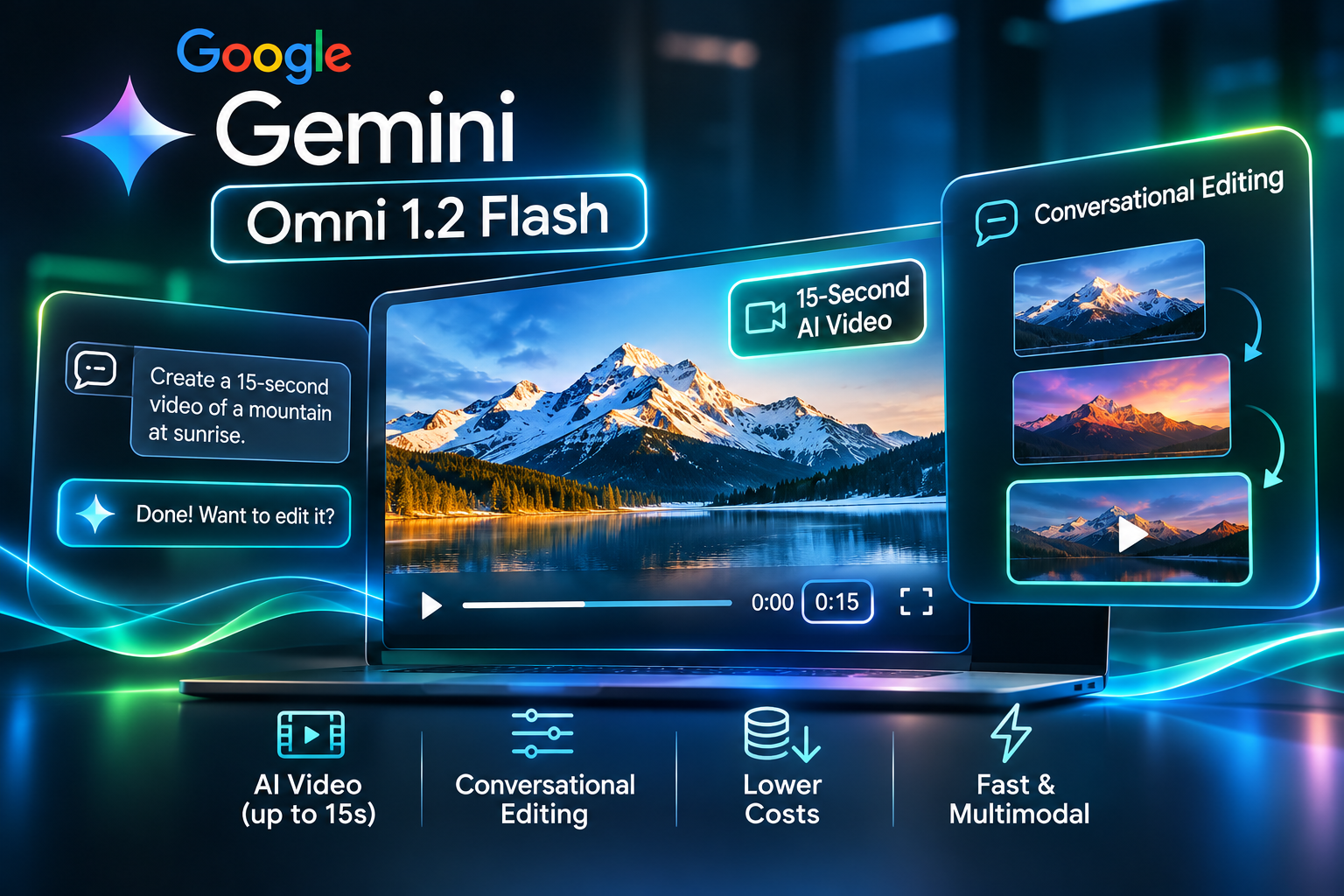
Google has moved its Omni Flash video model from short demonstrations toward an editable production workflow. The new release can produce 15-second clips, follow up on an existing clip through conversation and lower the stated generation price. The question for a business is how many usable seconds it gets per paid second.
Quick Take
- Release: Google announced general availability in the Gemini API and Google Cloud on 5 November 2026; access in consumer apps can vary by product and account.
- Length: Clips now run from three to 15 seconds in one-second increments; the earlier 1.1 Flash limit was ten seconds.
- Price: Google quotes $0.07 per second for 720p generation, 30% below its prior Flash price; evaluate edit and upscaling charges separately.
- Best test: Compare brand fidelity, speech, iteration count and final cost per accepted clip using the same brief.
What changed in Gemini Omni 1.2 Flash?
Google’s announcement describes a video model for generating and editing up to 15-second clips. A user can specify a duration from three to 15 seconds and combine a written brief with eligible image, motion or audio references. Google says character, product and scene details hold together better across a clip and through later edits. These are company claims; a real campaign still needs its own acceptance tests.
The release is generally available for developers through the Gemini API and in Google Cloud. Availability in Flow, Gemini, Google Vids and other interfaces depends on each product’s rollout and account rules. Google Cloud notes that audio references require allowlisting. Avoid promising that every business feature appears automatically in every consumer app.
How does conversational video editing work?
A first render is no longer the end of the workflow. Ask for the same shot with a different background, lighting or product, and the system tries to change the selected detail while keeping other parts recognizable. That gives a creative team a better path to several platform sizes or audience variants than rewriting the whole prompt after each round. It still requires a human editor to inspect the result frame by frame.
A practical pipeline starts with a short brief, permitted reference images and a clear list of elements that must remain stable. Render a low-resolution candidate, make a targeted follow-up change, review brand elements and dialogue, and upscale only an approved cut. Google describes 360p and 720p drafts with possible 1080p or 4K upscaling; those outputs have different operational costs and may need separate checks.
What does the lower price mean for a real campaign?
At Google’s quoted 720p generation rate, one 15-second render costs about $1.05 before any additional charges. Ten such renders would be about $10.50 at that specific rate. This is arithmetic from the stated price, not a vendor invoice: edits, alternate resolutions, audio, storage, API usage conditions and upscaling can change a real bill.
A better metric is cost per approved video, including every discarded generation and the staff time to inspect it. For example, if one usable 15-second ad requires five full renders, generation alone is roughly $5.25 at the stated 720p rate. Run a small sample with a consistent brief and record the full cost before deciding that the lower sticker price reduces campaign spend.
Which teams benefit, and where does the model still struggle?
Product teams can test short catalog spins, social marketers can produce localized variants, and trainers can illustrate a process. A single 15-second piece may now hold a complete setup and payoff that used to require a cut or extension. Reference consistency is particularly useful for approved characters, packaging and recognizable products, provided the team owns or licenses those references.
Google itself identifies fast sports action, rapid script changes and complex physics as continuing challenges. A visually convincing generated product demo can still imply an inaccurate product feature; require a product owner to verify what the video depicts. Speech and lip-sync should be reviewed by a fluent speaker when a claim, caption or translated line could influence a purchase or decision.
Omni 1.1 Flash vs Omni 1.2 Flash: what to compare
Google’s announcement supplies the reported changes; the final column is an independent production check.
| Decision | Omni 1.1 Flash | Omni 1.2 Flash | Your acceptance test |
|---|---|---|---|
| Single clip | Up to 10 seconds. | Up to 15 seconds. | Is the longer scene coherent from first to last frame? |
| Iteration | More prompt resets for large changes. | Conversational follow-up edits. | Does an edit preserve all locked brand details? |
| 720p price | Higher reference price in Google’s comparison. | $0.07 per second stated. | Measure full spend per accepted cut. |
| Delivery | Review platform-specific availability. | API and Google Cloud generally available. | Verify region, quota and output rights. |
Four creative workflows worth piloting
Show one approved feature in 15 seconds; reject scenes that invent controls or performance.
Create aspect-ratio and background variants while tracking the cost of each approved version.
Illustrate a controlled procedure and compare visuals with the actual instructions before release.
Use video drafts to agree on camera movement and pacing before professional production.
Copyright, provenance and EU safeguards
Use images, voices, music, likenesses and product names only with the necessary permissions. Editing a clip is not a license to copy another creator’s work. Google says outputs carry SynthID; a watermark can support provenance but does not by itself prove every downstream repost is authentic or lawfully sourced.
For EU campaigns, assess transparency for synthetic or manipulated media under the AI Act guidance and minimize personal data from customer images under GDPR principles. The intended use and provider/deployer role determine obligations; a product demo and a consequential biometric workflow present different questions.
MaGeN-AI View
The unit of value is a usable, reviewable clip
Omni 1.2 Flash combines longer video, targeted editing and a lower announced price. Its real advantage appears only if a team spends fewer attempts to produce an accurate, rights-cleared final asset. Pilot with an approval checklist and measure total cost per accepted 15 seconds.
Frequently Asked Questions
How long can Gemini Omni 1.2 Flash videos be?
Google lists three to 15 seconds per clip, selectable in one-second steps.
What is the quoted 720p price?
Google announced $0.07 for each generated second of 720p video; actual project costs can include more than generation.
Is Omni 1.2 Flash available through the API?
Google announced general availability through the Gemini API and Google Cloud on 5 November 2026.
Can I edit an existing generated clip with a prompt?
Google describes conversational follow-up edits for elements such as a background or product across a full clip.
Does a SynthID mark establish copyright permission?
No. Provenance and rights are different: creators still need rights to all supplied and published material.