Custom GPTs vs. Open Source: Choosing the Right Path for Your Internal Tools
As organizations move beyond AI experimentation and into real deployment, a critical architectural question emerges: should you build internal tools on top of custom GPT-style models, or should you invest in open-source AI models?
This is not a philosophical debate about openness versus convenience. It is a practical decision that affects cost, control, scalability, security, and long-term strategy.
This article breaks down the trade-offs between custom GPTs and open-source models—and provides a framework to help you choose the right path for your internal tools.
What “Custom GPTs” Really Mean in Practice
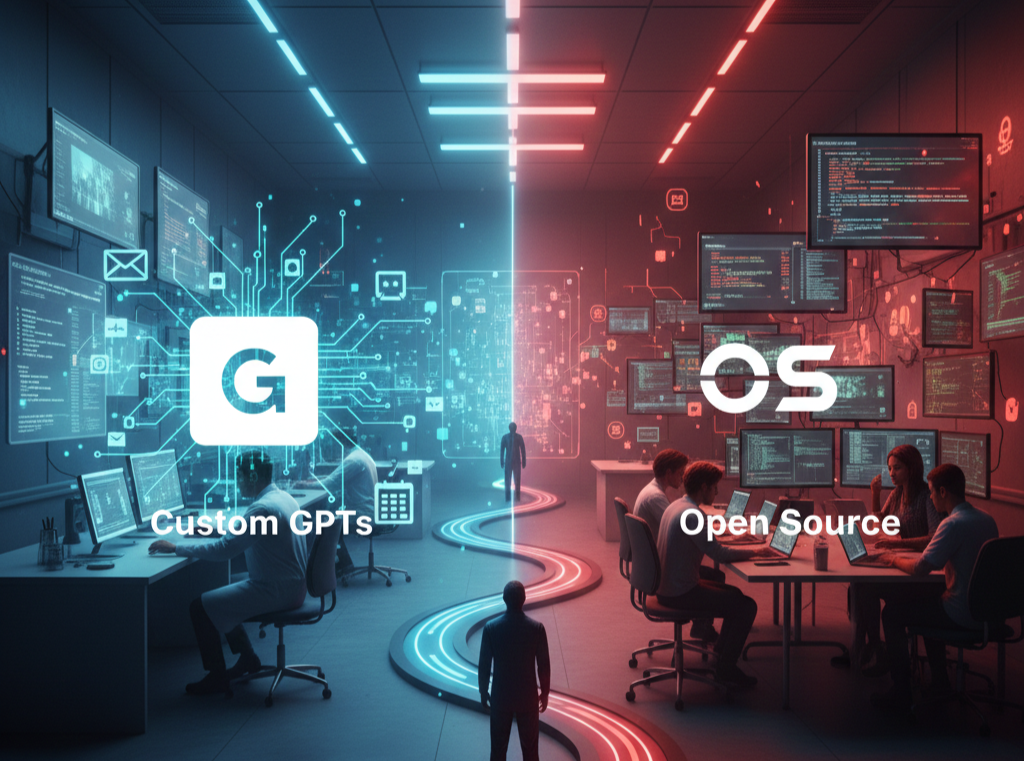
In this context, “custom GPTs” refers to proprietary large language models provided by vendors and adapted through:
Prompt engineering
System instructions
Retrieval-augmented generation (RAG)
Fine-tuning (where supported)
They are typically accessed via APIs and managed infrastructure.
Strengths:
Minimal setup and fast time-to-value
State-of-the-art performance out of the box
No model hosting or maintenance overhead
Continuous improvements handled by the vendor
Custom GPTs excel when speed and capability matter more than deep customization.
What Open-Source Models Actually Involve
Open-source AI models give you access to model weights and architecture, but not a finished product.
Using them effectively requires:
Model hosting and scaling infrastructure
Inference optimization
Ongoing updates and monitoring
Internal ML and MLOps expertise
Popular categories include:
General-purpose LLMs
Domain-specific fine-tuned models
Smaller task-optimized models
Open source offers freedom—but at a cost.
Key Decision Dimensions
1. Time-to-Value vs. Long-Term Control
Custom GPTs
Ideal for rapid prototyping and early production
Reduce engineering and operational burden
Open Source
Slower initial rollout
Greater long-term flexibility and ownership
If your goal is immediate impact, proprietary models often win. If you’re building a long-lived platform, control becomes more valuable.
2. Cost Structure and Economics
Custom GPTs
Usage-based pricing
Predictable early costs
Can become expensive at scale
Open Source
Higher upfront investment
Infrastructure and staffing costs
Lower marginal cost per request at high volume
The break-even point depends on usage intensity and workload predictability.
3. Data Sensitivity and Governance
Custom GPTs
Depend on vendor guarantees for data handling
Limited visibility into training and inference pipelines
Open Source
Full control over data flow and storage
Easier compliance with strict regulatory environments
For regulated industries, this alone can determine the decision.
4. Customization Depth
Custom GPTs
Strong general reasoning and language skills
Limited structural modification
Behavior shaped mostly through prompts and context
Open Source
Full fine-tuning and architectural flexibility
Better alignment with niche or highly technical domains
If your internal tools require deep domain specificity, open source may outperform despite weaker base models.
5. Reliability and Operational Complexity
Custom GPTs
High availability managed by the provider
Less operational risk
Dependency on vendor uptime and policy changes
Open Source
Full operational responsibility
Requires monitoring, scaling, and fallback strategies
The question is not “can we run models?” but “do we want to run models?”
Common Internal Tool Scenarios
Knowledge Assistants and Search
Best fit: Custom GPTs + RAG
Fast deployment, high linguistic quality
High-Volume, Narrow Tasks
Best fit: Open-source or smaller specialized models
Predictable cost and performance
Regulated or Sensitive Environments
Best fit: Open-source (self-hosted)
Full control and auditability
Experimental or Fast-Changing Tools
Best fit: Custom GPTs
Rapid iteration without infrastructure drag
The Hybrid Model: What Most Teams End Up Doing
In practice, many organizations adopt a hybrid strategy:
Custom GPTs for exploratory tools and general assistants
Open-source models for stable, high-volume, or sensitive workloads
Shared infrastructure for logging, evaluation, and governance
This avoids ideological rigidity and optimizes for business outcomes.
Strategic Questions to Ask Before Deciding
Before committing, ask:
How critical is this tool to core operations?
What happens if the model behavior changes unexpectedly?
Do we have internal ML and MLOps capability?
Is vendor lock-in acceptable here?
What does success look like at 10× scale?
The right answer depends on context—not trends.
Conclusion: Choose Outcomes, Not Allegiances
Custom GPTs and open-source models are not competing religions. They are tools with different trade-offs.
Choose custom GPTs when speed, quality, and simplicity matter most.
Choose open source when control, cost at scale, and governance are critical.
Choose hybrid when reality demands flexibility.
The best internal AI tools are not defined by the model you use—but by how well they align with your organization’s constraints and goals.