Beyond the Screen: How AI is Stepping Out and Into Our Physical World
Got it! Here's a more elaborate blog post on "AI is moving out of the screen and into the physical world," with more detailed explanations and examples, designed to be paired with the same image.
Beyond the Screen: How AI is Stepping Out and Into Our Physical World, Reshaping Industries and Daily Life
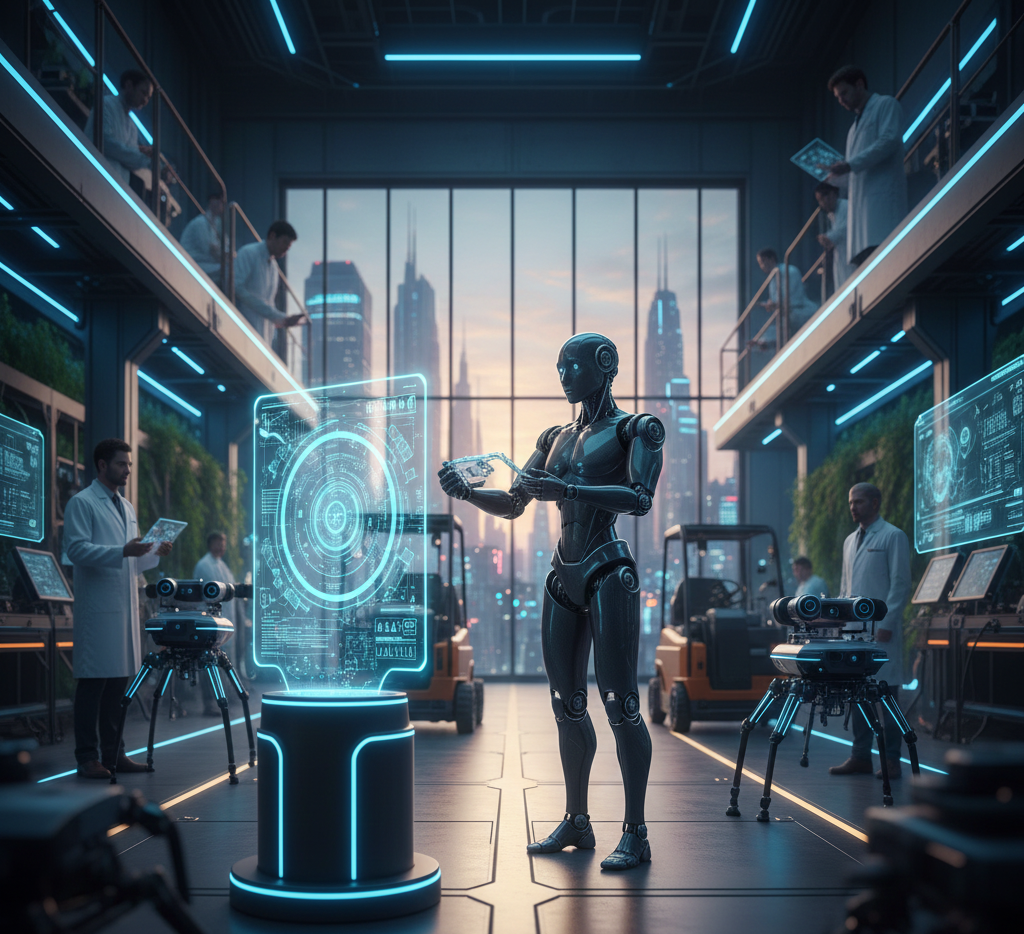
For decades, Artificial Intelligence has largely been an unseen force, operating behind the scenes in our computers, powering search engines, personal assistants, and recommendation algorithms. Our interactions with AI have primarily been confined to screens – typing commands into chatbots, generating images with text prompts, or consuming AI-curated content. However, a revolutionary shift is now fully underway: AI is rapidly transcending its digital boundaries, becoming physically embodied and directly interacting with our real-world environments.
This isn't merely about more sophisticated robots; it's about the profound integration of advanced AI reasoning and perception capabilities into physical forms. We are witnessing the birth of truly "physical AI" – intelligent systems that can perceive, understand, interact with, and even manipulate the three-dimensional world around them, often with a remarkable degree of autonomy.
The Evolution of Embodied Intelligence
The journey of AI moving into the physical realm has been a gradual, yet accelerating, one:
Early Robotics (Rule-Based): For a long time, industrial robots performed repetitive tasks with precision, but they lacked genuine intelligence. They followed pre-programmed instructions, unable to adapt to unexpected changes in their environment.
Sensor Fusion & Basic Machine Learning: The integration of sensors (cameras, LiDAR, haptics) allowed robots to perceive their surroundings. Machine learning then enabled them to make basic decisions based on this sensory input, leading to early autonomous vehicles and drones.
Modern Physical AI (Deep Learning & Agentic Systems): The leap forward comes with the fusion of powerful deep learning models (like large language models adapted for control) with sophisticated robotic hardware. This allows for:
Complex Perception: Understanding not just what an object is, but its properties, how it relates to other objects, and its potential uses.
Real-time Decision Making: Adapting on the fly to dynamic environments and unpredictable situations.
Fine Motor Control: Performing delicate manipulations that require human-like dexterity.
Goal-Oriented Autonomy: Moving beyond simple commands to execute high-level goals by planning and performing sequences of actions.
Where You'll See Physical AI in Action
The implications of this shift are monumental, impacting industries from manufacturing and logistics to healthcare and daily consumer life.
Humanoid Robotics in the Workplace:
Warehouses & Logistics: Companies like Amazon are deploying humanoid robots alongside traditional automation. These robots can handle irregular objects, navigate complex warehouse layouts, and perform tasks that require more dexterity and adaptability than fixed automation, working collaboratively with human employees.
Manufacturing: Beyond assembly lines, new generations of robots can perform intricate quality control checks, operate specialized tools, and even learn new tasks by observing human demonstrations.
Service Industries: Imagine robots assisting in elder care, helping with household chores, or even performing light tasks in retail environments, freeing up human staff for more complex customer interactions.
Autonomous Systems (Vehicles, Drones, & Beyond):
Self-Driving Transport: From cars to delivery trucks, autonomous vehicles are becoming increasingly common, navigating complex urban environments and long-haul routes. These systems integrate AI for perception (seeing the road), prediction (forecasting other drivers' actions), and planning (deciding how to drive safely).
Delivery Drones: AI-powered drones are beginning to revolutionize last-mile delivery, especially in remote areas or for urgent medical supplies.
Exploration & Inspection: Robots and drones equipped with AI are exploring hazardous environments, inspecting infrastructure (bridges, pipelines), and performing tasks in space or deep sea where human presence is difficult or dangerous.
Smart Environments & Edge AI:
Intelligent Homes & Buildings: AI embedded in sensors and devices within our homes and offices is creating environments that proactively adjust to our needs – optimizing lighting, climate control, and security, all while learning from our habits.
Healthcare Robotics: Surgical robots are becoming more precise, diagnostic tools more accurate, and assistive robots are helping patients with rehabilitation and mobility.
Agriculture: AI-powered robots are performing tasks like precision planting, automated harvesting, and targeted pest control, dramatically increasing efficiency and reducing resource usage.
The Interplay of Hardware and Advanced AI
This move towards embodied AI is fueled by advancements on multiple fronts:
More Capable Hardware: Lighter, stronger, more dexterous robots with advanced sensor arrays.
Advanced AI Models: Large Language Models (LLMs) and foundation models are being adapted to control physical actions, allowing robots to understand high-level commands and translate them into physical movements.
Edge Computing: Bringing AI processing power closer to the physical devices themselves, enabling real-time decision-making without constant reliance on cloud connectivity.
The Future is Tangible
The integration of AI into the physical world marks a critical inflection point. It moves AI from being a tool we interact with to a presence that interacts within our shared physical space. This development brings immense potential for automation, efficiency, and solving complex societal challenges, but it also necessitates careful consideration of safety, ethics, and the evolving relationship between humans and increasingly intelligent machines.
The screen was just the beginning. The next chapter of AI is being written, not in code alone, but in the tangible movements and intelligent actions of machines sharing our world.