Beyond the Chatbox: Why Gemini 3.0 and Claude 5 are Redefining "AI Reasoning" in Q1
The first quarter of the year has been nothing short of a seismic shift in the world of artificial intelligence. While the public imagination often fixates on the conversational prowess of AI chatbots, a more profound revolution is quietly unfolding beneath the surface: the redefinition of "AI reasoning." With the anticipated arrival of Gemini 3.0 and the latest iterations of Claude 5, we're seeing a move beyond sophisticated pattern matching towards something that increasingly resembles genuine, nuanced understanding.
For years, "AI reasoning" was often synonymous with logical deduction within predefined parameters. Think chess programs or expert systems that could navigate complex rule sets. However, the rise of large language models (LLMs) introduced a new paradigm. These models could generate coherent text, answer questions, and even write creative content, leading many to believe they were "reasoning." In reality, much of this was highly sophisticated statistical correlation and pattern recognition on massive datasets.
But Q1 is different. The advancements promised by Gemini 3.0 and demonstrated by Claude 5 are pushing the boundaries in ways that demand a fresh look at what we mean by AI reasoning.
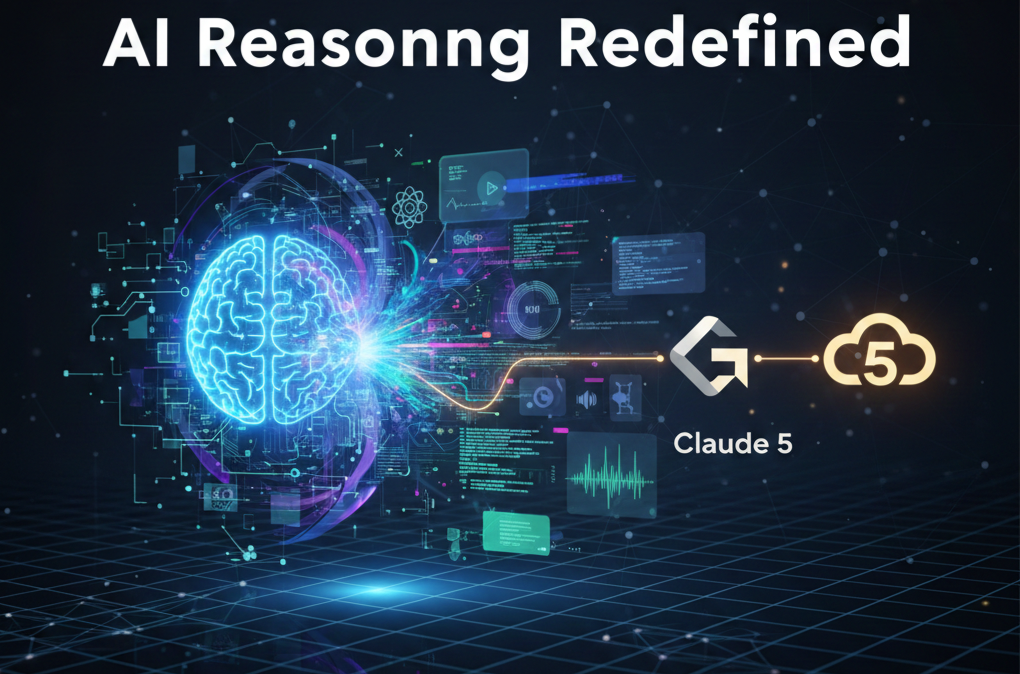
The Shift from Correlation to Cognition (or something very close)
What's making the difference? Several key areas are showing significant progress:
1. Multi-Modal Integration: The chatter around Gemini 3.0 heavily emphasizes its multi-modal capabilities. Imagine an AI that can not only understand complex text but also interpret images, videos, and even audio in a deeply integrated way. This isn't just about processing different data types; it's about forming a unified understanding across them. For example, an AI could analyze a scientific paper, understand its written arguments, and then interpret accompanying graphs and diagrams to synthesize a more complete picture, identifying discrepancies or drawing novel conclusions. This holistic approach is a giant leap towards more human-like reasoning.
2. Enhanced Contextual Understanding and Long-Term Memory: Previous LLMs, while impressive, often struggled with maintaining consistent context over very long conversations or documents. They might "forget" earlier points or contradict themselves. The latest iterations, particularly Claude 5, are showcasing vastly improved contextual windows and a more robust ability to retain and utilize information over extended interactions. This isn't just about having more tokens; it's about intelligent retrieval and integration of past information, allowing for more coherent, nuanced, and truly "reasoned" responses over time.
3. Abstract Problem Solving and Novel Idea Generation: This is perhaps the most exciting frontier. While current AIs can perform complex tasks, their ability to truly generate novel solutions to abstract problems or come up with genuinely creative ideas has been limited. Gemini 3.0 and Claude 5 are rumored to be demonstrating capabilities in this area that go beyond mere recombination of existing information. This could involve, for instance, an AI assisting in drug discovery by proposing entirely new molecular structures based on understanding biological mechanisms, rather than just optimizing existing ones.
What Does This Mean for "Reasoning"?
The implications are profound. If these models can truly integrate multi-modal information, maintain deep context, and exhibit nascent forms of abstract problem-solving, we are moving away from merely predicting the next word or identifying patterns towards something that starts to look like:
Causal Inference: Moving beyond "what happens next" to "why does it happen?"
Analogical Reasoning: Drawing parallels between seemingly disparate concepts to solve new problems.
Hypothesis Generation: Formulating plausible explanations or theories for observed phenomena.
Critical Evaluation: Not just summarizing information, but identifying biases, inconsistencies, and logical flaws.
Beyond the Hype: Practical Applications
The impact of this redefined AI reasoning will ripple across countless industries:
Scientific Research: Accelerating discovery by helping researchers synthesize vast amounts of data, identify novel hypotheses, and even design experiments.
Complex Decision Making: Assisting leaders in business and government by providing deeply reasoned insights based on comprehensive analysis of diverse data sources.
Education: Creating highly personalized learning experiences that adapt not just to what a student knows, but how they reason and learn.
Creative Industries: Acting as a co-creator, providing genuinely innovative suggestions and solving complex creative challenges.
Q1 2024 is proving to be a watershed moment. As Gemini 3.0 and the latest Claude 5 models become more widely accessible, we are not just witnessing incremental improvements in AI; we are seeing a fundamental shift in what "AI reasoning" truly means. It's a leap from sophisticated calculators to something that increasingly resembles a nascent form of artificial cognition, promising to redefine our relationship with intelligent machines.
What are your thoughts on these advancements? Are we truly witnessing a new era of AI reasoning, or is it just another step on a long road? Let us know in the comments below!