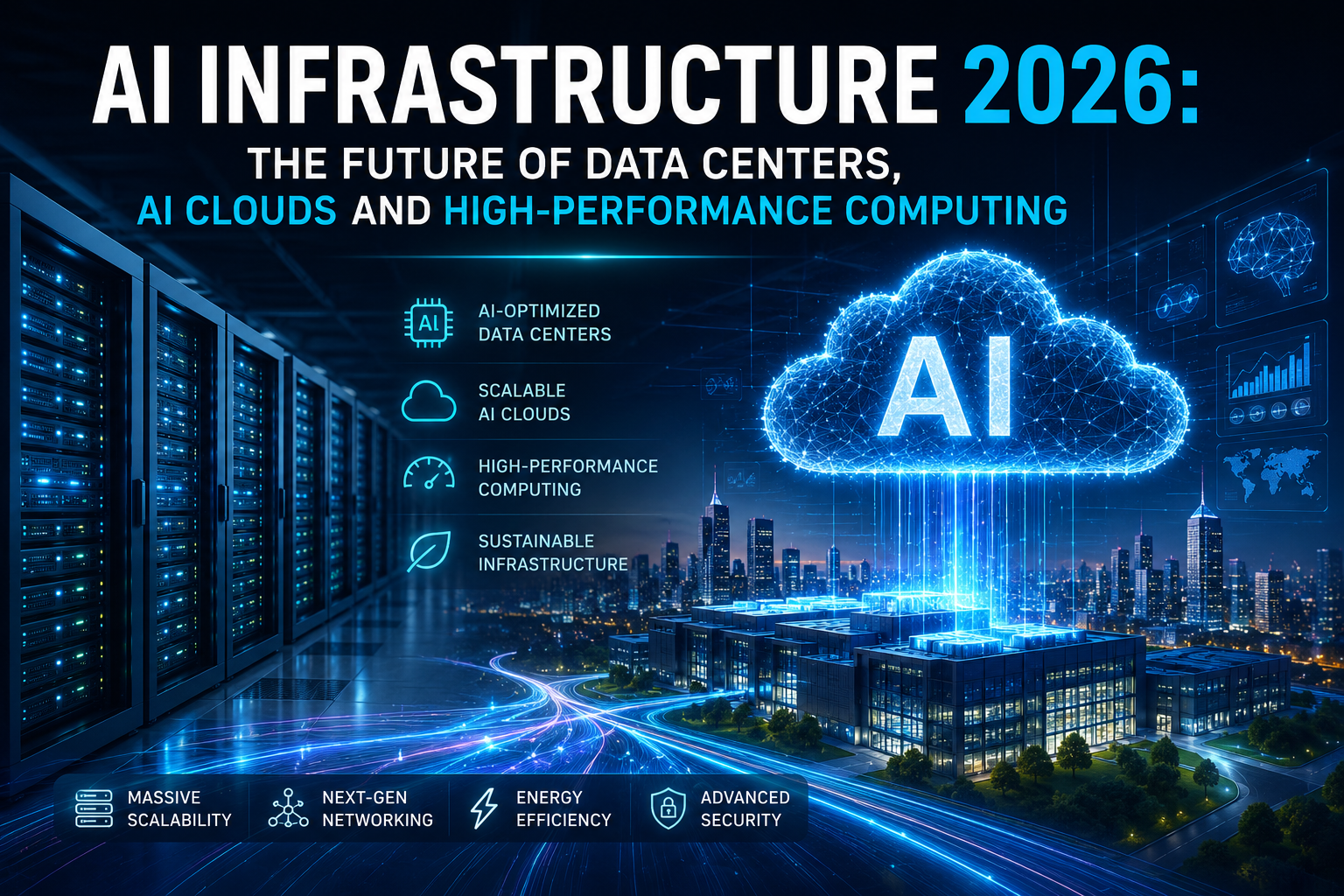
AI Infrastructure 2026: The Future of Data Centers, AI Clouds and High-Performance Computing
The world has officially transitioned from the era of experimental AI pilots to the era of industrial-scale AI production. As large language models (LLMs), multimodal frameworks, and autonomous AI agents become central to global enterprises, traditional computational frameworks have proven obsolete.
In 2026, the global tech landscape faces a monumental paradigm shift. The race to build out AI infrastructure has ballooned into a multi-hundred-billion-dollar hyperscaler rush. Building the foundation for modern intelligence requires a complete re-engineering of the physical and virtual stacks.
From the silicon up, here is how the convergence of next-generation data centers, decentralized AI clouds, and High-Performance Computing (HPC) is defining the architectural landscape of 2026.
1. The 2026 Data Center: Rebuilt as "AI Factories"
Traditional data centers were built to host central processing units (CPUs) that handle sequential tasks. Modern generative AI demands massive parallelism, forcing facilities to transform into specialized "AI Factories" optimized for Graphics Processing Units (GPUs) and specialized Neuromorphic custom silicon.
The Power Bottleneck and Grid Autonomy
The sheer volume of electricity required by dense AI clusters has created a global utility bottleneck, with wait times for grid connections stretching for years in primary tech hubs. To bypass this, 2026 data center strategies have shifted toward:
Microgrids & On-Site Generation: Top-tier facilities are relying on independent microgrids, utilizing advanced natural gas solutions, small modular reactors (SMRs), and local renewable arrays to guarantee continuous power.
Maximizing Intelligence Per Watt: The metric of success has shifted from pure compute capacity to thermodynamic and energy efficiency.
Liquid Cooling: From Option to Imperative
With rack power densities routinely exceeding 50kW to 100kW, standard air cooling is no longer physically viable. 2026 has marked the formal end of legacy air-conditioned "white space."
Modern infrastructures now depend entirely on Direct Liquid Cooling (DLC) and Immersion Cooling, where hardware is directly submerged in non-conductive dielectric fluid or attached to cold-plate loops. This allows systems to handle the extreme thermal output of superchips while lowering Power Usage Effectiveness (PUE) metrics significantly.
2. Next-Gen AI Clouds: Hyperscale vs. "Neoclouds"
Enterprise cloud strategy in 2026 is defined by a hybrid-by-design approach. Organizations have moved away from basic cloud-first mandates to deep optimization, trying to break the back of soaring infrastructure complexity.
         [ Core Enterprise Data / Hybrid Cloud Management ]
                                                  |
               +----------------+----------------+
               |                                                                      |
[ Hyperscale AI Clouds ]                       [ Specialized Neoclouds ]
 - Massively Scalable Foundation     - Low-latency bare-metal clusters
 - Global Data Lakehouses                 - On-demand custom AI silicon
 - Foundational LLM Training              - Fast-turnaround model inference
The Rise of Specialized Neoclouds
While classic hyperscalers retain dominance over foundational model training and sprawling data lakes, specialized AI neoclouds have captured massive market share. These boutique cloud providers offer bare-metal, highly tuned GPU clusters specifically engineered for low-latency inference and rapid distributed training, allowing developers to rent extreme scale without legacy virtualization overhead.
Overcoming the Complexity Drag
According to recent industry reports, over 65% of enterprise leaders note that their AI environments have grown too complex to manage manually. The response has been a massive wave of cloud infrastructure refactoring:
Abstracting the Control Plane: Tools like Kubernetes are fading into the background. Operations are now managed via self-service APIs and automated abstraction layers.
Task-Specific AI SREs: Data centers are deploying localized AI Site Reliability Engineering (SRE) agents to autonomously monitor systems, balance network traffic, and predict hardware failures before they occur.
3. High-Performance Computing (HPC) and Network Fabrics
The boundary separating enterprise cloud computing from High-Performance Computing (HPC) has entirely dissolved. AI training and multi-modal concurrency have effectively turned everyday cloud computing into an HPC discipline.
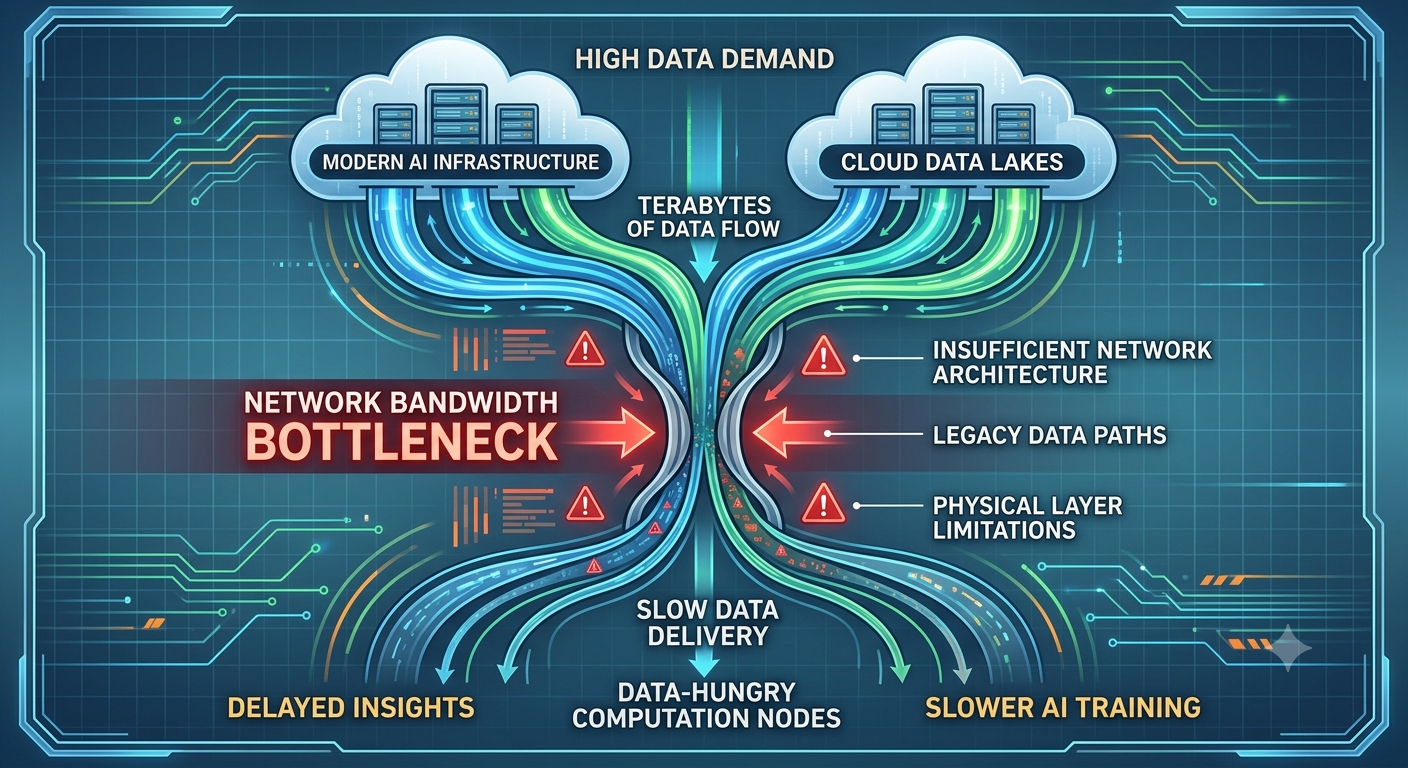
The Network Bandwidth Bottleneck
As cluster sizes expand to tens of thousands of inter-connected chips, the network fabric becomes the primary point of failure. Training frontier models relies heavily on lightning-fast data throughput.
4. Sovereign AI and the Shifting Regulatory Landscape
As AI infrastructure grows more critical to national infrastructure, governments are introducing strict regulatory controls.
In mid-2026, policy changes like the European Commission’s Tech Sovereignty Package have highlighted a global push for regional data autonomy. Enterprises can no longer simply dump data into any geographic zone. Modern AI infrastructure must be compliant with:
Localized data storage and sovereign residency mandates.
Strict environmental regulations and water-consumption caps.
Clear visibility over the entire hardware and open-source software supply chain.
Conclusion: The Path Forward
AI infrastructure in 2026 is no longer just about buying more chips—it is an intricate, multi-disciplinary engineering challenge spanning thermodynamics, localized power grids, automated network orchestration, and sovereign compliance. The organizations that successfully master this stack will define the technological baseline for the next decade, transforming raw computing power into the ultimate competitive advantage.
Tags
#AIInfrastructure #DataCenters #CloudComputing #HighPerformanceComputing #HPC #ArtificialIntelligence #GenerativeAI #LiquidCooling #TechTrends2026 #CloudArchitecture #AI #ArtificialIntelligence #AIInfrastructure #DataCenters #AICloud #CloudComputing #HighPerformanceComputing #HPC #AIHardware #GPUs #AIChips #Semiconductors #NVIDIA #AMD #Intel #ChipDesign #Networking #Storage #MachineLearning #DeepLearning #GenerativeAI #LLMs #Inference #AITraining #ScalableAI #EnterpriseAI #EdgeComputing #CloudInfrastructure #DigitalInfrastructure #DataInfrastructure #Supercomputing #AI2026 #FutureTech #Technology #TechTrends #Innovation #TechIndustry #Automation #NextGenComputing #DigitalTransformation