Agent Orchestration: The Symphony of AI – When Multiple Agents Collaborate to Solve Complex Problems
We've talked about the power of individual AI agents – autonomous entities capable of planning, executing, and self-correcting to achieve specific goals. But what happens when you combine their strengths? What if you could orchestrate an entire team of specialized AI agents, each contributing its unique capabilities to tackle a problem far too complex for any single AI (or even a single human team) to solve alone?
Welcome to the cutting edge of AI deployment: Agent Orchestration. This is the art and science of moving beyond isolated AI tools to sophisticated "multi-agent systems" where different AIs collaborate, communicate, and coordinate their efforts to achieve a common, overarching objective.
The Limitations of a Lone Wolf AI
While a single AI agent is incredibly powerful, it often faces limitations:
Specialization: Most powerful AIs are trained for specific domains (e.g., a language model for text, a vision model for images, a database agent for data retrieval). A single agent might struggle to seamlessly integrate these diverse functions.
Complexity: Real-world problems often require a sequence of highly varied tasks, each demanding a different skillset.
Scalability: Assigning a single, monolithic AI to solve everything can lead to bottlenecks and reduced efficiency.
Enter the Multi-Agent System: A Collaborative AI Team
Imagine a complex project in a human team. You wouldn't expect one person to be the lead strategist, the designer, the coder, the marketer, and the customer support specialist all at once. Instead, you'd assemble a team, each member bringing their expertise, communicating, and passing tasks to each other.
This is precisely the principle behind multi-agent systems. Here's how it works:
Define the Grand Goal: A human (or a supervisory AI) sets a high-level objective, e.g., "Develop and launch a new marketing campaign for Product X."
Decomposition: The overarching goal is broken down into smaller, manageable sub-goals.
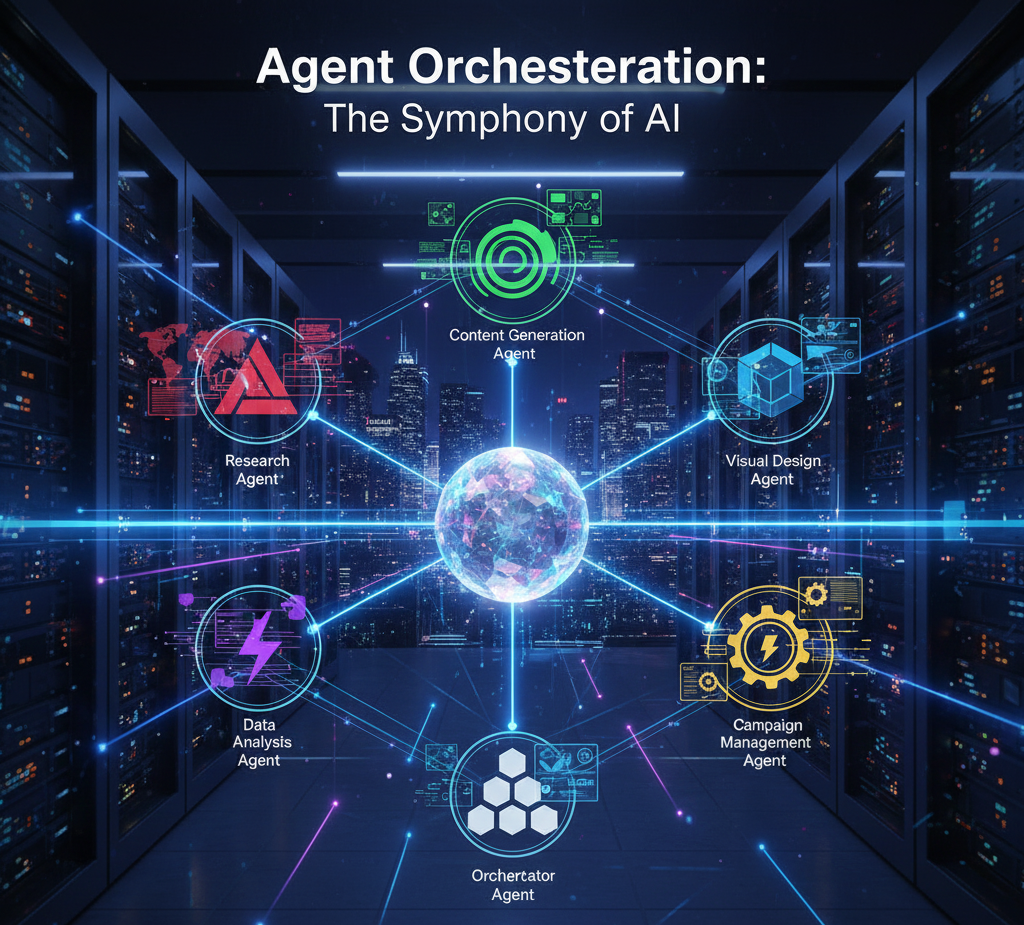
Role Assignment: Different AI agents, each with specialized capabilities, are assigned specific roles:
Research Agent: Gathers market data, competitor analysis, trend reports.
Content Generation Agent: Drafts ad copy, blog posts, social media captions based on research.
Visual Design Agent: Creates images, videos, and layouts.
Campaign Management Agent: Schedules posts, manages ad spend, monitors performance metrics.
Data Analysis Agent: Interprets real-time campaign data, identifies bottlenecks, suggests optimizations.
Communication & Coordination: Agents communicate with each other, sharing outputs, requesting inputs, and signaling when a task is complete or when human intervention is required. This often happens through a central "orchestrator" or a shared communication protocol.
Iterative Refinement: As tasks are completed, the system reflects on progress, adjusts strategies based on new information, and loops back to refine earlier steps if needed.
Real-World Scenarios for Multi-Agent Orchestration
Autonomous Software Development Teams: An "Architect Agent" designs the system, a "Coding Agent" writes the code, a "Testing Agent" identifies bugs, and a "Deployment Agent" pushes updates—all working in concert.
Dynamic Supply Chain Optimization: Agents could specialize in demand forecasting, inventory management, logistics routing, and supplier negotiation, continuously adjusting plans based on real-time global events.
Personalized Healthcare Pathways: A "Diagnostic Agent" analyzes patient data, a "Treatment Planning Agent" recommends therapies, a "Monitoring Agent" tracks progress, and a "Communication Agent" keeps the patient informed, all under medical supervision.
Complex Scientific Research: A "Hypothesis Generation Agent" proposes theories, an "Experiment Design Agent" devises tests, a "Data Collection Agent" gathers results, and an "Analysis Agent" draws conclusions—dramatically accelerating discovery.
The Orchestrator: The Conductor of the AI Symphony
The "orchestrator" or "meta-agent" is a crucial component. It acts as the project manager, ensuring that:
Tasks are correctly delegated.
Information flows smoothly between agents.
Conflicts are resolved.
The overall project stays on track toward the defined objective.
Human oversight is engaged at critical junctures.
The Future of Collaboration is Multi-Agent
Agent orchestration represents a paradigm shift from simply using AI tools to building entire autonomous workflows. It promises:
Exponential Productivity: Tackling problems that were previously too complex or resource-intensive.
Enhanced Reliability: Distributing tasks across multiple agents can make the overall system more robust.
Unrivaled Adaptability: The system can dynamically reconfigure its agents and their interactions to respond to changing circumstances.
As we move forward, the ability to design, implement, and manage these sophisticated multi-agent systems will become a defining skill in the AI-powered enterprise. The future isn't just about powerful individual AIs; it's about how effectively they can work together, harmoniously, as a truly intelligent silicon team.