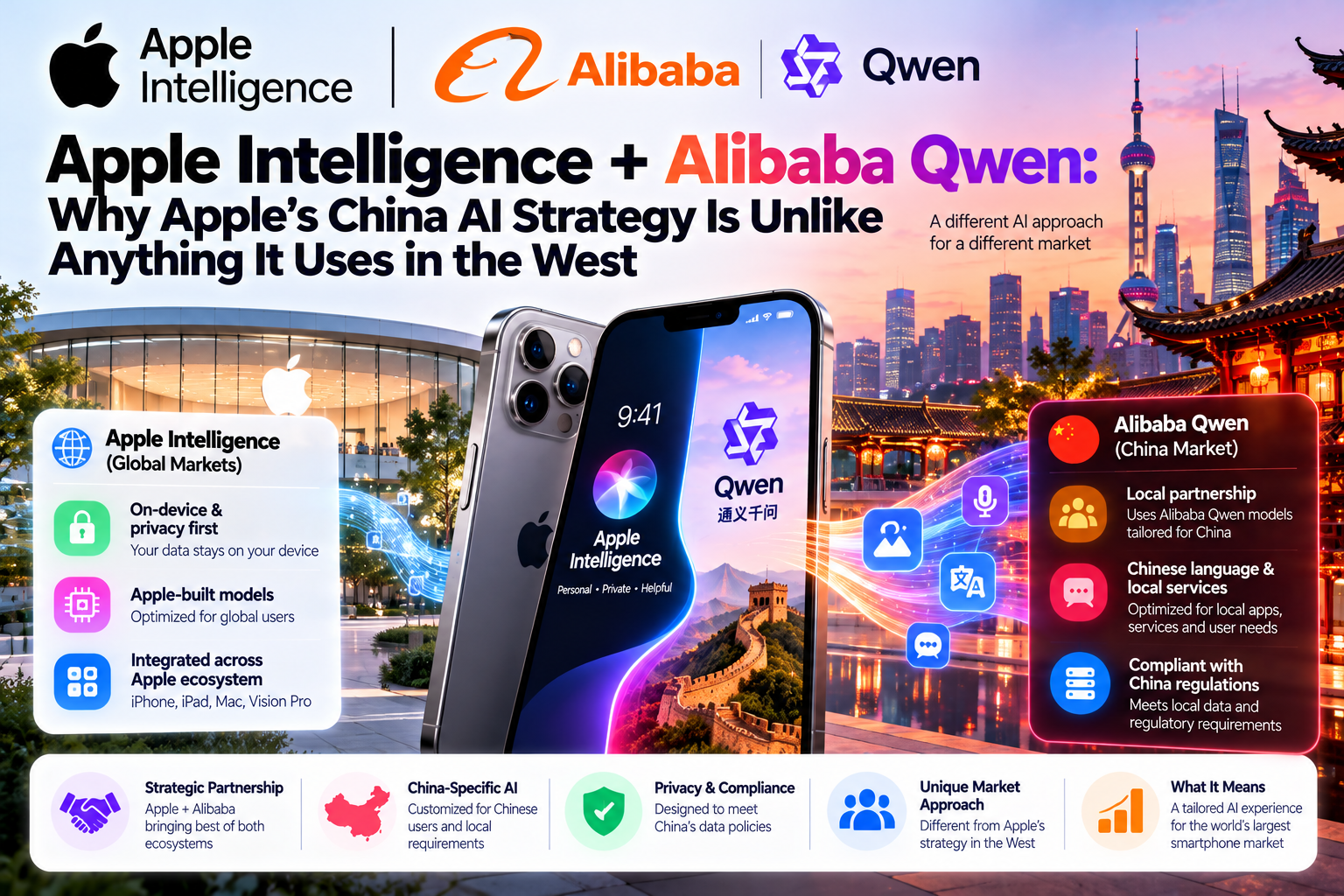
Apple’s AI story in China is becoming a test of how a global product can use different model partners in different markets. Reports say Chinese permits now name Alibaba’s Qwen alongside Apple Intelligence. But a permit is not a customer launch: Apple’s current support page still says the features do not work on eligible mainland-China devices. Here is what is known, what is planned and what to check before assuming an iPhone in China has the same AI stack as one elsewhere.
Quick Take
- Reported approval: South China Morning Post says updated Chinese network-access permits for several iPhones list Apple Intelligence, Alibaba’s Tongyi Qianwen (Qwen) and Tongyi Wanxiang.
- Current availability: Apple’s support page still says Apple Intelligence features do not currently work on supported devices purchased in mainland China. A regulatory milestone does not establish a live rollout.
- The global architecture: Apple says its latest Foundation Models were built with Google and Gemini, with processing on eligible devices and through Private Cloud Compute. The broader international story is more nuanced than “Apple uses ChatGPT in the West.”
- The unanswered question: Apple has not published a feature-by-feature technical map showing which China-bound requests, if any, would run on-device, use Qwen, reach a server or use other services after launch.
What Actually Happened With Apple and Alibaba in China?
South China Morning Post reported on 14–15 October that updated Ministry of Industry and Information Technology network-access permits for the iPhone Duo, iPhone 18 Pro and other models list three approved AI systems: Apple Intelligence, Tongyi Qianwen and Tongyi Wanxiang. SCMP is owned by Alibaba, a relevant disclosure when assessing coverage of Alibaba’s role. This article treats the permit description as reporting about regulatory records; an official Apple feature list for a released China edition has not been established by that report.
The three names are related but do not describe one product. Apple Intelligence is Apple’s user-facing set of features. Tongyi Qianwen, or Qwen, is Alibaba’s language and multimodal model family. Tongyi Wanxiang is an Alibaba family associated with generating visual content. A permit naming all three does not tell us whether each model is installed on a phone, hosted in China, invoked for a particular app or merely approved as part of a future product configuration.
That uncertainty matters because a partner name can be visible well before a feature reaches customers. Apple may need separate software releases, service configuration and feature-level approvals before it can enable anything. The practical milestone to watch is a region-specific Apple availability notice and a working feature on eligible mainland devices, with documentation of what it can and cannot do.
Is Apple Intelligence Available in Mainland China Today?
Apple’s own public support guidance says it is not currently available there. According to Apple’s supported-language and region guidance, Apple Intelligence features will not currently work on compatible devices purchased in mainland China. Devices purchased elsewhere are also affected when the user is in mainland China and the Apple Account country or region is set to mainland China. Those are different conditions; a traveller’s situation should be checked against the full Apple guidance rather than reduced to a blanket claim about every iPhone on Chinese soil.
Apple adds that previously purchased compatible devices will be able to activate a core set when Apple Intelligence becomes available in mainland China, while new Apple Intelligence features remain unavailable during regulatory work. In its October iPhone Duo announcement, Apple also says in a footnote that Siri AI and the other new Apple Intelligence features will not be available in China. These statements can coexist with reported permits: approval for a system and permission or readiness to operate each feature are different stages.
Apple lists simplified and traditional Chinese among its supported languages for features in supported regions. Language support alone does not mean the service is enabled in mainland China. This distinction is especially important for shoppers comparing device specifications with what they can actually use after activation.
What Does Apple Use Outside China?
Apple’s June 2026 architecture announcement describes the next generation of Apple Foundation Models as custom-built in collaboration with Google and its Gemini models. Apple says these models run on supported devices and on servers using Private Cloud Compute. It describes privacy properties for that architecture, including its claim that personal data handled through Private Cloud Compute is not stored or made accessible to Apple.
That is why the phrase “Apple simply switches from an OpenAI model in the West to Qwen in China” is too neat. Apple’s documented international product uses Apple-branded Foundation Models built with Google; individual features may involve different processing paths and regional limits. A model collaboration is also different from proving that every prompt goes straight to a partner’s public chatbot. Apple’s public statements describe an integrated product architecture, not one global server endpoint.
Crucially, Apple’s privacy description for its current global architecture does not by itself establish how a potential Qwen integration in mainland China would process, store or transfer a user’s requests. Readers should wait for the China-specific product and privacy disclosures before assuming identical protections or a completely different data flow.
Apple Intelligence in China vs Other Markets: What Can We Compare?
Use this as a comparison of published status and evidence, not as a benchmark or a claim that one region has the same feature set on every device.
| Question | Supported markets outside mainland China | Mainland China: reported or documented position |
|---|---|---|
| Current availability | Apple lists many AI features as available on eligible devices in supported regions; individual language and feature limits apply. | Apple’s current support page says Apple Intelligence features do not currently work on eligible mainland-purchased devices. |
| Model architecture | Apple says its latest Foundation Models were built with Google and Gemini and run on-device or through Private Cloud Compute. | Reported permits name Apple Intelligence, Tongyi Qianwen and Tongyi Wanxiang; Apple has not supplied a released feature-by-feature routing diagram. |
| Siri AI | Apple describes a beta with specific language, region and device limits. | Apple’s October iPhone Duo announcement says Siri AI and other new AI features will not be available in China. |
| Privacy documentation | Apple has published its general on-device and Private Cloud Compute claims for the documented global stack. | Do not assume the same data path or Alibaba server arrangements for a future China launch without China-specific disclosures. |
| Useful next check | Confirm device, software version, language, region and the individual feature’s availability. | Look for an updated Apple support page, release notes, feature list and privacy terms before describing a rollout as live. |
Why Would Apple Build a Different China AI Stack?
The commercial reason is straightforward: a phone maker wants its AI features to work in one of the world’s major smartphone markets. The engineering reason is harder. A model is part of a larger service covering language, speech, images, safety rules, server locations, permissions and third-party contracts. Local partners can help a company adapt to a market’s rules and user expectations. That is an interpretation of Apple’s strategic incentives, not proof of the exact terms of an undisclosed Apple–Alibaba agreement.
Chinese AI services operate in a distinct policy environment. China’s interim rules on generative AI services provide context for why service operators pay attention to local requirements. A network-access permit described by the press is a narrower kind of evidence than proof that all privacy, security, content and service requirements have been satisfied for each feature. Without the device’s final disclosures, claims that the entire architecture is “localized” or that no data could ever cross a border would go beyond the available evidence.
Regional design also raises a product question: can Apple give customers a familiar Siri, Photos and writing experience if the underlying capabilities differ? Consistency would require testing language quality, response time, error rates, image output, abuse prevention and accessibility in the actual local product. No permit record or partnership headline answers those questions for users.
Does Qwen Have to Run on the iPhone?
No such technical conclusion follows from the reported permits. Alibaba says Qwen models can be deployed through several routes, including on-premises, APIs and cloud systems. That describes what the model family can support generally; it does not document which variant or deployment Apple might use, whether a request would be sent to Alibaba, or whether a Qwen model would be placed directly on an iPhone.
Three separate design questions need answers: where computation happens, who operates the endpoint and what information reaches it. An on-device model can still rely on a cloud service for some features. A cloud model can run in infrastructure operated by someone other than the model creator. A local partner can provide a model without receiving every user’s photos, messages or voice requests. Each possibility should be documented and assessed separately.
Developers should also distinguish an Alibaba model family from the model distribution terms for a particular build. The availability of some Qwen models for download does not prove that Apple’s commercial integration would ship those same weights or offer the same rights to app developers.
Four Practical Questions for Users, Developers and Businesses
Check Apple’s current support page and the device’s region, account settings and software version before buying for a particular AI feature. A compatible chip or supported Chinese language does not guarantee that feature is enabled locally.
Design graceful fallbacks when a model or Apple Intelligence feature is unavailable. Test feature detection, consent, language behavior and offline performance on devices in the actual target market.
Ask which provider handles each request, where inference takes place, whether prompts contain company data, what the retention terms say and how auditing works. Recheck policies when a device changes region or account.
Compare outcomes across markets instead of assuming a single global model. Track availability, accuracy on local tasks, latency, incident handling, provider dependence and the cost of maintaining separate integrations.
What Are the Privacy, Copyright and EU AI Act Implications?
The most important privacy question is not the partner’s logo. It is whether a particular request remains on-device, goes to Apple-operated infrastructure, reaches a third-party service or is handled another way, together with the applicable notice and retention settings. Apple’s published Private Cloud Compute commitments are useful evidence for the architecture it describes; they should not be automatically copied onto a future China-specific Qwen service. Avoid uploading confidential documents or client information to an unverified feature on the assumption that all regional installations behave alike.
A mainland-China permit says nothing about European legal compliance. For a deployment in Europe, the GDPR principles described by the European Commission still require attention to purpose, data minimization and lawful processing of personal information. The Commission’s EU AI Act guidance explains that duties depend on the provider or deployer role and the AI system’s intended use. An ordinary writing aid should not automatically be classified in the same way as an AI system intended for certain employment or credit decisions.
Copyright questions also follow the content and use: permissions for source documents, training or inference inputs where relevant, and rights in generated text or images must be checked for the specific workflow and jurisdiction. Neither an approved permit nor a familiar model name grants permission to reuse protected photographs or articles. This post uses original analysis and links readers to the published evidence without reproducing another publisher’s graphics or long passages.
What Evidence Would Show the Strategy Is Working?
Watch for Apple to update the China section of its support documentation and publish the first supported-device and feature list. Then compare it with release notes that specify which generation of Apple Intelligence is enabled, whether new Siri AI remains excluded and what privacy notices apply. Independent testing on eligible mainland devices should examine Chinese-language task quality, image-generation guardrails, response time, accessibility and whether the experience changes with a different Apple Account region.
For Apple, the hard part is maintaining trust across regions. If users see the same interface but receive different capabilities, Apple should make those differences easy to discover before someone relies on a feature for work or purchases hardware to use it. For Alibaba, any contribution to a widely used device platform would increase the importance of integration quality and clear accountability. Those are strategic implications, not evidence that a particular request is already being processed by Qwen.
MaGeN-AI View
Approval is a start; the operating model is the story
Reported Qwen permits make Apple’s China plans more concrete, but Apple’s own availability notice remains the decisive reference for customers today. The longer-term question is whether Apple can preserve a coherent product and clearly explain the model, privacy and feature differences between markets. We will know much more once Apple documents and ships a working China edition. Until then, compare the reported regulatory step with the current product status rather than treating them as the same event.
Frequently Asked Questions
Is Apple Intelligence available in mainland China now?
Apple’s current support guidance says Apple Intelligence features do not currently work on eligible devices purchased in mainland China. Reported Chinese permits are not proof of a customer launch.
Will Alibaba Qwen run directly on the iPhone?
That has not been established publicly. The reported permits name Qwen, but they do not reveal which model variant Apple would use, where it would run or which features would call it.
What did the reported Chinese approval cover?
South China Morning Post reports that updated network-access permits for several iPhones list Apple Intelligence, Tongyi Qianwen and Tongyi Wanxiang. A permit is separate from enabling every feature for customers.
Will Siri AI be available in China?
Apple’s October 2026 iPhone Duo announcement says Siri AI and the other new Apple Intelligence features will not be available in China. Check Apple’s region-specific notices for any later change.
Does Apple use only OpenAI outside China?
No. Apple says its latest Apple Foundation Models were built in collaboration with Google and Gemini and run on supported devices or through Private Cloud Compute. Feature and region availability still varies.